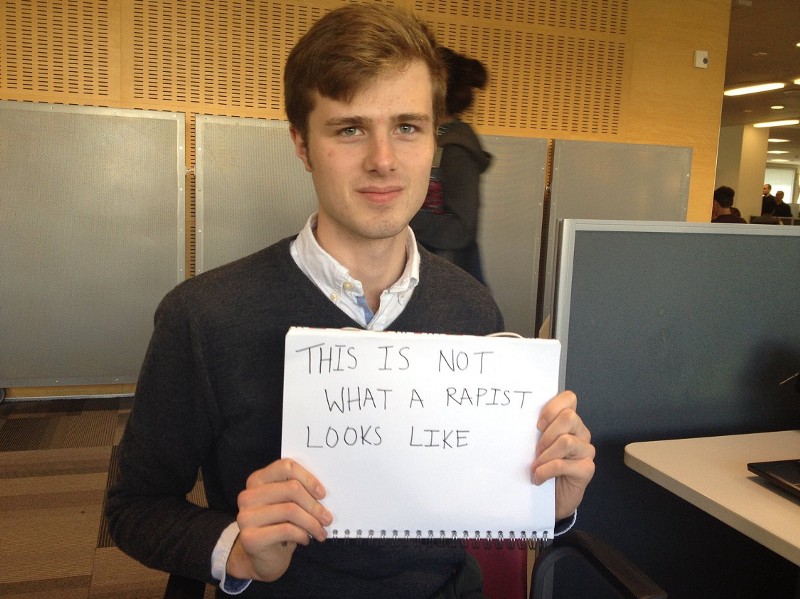
A photo of a U.K. student objecting to classes on sexual consent, saying he doesn’t need to be taught not to rape because he’s not “what a rapist looks like,” has quickly spread across social media. Many universities in the U.K., such as Cambridge and Oxford, have introduced workshops to teach students about consent, but George Lawlor thinks they’re a “waste of time.”
In a post in The Tab, a site for students, Lawlor wrote:
Like any self-respecting individual would, I found this to be a massive, painful, bitchy slap in the face. To be invited to such a waste of time was the biggest insult I’ve received in a good few years. It implies I have an insufficient understanding of what does and does not constitute consent and that’s incredibly hurtful. I can’t stress that enough.
Although this conversation has been started by a U.K. student, discussions about consent at American universities have also increased in recent years, especially as affirmative consent, or “yes means yes” campaigns, have received national attention.
College sexual assault advocates would counter that people’s safety is more important than Lawlor’s feelings. A survey conducted by The Telegraph found that one in three female U.K. students had been either sexually assaulted or received unwanted sexual advances and one in eight college men had been groped or received other unwanted sexual advances. Several U.S. studies have found that about one in five undergrads here are sexually assaulted.
Lawlor asserts that he doesn’t “look like a rapist.” But what, exactly, does that mean? Lawlor never describes what a rapist should look like. And, unlike the stereotype that sexual predators are strangers who jump out of the bushes, most rapists are actually people who the survivor trusted or at least knew. According to U.S. Department of Justice data analyzed by the Rape Abuse and Incest National Network, or RAINN, four-fifths of rape survivors were raped by someone they knew and 47 percent were raped by a friend or acquaintance.
Plus, despite the fact that Lawlor assumes most students know what consent is — even in what he calls “nuanced situations where consent isn’t immediately obvious” — the evidence suggests that college students aren’t entirely aware.
According to a University of North Dakota study released this year, one-third of college men said they would “force a woman to sexual intercourse” if no one found out and there were no consequences. That number dropped substantially to 13.6 percent when researchers actually used the word “rape” in their question. Researchers said that the men who responded in the affirmative to the question without the use of the word “rape” did so because women are viewed as “passive sexual objects” and they see aggression as “an appropriate and accepted expression of masculinity.”
A Washington Post and Kaiser Family Foundation survey that surveyed a larger group — 1,053 students aged 17 to 26 — found that students are generally confused as to what constitutes consent. Forty-seven percent of students surveyed said that if a person removes their clothes, they’re giving consent, and 49 percent said removal of clothes did not provide consent. There was also a difference in how men and women defined consent, with 30 percent of men saying foreplay constituted consent while just 15 percent of women said the same.