Florida Senator Marco Rubio (R), advocated for leniency in the U.S. Department of Education’s investigation of Corinthian Colleges and its job placement claims. The company shut down its remaining for-profit college campuses after the U.S. Department of Education fined the bankrupt company $30 million for its fraudulent claims to students about job placement rates. Several Corinthian Colleges’ campuses were located in Florida. The decision to shut down their campuses left some 16,000 students in a lurch, though the Department has given them the option to discharge their debt.
Rubio’s spokesperson released a statement to Bloomberg Politics, saying the senator “felt it was important to protect the thousands of students in Florida from being punished and having their education disrupted while the investigation was underway.”
Rubio has also received contributions from for-profit colleges.
But the Florida senator isn’t the only Republican presidential candidate to support or have connections with for-profit colleges.
Jeb Bush
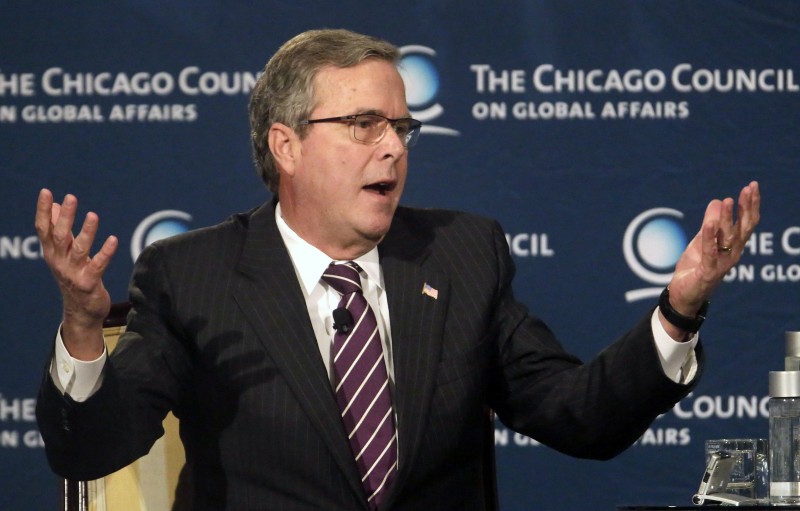
Last June, former Florida Governor Jeb Bush was the keynote speaker at a Las Vegas annual convention of the trade association for for-profit colleges, The Association of Private Sector Colleges and Universities. Their members include ITT, Kaplan University, Corinthian Colleges and Career Education Corp. He told the convention that President Barack Obama’s “gainful employment” rule was a “sledgehammer to the entire field of higher education.”
The rule required that to qualify for federal student aid, for-profit colleges would have to show that they prepare students for “gainful employment in a recognized occupation,” and the regulation sought to define this with a debt-to-income ratio.
Mike Huckabee
In 2010, former Governor of Arkansas Mike Huckabee accepted a position as chancellor of Victory University Foundation. Huckabee was also paid for his work at the Significant Federation, which bought Victory University, formerly known as Crichton College, and began running it as a for-profit college.
Ted Cruz
Ted Cruz announced his presidential bid from Liberty University, a private Christian college that has embraced the model of for-profit colleges. Liberty University graduates also have trouble furthering their careers after college, as it is considered one of the “worst value” colleges in the U.S. CollegeFactual reported that the average cost of a degree is $126,000 and that, with an average starting salary of $32,000, graduates would struggle to catch up with the earnings of a high school graduate before mid-career.
Rand Paul
Kentucky Senator Rand Paul hasn’t been very vocal on the issue of for-profit colleges’ responsibilities toward students but he has received money from them in the past. To be fair, however, so did Nancy Pelosi and some other Democrats. But one of Paul’s talking points has been to abolish the U.S. Department of Education, stands in conflict with maintaining oversight of for-profit colleges.
Bobby Jindal
Louisiana Gov. Bobby Jindal has been one of the most vocal supporters of for-profit schools, opposing the president’s “gainful employment” rule. He wrote in a column for the Washington Examiner, “The first programs to disappear under the ‘gainful employment’ regulations will be the ones that try to give Americans their first rung on the higher education and career ladders … It is tantamount to redlining educational opportunities for low-income and minority youths.”
His brother, Nikesh Jindal, is an attorney at Gibson, Dunn & Crutcher LLC, represents the schools’ association, The Association of Private Sector Colleges and Universities.
For all of his concerns about what he calls liberal elitism and its reduction of opportunities for less-advantaged students, Jindal proposed as much as $300 million in cuts for public colleges and universities. Lousiana State University began the process of filing for “financial exigency,” which essentially means filing for bankruptcy, last week.
Chris Christie
New Jersey Gov. Chris Christie formerly worked with private practice firm Dughi, Hewit & Palatucci, which represented the well known for-profit University of Phoenix. Apollo Group, which owns the University of Phoenix, was a leader in the fight against the “gainful employment” regulation effort by the Obama administration. The Apollo Group has also contributed campaign donations to members of Congress who have sponsored legislation that seeks to block the regulations, like Rubio.
Scott Walker
Wisconsin Gov. Scott Walker’s budget contained a proposal to remove oversight of for-profit colleges, which would make it the only state without those protections. It would get rid of the state’s Educational Approval Board, which monitors for-profit colleges and redirect that oversight to the Department of Agriculture, Trade and Consumer Protection. According to the Capital Times, which interviewed David Dies, the director of the EAB, in about 60 percent of complaints against schools, the school is at fault. The proposal has since been introduced separately from the budget at the governor’s request, with two Republican legislators, Roger Roth and Joan Ballweg, taking the lead.
It isn’t just the presidential candidates, and soon-to-be candidates, making their support for for-profit colleges known. Republicans on Capitol Hill, such as, Senator John McCain, Arizona Senator Jeff Flake, and Utah Senator Orrin Hatch, as well as some Democrats, including Florida Rep. Alcee Hastings, have also pushed for legislation seeking “transparency” on gainful employment regulations — legislation that actually sought to meddle in the process.