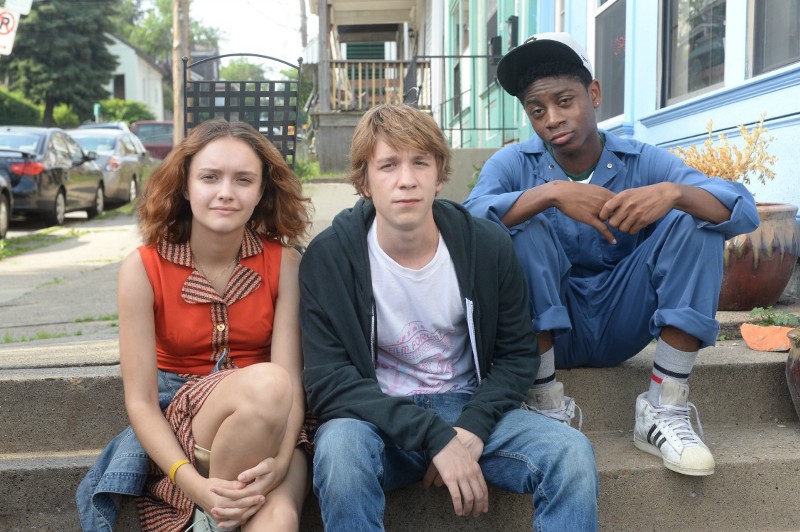
The movie is called Me and Earl and the Dying Girl, so you get the idea: it’s a quippy, almost flippant title about someone with a fatal illness.
That’s the balancing act of the film, based on the novel of the same name by Jesse Andrews (who also wrote the screenplay) and directed by Alfonso Gomez-Rejon. Can you be clever in the face of death? When is cracking jokes a form of catharsis and when it is just a way to be callous? Are pop culture references a way of connecting to another human being through a shared language of stories or are they a wall of affectations to hide behind, a stand-in for an independent worldview and personality you don’t have the confidence to cultivate?
Greg (Thomas Mann) is the “Me” of Me and Earl, a high school senior who navigates high school by being the just-right-amount of semi-involved in the lives of his classmates: on high-fiving terms with everyone, intimate with no one. He calls Earl (RJ Cyler) his “co-worker,” ostensibly because they spend the bulk of their time together making parodies of their favorite movies but really as a way of avoiding calling anyone his “best friend.” (This is the platonic equivalent of “he’s not boyfriend, we’re just, like, seeing each other.”) In a somehow never-not-funny recurring bit, Earl and Greg’s parodies involve dumbing down the titles of classic flicks: A Sockwork Orange, A Senior Citizen Kane, My Dinner with Andre the Giant, Pooping Tom.
Rachel (Olivia Cooke) is a girl in Greg’s class, so by his own design, he barely knows her. But when Greg’s mom finds out Rachel has been diagnosed with leukemia, she insists Greg head to Rachel’s house and force friendship upon her. In a casting decision that makes me think someone’s been reading my dream journal, Connie Britton and Nick Offerman play Greg’s parents, and Rachel’s mom, who guzzles white wine like, well, Tami Taylor, is played by Molly Shannon.
I talked to Gomez-Rejon about the story behind his film, which took home the Grand Jury Prize and the Audience Award at Sundance this year.
Talk a bit about where you were in your life when this script came to you.
I was between Glee or American Horror Story episodes. It was around the time when I was doing both at the same time. And I’m trying to remember why I got this, because it wasn’t like I was looking for a high school comedy. But somehow I read it quickly, and I found it so funny and fresh and the dialogue so original. I didn’t hate these teenagers. Usually teenagers in movies are so cynical. [Greg] was clumsy, and I loved that. He tells Rachel that he’s only there because his mom is making him visit her. I loved how it was a valentine to movies as well.
But it was the Mr. McCarthy scene, where he tells Greg that people’s stories continue to unfold after they die, that’s what really hooked me. I saw myself in Greg at the beginning of the movie. I think I’ve talked quite a bit now about, to the point where I’m almost uncomfortable by it, I lost my father shortly before I got the script and I was very much in denial. And when I got to that lesson, I was really moved by it, but I didn’t believe that, and now I do.
And it’s funny because now, I talk about him all the time, as opposed to avoiding talking about him. Now he’s very much alive, you know? He’s quite vivid now, because he’s everywhere. And that’s kind of Rachel also. I read myself in [interviews] and I sound like the most depressed guy, but my father was the funniest person in the world! And the fact that it’s a comedy, I know it gets trickier in the second half, but that made me feel that I was the only person who could make this.
Was there any part of you that felt like this was too personal, and you didn’t want anything to do with this movie? Or were you totally sent in the opposite direction, thinking: No one can do this but me? How long did it take you to get to the point where you felt ready to tell this story?
Immediately… [Working in TV], you get these scripts and they become incredible exercises, because you have to do it quickly, but I wasn’t telling my own story, and I really wanted to. I really wanted to tell a personal story, but I had gotten a little bit away from that. So when I saw [Me and Earl], I thought: Okay, there is me in this movie and no one will ever know. But now everyone knows. Originally it was going to be a private thing. I never led with that [about my dad]; you don’t want to be that guy.
One of the most striking things about Me and Earl is this tricky balance between comedy and sadness. Rachel is sick from the moment we meet her; even when her prognosis is good, she’s still a teenager with cancer. And yet there is a ton of humor here — a lot more humor than I think people would expect to find in this kind of story. How did you approach those comedic elements so they didn’t distract or feel out of place?
There were little moments that I loved in Jesse’s script. When [Greg and Rachel] meet in the hospital lounge, by the window, and he’s typing his personal essay like Werner Herzog, and he refuses to write the personal essay at the end, until he says, “Okay I’ll do it, but only because cancer.” You get really uncomfortable reactions from audiences to that line because you break the ice. You’re talking about it. And [the movie] does that over and over again. It doesn’t shy away from it. And I think that was quite bold. Even after a really heavy scene, right after is a Julian Assange joke, but it’s in the context of someone who is tormented, He’s really confused. Even at 40, you don’t understand how someone could be there, then you blink and they’re not there, and how does life go on?
Jesse’s script had a nice balance between both, and in realizing it, you cast the actors that can go back and forth between comedy and drama in a way that made it feel real. There’s a version of this movie that could play broad and be much broader into comedy, but I don’t like that version of it. So you have to find people that are real, even down to the extras. I didn’t want the blonde, six-foot-tall guy in the letterman jacket playing the jock. And the comedy naturally comes from that [realness].
Balancing the tone, it’s something you hope you do on set and do it right with the performances, and you start calibrating it in editorial. When to cut into a parody and cut into the shorts. A lot of the composition in the first half of the movie, the closeups, they’re playful — wide lenses, or they’re flush against the edge of the frame. You start being playful and, once you earn their trust, you can start being still. And being so still that it’s awkward, that you feel like you’re in the room with him. You become him, the movie forces you to look at certain things.
But you don’t know. You hope it works. When do you let the audience sit and think and feel? It’s something I was always worried about. You don’t want to go too far and have the audience feel manipulated. Even the volume, the sound mix, what is too loud or too soft? So you don’t hear the music but you feel it. You release it and you hope.
Were there any lines or scenes that you loved but needed to cut in order to keep that balance?
Oh, yeah. There was a very, very important scene in the novel and the script that was the big audition scene for everyone who came in to read for Greg. Thomas did this monologue three or four times and prepared for it throughout the entire shoot, and it’s the last thing we shot. It’s a heavy, beautifully written and acted scene where Greg, the guy who wants to be invisible in high school, is standing on stage with a spotlight telling the world [how he feels]. And they were going to project the movie he made for Rachel, and it’s him being completely visible. It was so beautiful. Even during the beginning of post-production, I would have said, “No, that scene would never get cut; it’s such an important scene.” But we realized, the movie didn’t want it anymore. At that point, you didn’t want to stop the movie for more dialogue.
One of the lessons Rachel says to him is that it’s okay to be quiet for a while. At some point, he should start learning that. It almost disrupted the audience’s emotional journey by stopping to hear more dialogue. And the second we lifted the scene, it just flowed. It had an energy to it that felt light, as opposed to adding another dialogue scene and make the rhythm be off in the movie. It wasn’t that it was too heavy but, visually, you have a guy who wants to be invisible, you have a lot of wide lenses in the high school — sometimes you can’t even see him in the frame, and that’s the whole point — and in [this scene], the room is a white room and he’s a black cutout in the tuxedo. And him going in, being as visible as he is, showing this film he makes for her as opposed to for himself, that was the auditorium scene, and that was enough. Emotionally, this was the way to go. it was just more respectful.
Having a lot of humor in the movie also gets at this idea that grief is not just one feeling, sustained over an indeterminate length of time: That everyone deals with it in their own, individual way, that it’s not this monolithic experience.
When Brian Eno liked the movie and okayed me using his music, he said what he liked about it was that in real life, the most memorable moments are made up of contradictory currents. And that was the goal, never going too heavy or too light. I had a laugh attack at my grandfather’s funeral. Sometimes things just happen. And that’s what I liked about this movie. I wanted to achieve something that is earned. It’s up to the audience to know if it’s working or not working, but we never go for anything easy, because I was dealing with something real.
How much this movie Greg is making for Rachel is described in the book? Does the screenplay just have parenthesis with “make an incredibly moving short film here?”
That was one of the bigger departures: In the script and in the book, it’s a montage of a compilation of all their bad movies. And I was worried that that wouldn’t be right, that it had to evolve to something different. I thought a narrative to that little short would be about Rachel becoming energy. It was just going to be abstract, something about Greg expressing himself beyond words, without words, without relying on his jokes and his parodies. It became a journey about making something for somebody else.
Even by the laws of The New York Times Styles, it takes three to make a trend. So I don’t want to suggest that Me and Earl is part of a teens-with-cancer trend that was started with The Fault In Our Stars. And they are very, very different films and stories. But do you feel like these movies are in conversation with each other at all, or is there something about this type of story that audiences are looking for right now?
I got into it for very personal reasons. Believe me, I had no intention of doing the movie because it was a trend. I knew that much. I saw in my head a way I could make this into a personal movie without being autobiographical. I thought, I could make something that documents what I’m feeling. And that’s it, there’s nothing else. You get the job and you move forward. The Fault In Our Stars opened while we were shooting, so I didn’t see it. I can’t be influenced by a film that I hadn’t seen. I saw myself in Greg.
You want people to discover the movie because it’s really funny and people seem to like it. I really don’t know [what will draw people to it], I just know why I made it. I saw myself in Greg and so did Thomas Mann, and we have a 20 year gap between us. My high school years were some of the hardest of my life. They were very vivid, and very painful. They’re the hardest years and you never forget them. And you think you’re at the center of the universe until you remember that you’re not. In high school, you feel like everything revolves around you.
I love that you really captured the essence of walking into a high school cafeteria. It’s kind of a classic teen movie trope, to show where all the cliques hang out, but usually those scenes have a heightened, candy-colored-sheen to them, and your cafeteria looks really grungy and depressing. It’s almost prison-like.
It’s the worst! Here’s how I got my first job in New York: I’m 17, it’s 1990, and it’s orientation week at NYU, and the cafeteria in my residence hall wasn’t open. So we walked to Hayden Hall, across Washington Square Park. And I was so fucking terrified to walk into this lunchroom — you don’t know anyone, and you’re an introvert, do you sit alone? — and as I walked through the park, they were shooting Sesame Street. So I never went to the cafeteria. I stayed on the set. In hindsight, it was nothing, but I was so transfixed. I stood there for so long, the line producer asked me who I was, and she put me to work blocking street traffic. So they called me back a few times, and by the time I started school, I had three PA credits. But it was that fear of not having anyone to sit with that made that happen.
This interview has been edited and condensed for clarity.