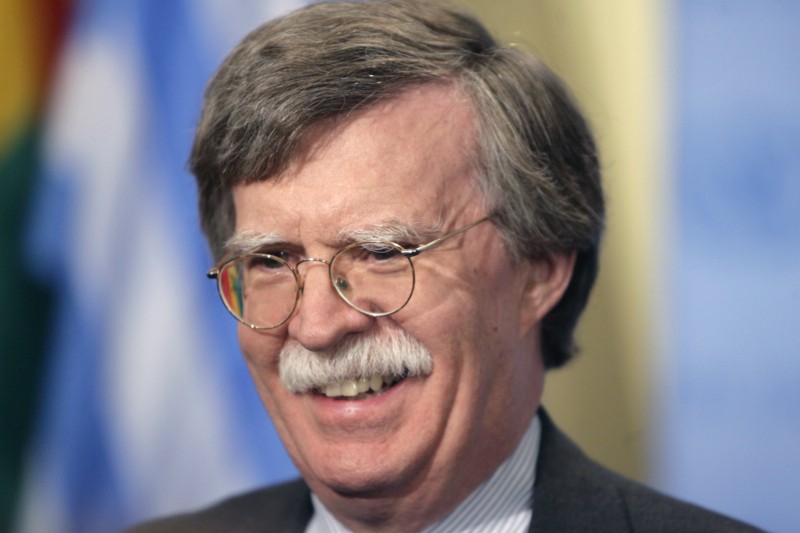
Former UN ambassador John Bolton announced today that he would not join the roster of Republicans seeking the nomination for President in 2016.
“I believe I can make the strongest contribution to our future by continuing as a clear and consistent advocate for a strong Reaganite foreign policy,” he said in a video posted to his Facebook page. “While I am not a candidate, I am certainly not going to sit this election out,” he added, saying he would push for national security to become a central issue in Republican races.
Bolton is already advising some of the more hawkish 2016 candidates and soon-to-be candidates, including Sen. Ted Cruz (R-TX) and Gov. Bobby Jindal (R-LA).
Bolton, best known for helping to sell the Iraq War to the American people, made his announcement at a time when the Iraq War is back in the political conversation. Jeb Bush is currently getting slammed by fellow candidates and the press for his unwillingness to criticize his brother’s decision to invade the country in 2003 based on cherry-picked and manipulated intelligence.
Here are some key positions Bolton has taken over his career that may be revived in the 2016 election cycle:
1. He would cut off diplomacy with Iran and bomb its energy plants.
Earlier this year, Bolton wrote a public op-ed calling for the US to sever talks with Iran over its nuclear program and instead conduct “a military attack, carried out in conjunction with Israel.” One problem? The CIA and Israel’s military leaders have said this is a terrible idea, one that would make Iran’s leaders more politically powerful due to “popular anger against foreign aggression.”
Bolton’s advocacy for war with Iran goes back many years. His PAC spent generously to elect who share his views, including freshman Senator Tom Cotton (R-AR), who spearheaded the recent effort to derail Iran diplomacy.
2. He assured the American public there were weapons of mass destruction in Iraq.
In a speech laden with claims that were later proven false, then-Under-Secretary of State for Arms Control Bolton said he was “confident that Saddam Hussein has hidden weapons of mass destruction and production facilities in Iraq.” He also claimed in the lead up to the 2003 invasion that “the American role actually will be fairly minimal.” Twelve years and $2 trillion later, the US still has a military presence in the country and the Iraqi forces they trained and funded are in shambles.
3. He supports lethal drone strikes against US citizens.
Though Bolton has been a harsh critic of President Obama’s military and foreign policies, he agrees with him on one controversial point: that the President has the legal authority to order lethal drone strikes against against US citizens overseas. Though international law and human rights groups have brought lawsuits against the Obama Administration for ordering the killings, including that of 16-year-old Abdulrahman Al-Aulaqi.
Federal courts have said the secretive drone strikes against citizens who have never been publicly charged with a crime are “disconcerting” but have not yet ordered an end to the program.
4. He backed Michelle Bachmann’s Muslim witch hunt.
When former Rep. Michelle Bachmann (R-MN) began accusing members of the Obama Administration — those of Middle Eastern descent — of ties to the Muslim Brotherhood, many members of her own party were horrified. But Bolton defended the crusade, asking on a radio show, “What is wrong with raising the question?” and saying he was “just mystified” by the backlash.
5. He doesn’t think the UN Human Rights Council, or the UN for that matter, should exist.
Former UN ambassador Bolton has repeatedly voiced his view that the institution he served in shouldn’t exist.
If he can’t topple the organization in its entirety, Bolton wants to chip away at it, eliminating in particular the U.N. Relief and Works Administration, the International Criminal Court, and the UN Human Rights Council, which he refers to as a “clown convention.”