MANHATTAN, NEW YORK — Here’s a little-known fact about New York’s fast-approaching presidential primary election: More than 3 million people — about 27 percent of the state’s voters — can’t participate in it.
That’s because they’re not registered with either the Democratic or Republican party. Some are registered independents, others are registered with smaller parties, like Green or Working Families.
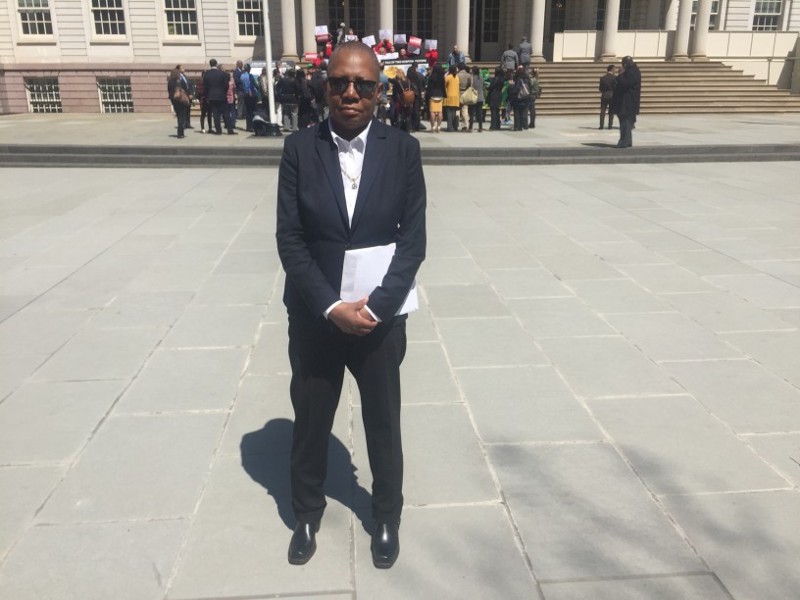
On Thursday, approximately 150 New Yorkers rallied in front of New York City Hall to demand open primaries.
Either way, these people can’t participate because of New York’s strict closed primary rules, which state that only registered Democrats can vote for Democratic presidential candidates, and only registered Republicans can vote for Republicans. In addition, New York has the earliest change-of-party deadline in the country. If registered independents wanted to change parties to vote in the primary, they had to do so before October 9, 2015 — more than six months ago.
On Thursday, approximately 150 New Yorkers rallied in front of New York City Hall to demand open primaries. Right now, at least 16 states have completely open primaries, where anyone is allowed to vote in the presidential nominating contest, regardless of party affiliation. Ten states have semi-open primaries, where party-affiliated voters are restricted to their party’s primary but independent voters can choose which nominating contest they’d like to vote in.
At the rally, ThinkProgress heard from some of the voters disenfranchised by New York’s closed primary law and strict change-of-party deadline. Here’s who they are, and what they had to say:
Alvaader Frazier, attorney: ‘I should be able to be an independent.’
Alvaader Frazier, a Harlem resident, has been a registered independent her whole life. Her reason is extremely personal.
“I grew up in the south, in Savannah, Georgia, poor. I had a very hard life,” she said. “I struggled, but I got myself into college. Once I stabilized myself, I realized that nobody came to help us out when I was younger. .. I realized that out of all these institutions, none of them helped us. We had to sink or swim. A lot of my friends didn’t make it. And I did not feel like I could have any loyalties to these institutions.”
When it comes to primaries, Frazier said she feels political parties are dominating elections, and turning independents into a “suspect class.”
“I feel that I should be able to be an independent,” she said. “Political parties are private organizations that the taxpayers pay for — why should they dominate and own the process? Why can’t Americans organize and participate in the political process without the permission of two major private parties? I find that kind of offensive.”
Fred Thiele, New York state assemblyman: ‘The laws are skewed against independents.’

Thiele, the only independent in New York’s state Legislature, can’t participate in the state’s presidential primary on April 19. At the rally, Thiele said he believed the major political parties had too much control over the state’s electoral process.
“The laws are skewed against independents, whether it’s voting, or the entire electoral process,” he said. “You have to work extra hard if you’re an independent, and that’s one of the reasons, I think, that you’re seeing such depressed turnout in elections. Independents are not coming out to vote because they think they don’t have a stake in the process.”
Thiele introduced a bill this year to change the law in New York, and require open primaries. It has not yet moved past the committee hearing stage.
Allen Cox, high school basketball referee: ‘Since I pay my taxes, I should be able to vote.’

Allen Cox, a Bronx resident, said he’d probably vote for Bernie Sanders if he could participate in Tuesday’s election. But more important to him than his current election is changing New York’s election law to allow independents to vote in primaries.
“I’m pissed off,” he said. “Since I pay my taxes — which support primary elections — I should be able to vote. I don’t feel you should be forced to join a party just to be able to vote. I became an independent because I don’t trust the parties. Their interests are getting elected, as opposed to solving problems in the communities.”
Lorraine Marcellin, Brooklynite: ‘I feel like a second class citizen.’

Unlike most of the people at Thursday’s rally, Lorraine Marcellin said that she wouldn’t vote for Bernie Sanders if she could participate in New York’s presidential primary election. Instead, she said, she’d probably vote for Ohio Gov. John Kasich, a Republican.
“I just want to be a part of the process and vote in the primary,” she said. But it’s not just the presidential primary that she’s irked about — Marcellin also said she’s annoyed that she can’t even participate in her local primary elections.
“I don’t even have an opportunity to elect my local officials,” she said. “It makes me feel like a second class citizen. I feel cheated.”
Jacqueline Salit, president of IndependentVoting.org: ‘There’s a spirit of independence in this country where people don’t want to be categorized.’

Jacqueline Salit is the president of the organization that organized Thursday’s rally. But she’s also a registered independent, and she herself can’t vote in Tuesday’s primary election. As it does every year, Salit says that fact makes her feel “angry.”
“It makes me feel like my state does not appreciate the political spirit that is washing through this country,” she said. “There’s a spirit of independence in this country today where people don’t want to be categorized. They don’t want to be categorized ideologically, the don’t want to be categorized by a party label. They want to be able to participate in the political process on the basis of what’s needed for their community, their state, and our country. And the political system here does not permit that.”
Luvenia Suber, social worker: ‘Open primaries would bring us new voices.’

If she could, Luvenia Suber said she’d probably vote for Bernie Sanders in Tuesday’s presidential primary. But she said she believed open primaries nationwide would open up more opportunities for non-establishment candidates — “fresh blood,” she said — to win elections.
“People are dissatisfied with their choices this year,” she said. “Bernie is saying some things that people can identify with, but he’s still in a sense part of the establishment — he’s been in power for so long. So I think we need fresh blood. Open primaries would bring us new voices.”
Like many others, Suber said the closed primary process makes her feel like she can’t be part of the electoral process.
“I feel very upset, very angry, very left out,” she said.