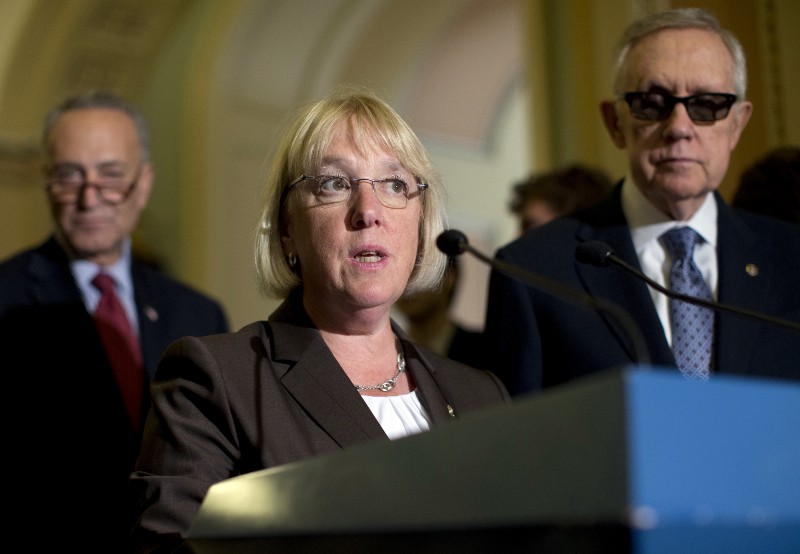
On Wednesday, Sen. Patty Murray (D-WA) and Rep. Bobby Scott (D-VA) will introduce the WAGE Act, a bill aimed at enhancing American workers’ rights to form a union and organize in other ways to improve their working conditions. One big piece of the law would include a bigger crackdown on employers who violate their workers’ rights.
The bill would reform the National Labor Relations Act (NLRA), which grants labor rights, to bring the penalties that employers face for violating rights more in line with other rights Americans enjoy, such as those under the Civil Rights Act. Currently, the National Labor Relations Board (NLRB) can’t collect damages or hit employers with fines, only reinstate fired workers and order them to be given backpay. “The penalties that are supposed to protect workers do little to deter employers from breaking the law,” a fact sheet on the bill states.
The WAGE Act would change that so that the NLRB could hit them with civil penalties of up to $50,000, which would bring it in place with other workplace laws. It would also triple the amount of backpay employers have to give workers who are fired or retaliated against for organizing.
Workers also currently can’t bring any claims that their labor rights were violated to court, but must rely on the NLRB to prosecute their cases. The WAGE Act would give Americans the right to bring suits against employers to seek monetary damages and attorney fees as under other civil rights laws.
“Unfortunately, when workers want to improve working conditions, some companies do everything they can to prevent workers from having a voice in the workplace, and our labor law lacks the remedies that would discourage these unlawful tactics,” Murray will say in her remarks in unveiling the bill. “This law would finally crack down on employers who break the law when workers exercise their basic right to collective action.”
The bill would make other tweaks to labor law: It calls for federal court injunctions to quickly reinstate workers who are fired for organizing and would hold companies jointly responsible for violations even if they happen under a franchisee or contractor. Large corporations like McDonald’s have been fighting a “joint employer” model that holds them responsible for conditions in stores that are operated by franchisees, although in a recent NLRB ruling a company was held responsible as a joint employer and the agency updated the standard it uses.
Unionization has been on a steep decline for a long time. In the mid-1950s, 35 percent of the workforce belonged to a union. As of last year, just 11 percent did, a more than 70-year low.
Yet there are clear benefits of being part of a union. Unionized workers see an 11.3 percent wage boost over those with similar characteristics who aren’t in one. The effects are even starker for women and people of color. Black workers get a 17 percent wage boost and Hispanic workers see 23 percent more. The gender wage gap is much smaller among unionized workers.
The benefits are also larger than just wage increases for individual workers. The middle class is stronger where unions are stronger, while the decline in unions has been linked to growing income inequality. And new research has found that children have a better chance of earning more than their parents in areas with higher unionization rates.