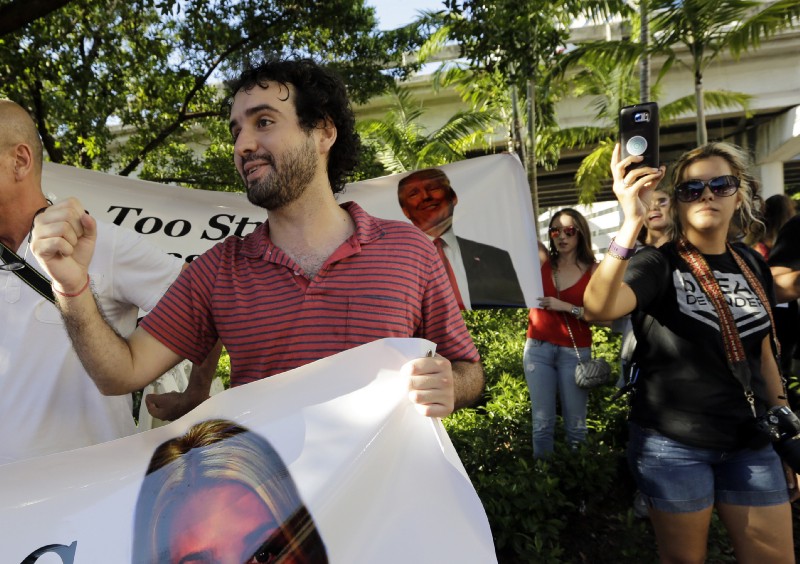
On Thursday, Miami became the first sanctuary jurisdiction to announce it will change its immigration policy in response to President Donald Trump’s nationwide crackdown on immigration. The president threatened this week to cut hundreds of millions of federal dollars from cities who refuse to force local police to enforce immigration law. There are nearly 400 sanctuary communities or cities in the U.S.
Miami-Dade County Mayor Carlos Gimenez, himself an immigrant from Cuba, signed an executive order Thursday instructing local law enforcement to hold suspected immigrants and turn them over to federal agents. Trump immediately responded to the announcement by heaping praise on Gimenez.
Miami-Dade Mayor drops sanctuary policy. Right decision. Strong! https://t.co/MtPvaDC4jM
— Donald J. Trump (@realDonaldTrump) January 26, 2017
Other sanctuary cities, including Boston, San Francisco, and Washington, D.C., have vowed to ignore the threats and defy Trump’s orders. Local leadership in various cities have announced plans to challenge any potential funding cuts in court.
Though Trump’s executive order may ultimately be unconstitutional and not survive a court challenge, the estimated 150,000 undocumented immigrants in Miami-Dade County are now living in legal limbo and uncertainty.
Tomas Kennedy is a 25-year-old community organizer for the Service Employees International Union (SEIU) in Miami, who became a citizen and voted for the first time last year. Kennedy and his family came to the U.S. undocumented during Argentina’s economic meltdown in the year 2000.
Kennedy spoke to ThinkProgress on Thursday about what the mayor’s decision means for his community and how he and other activists plan to fight back in the weeks to come.
What was your reaction to Mayor Gimenez’ announcement?
A month and a few days ago, I went with the SEIU and the social justice Quaker organization American Friends Service Committee to take about 30 kids to Mayor Gimenez’ office who are undocumented or have undocumented parents. It was just before Christmas, so the mayor came out and met with them, and he said he would protect their families and fight for comprehensive immigration reform. He gave these kids assurances.
So it’s really disappointing, honestly. If he was really interested in helping families and sticking up for the immigrant community of Miami-Dade County, he would take the position of cities like Philadelphia and New York and find the courage to stand up for his own community. It’s a shame for a cosmopolitan city like Miami, an immigrant city, to have this policy.
Trump is going to be around for four years, but immigrants are an integral part of this country and will be here forever.
I used to be undocumented. Several members of my family are still undocumented, and they’re discouraged and disappointed. But you know what? We’re here to stay. Trump is going to be around for four years, but immigrants are an integral part of this country and will be here forever.
You have said that the term “sanctuary city” is arbitrary and “could mean anything,” and it varies widely from city to city. What has the policy meant on the ground in Miami since it was formalized in 2013?
It basically means that the county does not cooperate with federal immigration agencies. They did not decide to do this necessarily out of principle, but because the feds did not reimburse the full cost of what it costs the county to keep someone in detainment indefinitely for immigration purposes.
Most police officers don’t want to serve as immigration enforcement. It doubles their work, and it actually hinders their work. A lot of officers were vocal about not wanting to serve as immigration officials.
What do you fear will happen now?
I’m afraid that local police officers will start acting like immigration agents. I’m afraid the county jails will be in direct cooperation with with the immigrant detention centers. I’m afraid a simple traffic violation will now put people in detention or get them deported.
I’m afraid a simple traffic violation will now put people in detention or get them deported.
I remember that there was definitely a connection between the detainer policy and the persecution undocumented immigrants felt during the [George W.] Bush years. Workplace raids and those sort of tactics were much more prevalent. That’s not to say the Obama administration didn’t do their share of deporting — they deported more people than any administration in history. But there was not the sense of violent persecution that happened during the Bush years. Now it seems that not only are we going back to that, we’re expanding those efforts.
How is the community planning to fight this?
Today, we will have a rally outside of the mayor’s office.
Protestors demand to get inside Miami-Dade County Hall to speak with Mayor Carlos Gimenez @nbc6 #Miami pic.twitter.com/pbbU8s7XA1
— Marissa Bagg (@MarissaNBC6) January 27, 2017
On February 7, we will pack the county commission hearing [on the sanctuary city policy]. We’re making phone calls, sending e-mails, writing e-mails, and lobbying our commissioners. We’re going to strengthen our community networks and build a circle of protection for our immigrant neighbors. We’re going to continue pushing back against this unfair and unjust policy. We’re scared, but we’re ready to fight.