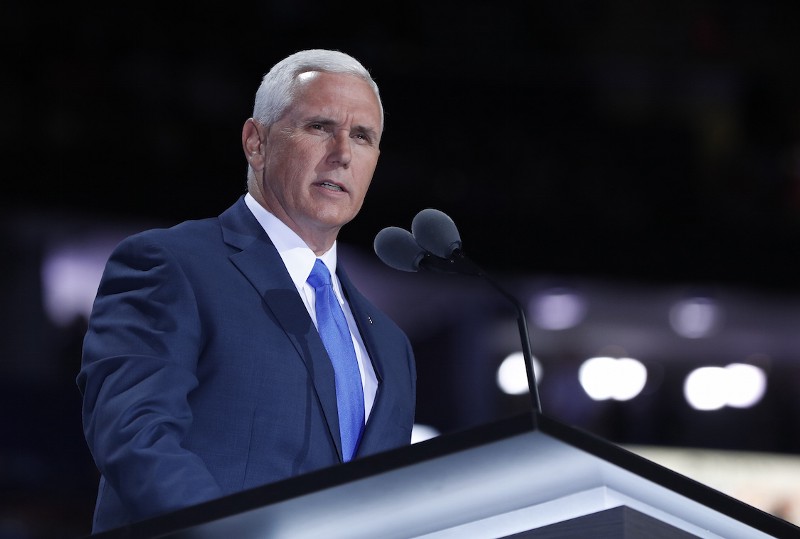
Members of the Indiana State Teachers Association will rally near the annual convention of the American Legislative Exchange Council (ALEC) in Indianapolis Friday afternoon where Republican vice presidential nominee Indiana Gov. Mike Pence is speaking on Friday. ALEC, whose members are a mix of representatives of large corporations and legislators, is a group known for drafting model legislation for conservative lawmakers.
Teachers are protesting ALEC because it promotes school vouchers, which many public school teachers say diverts money from public education to private schools, and supports collective bargaining restrictions and high-stakes teacher evaluations. Pence has a record of embracing school vouchers and supported a school funding formula for the 2016–2017 year that would allow only 12 of 25 of schools with the lowest-income families to receive an increase in funding, while all 25 schools in higher income areas would see a rise in funding.
“ALEC has driven the privatization of public education in Indiana,” ISTA President Teresa Meredith said in a statement released to ThinkProgress. “Our state is a leader in funding private school vouchers and charter schools with taxpayer money to the detriment of the more than 90 percent of Hoosier kids attending public schools.”
Hundreds gather for @ALEC_states protest https://t.co/LvnGW8afc2 pic.twitter.com/gmYN6maZg7
— NUVO (@NUVO_net) July 29, 2016
ALEC, a nonprofit, has been around since the 1970s, but it only gained national attention for its role in crafting model legislation and for its sizable influence in conservative politics after the Center for Media and Democracy and The Nation teamed up to publish a series in 2011 documenting the group’s ties to powerful political players such as the Koch brothers. The series of articles provided hundreds of examples of model bills and where they ended up being enacted. Many of the corporate representatives left ALEC after media scrutiny of the nonprofit increased.
As of 2014, ALEC had an increase of 40 percent in legislative members from Indiana, including Pence, who has keynoted conventions and hired an ALEC staff member as his policy director, according to IndyStar.
“ALEC has driven the privatization of public education in Indiana.”
When ThinkProgress asked Jennifer Smith-Margraf, a Spanish teacher at Lafayette Jefferson High School whether she was more concerned about Pence’s education record or the influence of ALEC over state education policy throughout the years, she said, “Well unfortunately, in our state you don’t have [one] without the other… That’s obviously why he was been invited to speak and will be a speaker there. The effect that this model legislation has had on our state, especially on the area of education, is the reason why I’m going to the rally.”
Under its education section, the ALEC website makes it clear that the nonprofit supports the expansion of private schools and voucher programs. It reads, “…it’s time to let parents take back control over their children’s educations by allowing them to apply competitive pressure to schools and educational providers. Innovative, parent-empowering choices such as charter schools, voucher programs, tax credit scholarships, homeschool, and education savings accounts allow each child the opportunity to reach his or her potential.”
The words “public schools” are nowhere to be found, only a reference to an “expensive K-12 education system” that “is failing our students.”
Pence has an interesting education record because some of his education proposals were typically conservative, while others strayed outside of ideological lines. The governor advocated for lifting a cap on the pot of money elementary school students could receive for private school vouchers, effectively increasing the number of students who could afford to attend private schools. Indiana’s voucher program is one of the largest in the nation. Pence supported providing $1,500 more per pupil to charter schools compared to traditional public schools but the legislature eventually decided to provide only $500 per pupil and supported more regulation of charter schools, especially those with poor academic results over the course of a few years.
Indiana’s Economy Isn’t The Conservative Success Story Mike Pence Is TellingEconomy by CREDIT: AP Photo/Mary Altaffer As Republican vice presidential nominee Mike Pence took the stage on…thinkprogress.orgThis spending on vouchers that benefit private schools, many of them parochial schools, bothers Smith-Margraf, who said she is concerned that without more funding of public education, it will become harder to attract quality teachers to the profession and turnover will rise. She said she is particularly concerned about small rural schools, which can’t simply rely on attrition and other means to balance the budget and instead have to cut staff and vital programs.
“They generally have to actually cut people and it’s much more challenging to them because there are all of these graduation requirements they have to meet, but where do we cut because we have to offer all of these things? They’re teaching five or six classes and every single one of those is a different class and they don’t have the time to adequately prepare for all of those and spend time on an in-depth curricula for students and really make sure they’re giving them an adequate education,” Smith-Margraf said.
Like many conservatives, Pence also opposed Common Core state standards and pushed for the state to come up with its own standards, which actually looked a lot like the previous standards. Superintendent of Public Instruction for Indiana Glenda Ritz also warned that the new statewide test that replaced the test aligned with the Common Core standards would cause scores to drop and asked the governor not to hold teachers accountable. Pence didn’t budge on pausing sanctions for teachers and schools until the test’s pass rate fell by 22 percent, according to NPR.
His support for preschool programs is mixed, since Pence supported the creation of a publicly funded preschool program but left behind an application for an $80 million federal grant for its program, which had been slated to receive only $15 million.
As for Indiana’s public institutions of higher education, Pence has taken a more conservative approach by embracing performance-based funding. Performance-based funding means that information like graduation rates and completion time are a factor in determining how much funding colleges and universities receive. Opponents of this funding model say that by doing this, states are only ensuring that the universities that need the funding the most continue to decline in quality while universities that are already thriving simply receive more funds.