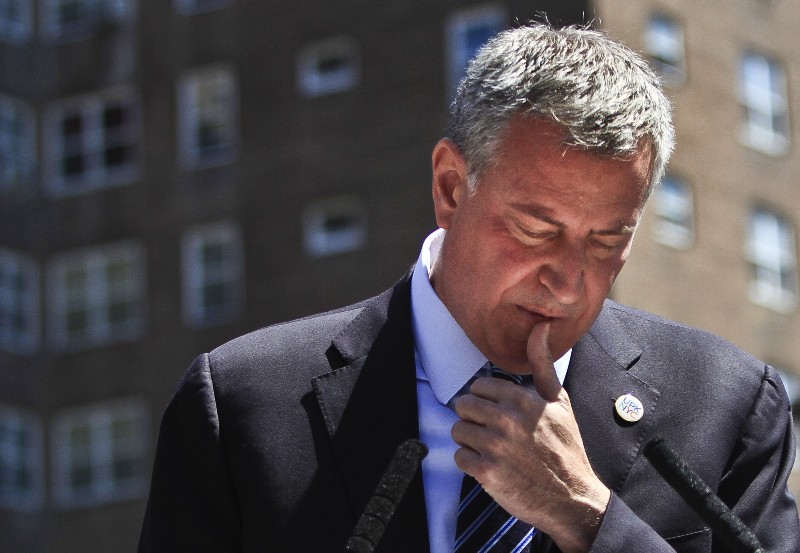
Ever since Mayor Bill de Blasio took office, New York City has taken great strides to meet the needs of residents with mental illness, expanding mental health services for people living on the streets and people behind bars. But now, after a homeless man was involuntarily and unlawfully held at a psychiatric hospital, a city scheme to prevent people with violent histories and a history of mental illness from reaching their breaking point is raising questions about whether the city can balance preventative care with civil liberties.
Last September, a 26-year-old man doing time at a homeless shelter was forced to take a psychiatric evaluation after arguing with police stationed there. Then he was taken to a hospital against his will and held there for a week for violent behavior and a mental illness that he didn’t have — all because of a city program to reduce the likelihood of violent outbursts from people with psychiatric disorders.
Under the $22 million Safe NYC initiative, officials from government agencies identify people who have both mental illness and violent tendencies and pair them with helpful services. The program — a collaborative effort by the Department of Health and Mental Hygiene and the Department of Homeless Services — was designed to expand mental health care and prevent future crime. Safe NYC tracks people’s criminal cases over time and keeps tabs on participants to make sure they attend treatment programs. It also encourages more policing near shelters, stationing more peace officers inside shelters, and establishing treatment teams throughout the city.
But the unidentified 26-year-old’s story is alarming to mental health experts and advocates of civil liberties. They worry the program could also lead to unfair targeting of people with mental illness, who are often inaccurately characterized as more prone to violence and blamed for violent crimes.
Though the man in question had no record of mental illness, he was ultimately held at the Bellevue Hospital because a doctor said he was dangerous. Records indicate that the man only lashed out when he discovered he would be kept at the hospital indefinitely. When a judge ordered the man’s release and ruled that his rights were violated, a representative from the mayor’s office stepped in and recommended that the man’s name be kept on the program’s list of people to monitor.
When Safe NYC was first unveiled last summer, de Blasio’s director of criminal justice explained, “Now when city workers are concerned about somebody, they will immediately flag those folks for a kind of air traffic controller, what we’re calling the Hub. Something that’s never existed before.”
Usually, homeless shelters flag people who should be on Safe NYC’s radar based on “aggressive and alarming” behavior. People linked to criminal cases are also identified by aides from de Blasio’s office and added to the list for monitoring. Creating the list is a collective effort, but ultimately means that files are shared across agencies.
That’s why the 26-year-old was targeted by the mayor’s office upon his release from the hospital. Once a person is added to the list, they aren’t taken off — and agencies across the city have that information.
“Politics is interjected into this difficult decision of who’s a danger to themselves and others,” a former director of the New York Civil Liberties Union told the Associated Press. A policy advocate from Disability Rights New York shared those concerns as well. “The city is trying to do the right thing, but it’s not clear the people involved get a say in this.”
Although the program is still working out its kinks, de Blasio’s administration has demonstrated its commitment to mental health care reform. In 2014, the mayor announced a $130 million plan to pair mentally ill who’ve spent time behind bars with community treatment programs, instead of re-incarcerating them. De Blasio also expanded screening before arraignment and restored Medicaid benefits to people after they do time. And last May, first lady of New York City Chirlane McCray pushed for mental health clinics in 80 schools.