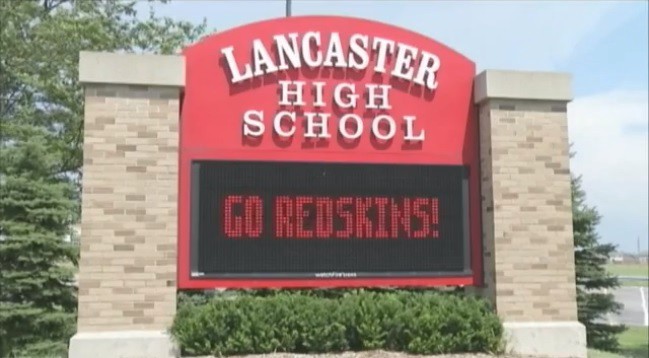
Two years after a debate over a New York high school’s “Redskins” nickname helped give rise to a larger national controversy around Washington’s NFL team, another New York school district is wrapped up in a controversy over the same name. Hundreds have packed school board meetings in recent weeks in Lancaster, New York to debate the use of the term, and as Lancaster officials continue their “educational journey” around the issue, the effects are now spilling over into other local school districts.
In the last week, two western New York schools with large Native American student populations announced that they were canceling scheduled lacrosse matches against Lancaster High School because of the school’s nickname.
The Akron Central School District made the decision first, canceling a boys’ lacrosse match with Lancaster scheduled for March 31. The conversation about the controversy spread to Akron, which serves the Tonawanda Reservation and where 12 percent of the student body is Native American, when parents noticed the game against Lancaster and asked where officials stood on the name issue. That spurred discussions with parents, local tribal leaders, Native American students, and the lacrosse team, Akron district superintendent Kevin Shanley told ThinkProgress.
“We thought the best thing to do to protect our students was to cancel the match,” Shanley said.
The decision will only affect the lacrosse team, as Akron doesn’t play Lancaster in other sports. The Lake Shore Central School District, which serves another reservation and also has a sizable Native American student population, followed suit, canceling its lacrosse match with Lancaster too.
Despite the controversial nature of the debate in Lancaster and in school districts across the country, the reaction in Akron has been “fairly quiet,” Shanley said, estimating that 95 percent of the feedback he has received has been positive. Akron’s decision was not made with the idea of influencing the Lancaster debate.
“They’re having the conversation in the Lancaster district, and they’ll make a decision,” Shanley said. “But the conversation came into our district. The intention wasn’t to influence anybody, we just wanted to make the decision that was right for us.”
Still, that has had an effect on the debate in Lancaster. The Buffalo News reported this week that some parents at the hearings did not want their children playing against teams that felt offended by the name. Still, the fight in Lancaster has taken a familiar shape, with Native American students calling the name an offensive stereotype and others arguing that Lancaster’s tradition won’t change just because the mascot does. Others, however, have argued that it is a matter of honor and tradition.
The Lancaster debate “provides yet another example of how this term is divisive and doing more to drive people apart than being people together,” Ray Halbritter, the representative of the Oneida Indian Nation of New York, said in an email. “Whether it’s at the local level or national level, more and more people are making it clear that they don’t believe taxpayers should be subsidizing a racial slur.”
Oneida is based in central New York, hours away from Lancaster, but it has become a prominent voice against the use of “Redskins” since Cooperstown Central High School, a New York school near the tribe, decided to quit using the same name. Oneida joined the fight against the Washington name after that and is now, along with the National Congress of American Indians, part of the Change The Mascot campaign.
The ongoing arguments — Lancaster officials haven’t said when they would reach a final decision — have drawn the attention of professors at nearby University of Buffalo too. The university issued a release this week in which clinical psychologist Wendy Quinton, an assistant professor at Buffalo, pointed to research showing that such mascots perpetuate negative stereotypes that are harmful to Native Americans and their communities. The American Psychological Association and American Sociological Associations have for years held the position that such names should be changed.
“Studies show that regardless of their intention, these mascots do not honor American Indians, but instead bring to mind negative thoughts associated with them as a group of people,” Quinton said in the release. “Furthermore, other studies with mostly white samples have found that people exposed to American Indian mascots are more likely to negatively stereotype other ethnic groups as well.”
“We now know better,” she added. “The research documenting their negative effects is clear.”