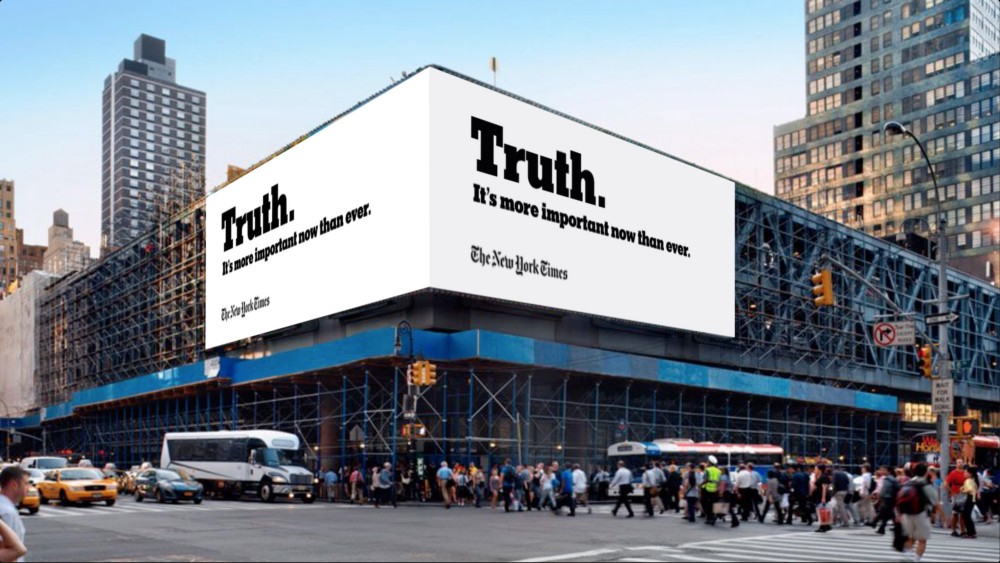
The New York Times’ controversial “The Truth Is Hard” TV ad, which is being launching at the Academy Awards Sunday night, may be great marketing, but it doesn’t advance the cause of truth. Quite the reverse.
The ad repeats Trump’s long-debunked lie about climate change — “The truth is climate change is a hoax” — without any rebuttal.
As one branding expert put it, “In a bid to be creative, they confuse the message.”
Here’s the ad:
The backstory is the story here. Trump has been baiting the New York Times for a while now, calling it “fake news” and “the enemy of the American people.” On Friday, the White House even banned the paper from a press briefing, while making room for outlets like Breitbart, who parrot Trump’s alternative facts.
The FAKE NEWS media (failing @nytimes, @NBCNews, @ABC, @CBS, @CNN) is not my enemy, it is the enemy of the American People!
— Donald J. Trump (@realDonaldTrump) February 17, 2017
Trump’s election and his attacks on the media have brought a surge in digital news subscriptions. The New York Times added 276,000 new subscribers in the last quarter of 2016.
Capitalizing on this attention, the paper created this ad. The problem is that effective advertising uses “propaganda” and “manipulation,” which may be the go-to tricks of team Trump, but, as media expert Dr. Robert J. Brulle of Drexel University told ThinkProgress, they are counter to the media’s primary “public information role” in society. “Apparently,” Brulle said, “the NY Times management has made that role a second level concern.”
The ad is a hopeless muddle of outright falsehoods (“The truth is climate change is a hoax”), statements that are widely agreed-upon by Americans (“The truth is everyone has the right to speak their mind”), and just provocative statements that are far too open to interpretation to be called either fact or alternative fact (“The truth is a woman should dress like a woman”).
In an effort to brand itself as the antidote to a world where conflicting statements and “alternative facts” are flooding the airwaves and confusing people, the Times has opened up a water cannon of conflicting statements and alternative facts on the public. The result confused even senior media analysts, and would seem to undermine the Times’ main point that they are the go-to resource in a world where “The truth is more important than ever.”
Brulle — whom the Times itself has called “an expert on environmental communications” —had particularly harsh words for the “unrebutted point in the ad that climate change is a hoax.”
“That claim has been shown to be a wholesale construction of the climate misinformation effort,” said Brulle. “To imply that there is a controversy about climate change gives this long standing false claim a veneer of legitimacy that we need to turn to the NY Times to resolve. Thus it serves to keep a nonsensical debate going.”
UPDATE: For the Oscars, the Times replaced the ad they had released with one that did not contain the line “The truth is climate change is a hoax” (video here).
Predictably, Trump has already replied to the ad with a tweet:
For first time the failing @nytimes will take an ad (a bad one) to help save its failing reputation. Try reporting accurately & fairly!
— Donald J. Trump (@realDonaldTrump) February 26, 2017
Just as predictably, this tweet is false: Sunday’s ad won’t be the first time the Times has created a television ad.
But given the serious repercussions of fake news, the New York Times could have done a lot better — both in avoiding repeating dangerous lies and in reflecting the paper’s own work.
“The NY Times has many excellent reporters,” said Brulle. “Surely their work alone will speak to why we need a free press.”