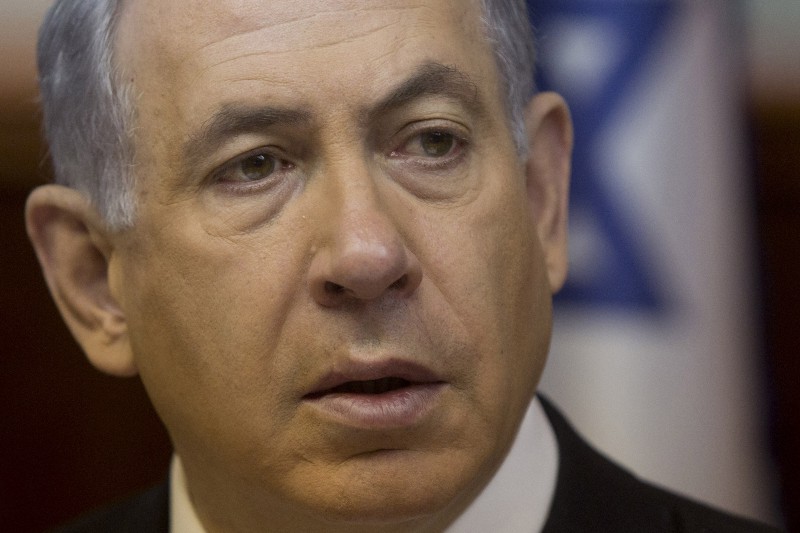
Officials in the United States and Israel are mired in a game of political chess ahead of two big events slated for March: a deadline on multinational negotiations over Iran’s nuclear program and a controversial Congressional address by Israel’s Prime Minister Benjamin Netanyahu.
President Barack Obama’s efforts to secure a diplomatic deal and to contend with a “breach of protocol” around Netanyahu’s visit have led to friction among lawmakers in either country.
A Very Real Difference
“I don’t want to be coy. The Prime Minister [of Israel] and I have a very real difference around Iran sanctions,” Obama said in a press conference alongside German Chancellor Angela Merkel on Monday.
That “real difference” stems from Netanyahu’s hawkishness on Iran. He has for years talked about the need to clamp down on Iran’s nuclear capabilities, and just this Sunday said he believes the P5+1 with Iran “will endanger the existence of the state of Israel.” He is deeply distrustful of Iranian leaders and has favored the sort of hardline sanctions that are now off the table.
Obama further alluded to the fact that Netanyahu’s address — likely to be the same sort of impassioned call to check Iran’s nuclear abilities that he’s made for years — would run counter to U.S. policy against meeting with world leaders just before they stand for elections in their home countries.
Counting Votes
There’s another issue as well. Netanyahu’s March 3 speech would fall just two weeks before upcoming Israeli elections.
“As much as I love Angela,” Obama said, “If she was two weeks away from an election, she probably would not have received an invitation to the White House. And I expect she wouldn’t have asked for one.”
Obama further drew support for his stance against Netanyahu’s Congressional address from the leaders of countries actually playing a part in the negotiations.
“I have been very clear, and Angela agrees with me, and David Cameron agrees with me, and the others who are a member of the negotiations agree that it does not make sense to sour the negotiations a month or two before they are to be completed,” Obama said.
In an effort to avoid snubbing Obama or hindering the US-Israeli relationship, officials in Israel are weighing whether it might be better for Netanyahu to address a closed-door session of Congress, or else speak at the American Israeli Public Affairs Committee meeting instead.
“The issue has been under discussion for a week,” a source close to Netanyahu’s office told Reuters. “[Netanyahu] is discussing it with Likud people. Some say he should give up on the speech, others that he should go through with it.”
“While some are busy with protocols or politics, a bad deal with Iran is taking shape,” Netanyahu wrote in a series of tweets through which he explained why he would, after all, go make a Congressional address.
The calculus hasn’t been easy.
While polls previously showed Netanyahu’s Likud party as neck-and-neck with its main, center-left opposition, with just two weeks before elections, a Times of Israel poll on Monday put the opposition ahead by four seats in the 120-seat legislature — perhaps because of the diplomatic tension with the U.S. On the other hand, Netanyahu is keeping count of another set of votes: those for or against a potential Iran deal.
“The Republicans know, as the president has already made clear, that he will veto this legislation. So in order to pass legislation that overcomes the veto, two-thirds are required in the Senate,” A senior Likud party member said on Friday. “So if the prime minister can persuade another one or two or another three or four, [his visit] could have weight.”
That’s exactly what some key Republican lawmakers are hoping will happen.
Bipartisan Leadership?
John Boehner (R-OH) invited Netanyahu to speak before Congress without approval from the President as is customary for world leaders.
He told fellow GOP lawmakers that he was determined to keep a deal with Iran from materializing. As Reuters reported, he and other Republicans are using the invitation to Netanyahu as a way to “thumb their noses” at the President’s attempt to strike a deal with Tehran.
‘‘[Obama] expects us to stand idly by and do nothing while he cuts a bad deal with Iran,’’ Boehner said last month. ‘‘Two words: ‘Hell no!’…We’re going to do no such thing.’’
“America and Israel have always stood together in shared cause and common ideals, and now we must rise to the moment again. Let’s send a clear message to the White House — and the world — about our commitment to Israel and our allies,” he continued.
Boehner extended an invitation to the Israeli Prime Minister “on behalf of the bipartisan leadership of the House of Representatives and the U.S. Senate.”
But the invitation has been met with a response that’s anything but bipartisan. On Thursday, Nancy Pelosi (D-CA), the top Democratic lawmaker called the scheduled address, “politicized,” and said that she hoped it would not take place.
On Monday, Sen. Bernie Sanders (I-VT) joined a group of a few in Congress who have decided to boycott Netanyahu’s address.
“The president of the United States heads up our foreign policy and the idea that the president wasn’t even consulted — that is wrong,” Sanders said. “I am not going. I may watch it on TV, but I’m not going.”