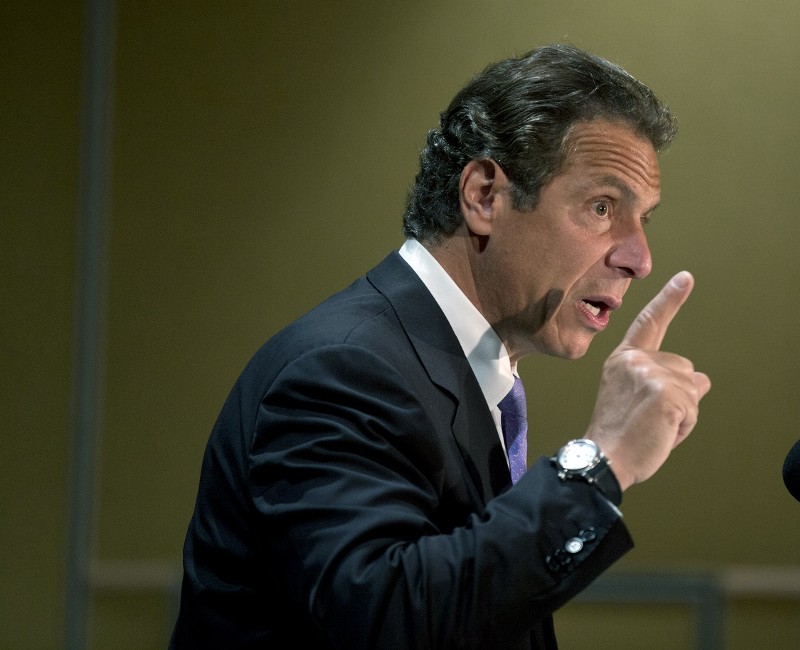
New York was one of the first major states to implement Common Core state standards. Now its governor, Andrew Cuomo, will join many governors who have shifted from acceptance or even support of Common Core to scrutiny of the standards.
Cuomo launched the Common Core Task Force on Tuesday, which will review and make recommendations to overhaul the standards. The governor said the standards must continue to be high, but that teachers need additional support to make sure teachers know the material well before they teach according to the standards.
“It is also critical that teachers who need assistance should be given the support they need. While the teacher evaluation systems are nationally recognized as a step in the right direction, I believe it must be done correctly and fairly,” Cuomo said in his remarks. “It is critical that teacher evaluations support teachers in improving their practices, not punish them. At the same time we should ensure all students have access to high-quality teachers.”

This is a significant change in tone from Cuomo’s past rhetoric on teacher performance and evaluation systems. Cuomo laid out a controversial agenda for school reform during his last State of the State Address, which included making students’ standardized test scores 50 percent of teacher evaluations, with the other half determined by outside evaluators’ and school officials’ observations. Cuomo refused to boost overall school funding by 4.8 percent, or nearly $1 billion in extra funding, unless legislators agreed to all of his reforms; if those reforms were not adopted, funding would only rise 1.7 percent.
“In New York last year, about 99 percent of the teachers were rated effective while only 38 percent of high school graduates are ready for college or careers. How can that be?” Cuomo wrote in Newsday after his address.
What the the new task force will do
In addition, the task force will look at whether student tests fit the curricula and standards, consider whether the moratorium on Common Core grading should be extended and develop a plan to analyze state tests and local tests’ “purpose and usefulness.” The goal of taking a closer look at testing methods is to reduce the number of tests and time spent on tests.
The focus on reducing the number of tests comes after parents’ decision to opt their children out of standardized tests. The hotbeds of the opt out movement were mainly in suburban and higher income areas such as the South Shore Long Island and Suffolk County. According to The Wall Street Journal’s analysis of New York Department of Education data, 20 percent of eligible students opted out of standardized tests without a valid excuse. Federal rules require that in order to receive some federal funding, at least 95 percent of those students in tested grade levels have to take the exams.
The task force will include New NY Education Reform Commission, including Richard Parsons, who chaired the commission. Parsons is the senior adviser of Providence Equity Partners Inc. and the former chairman of Citigroup’s board.
The task force also includes Nancy Zimpher, chancellor of the State University of New York system, Catalina R. Fortino, vice president of the New York State United Teachers, and Randi Weingarten, president of the American Federation of Teachers, who served as president for the United Federation of Teachers for more than a decade.
Why the standards were so controversial in New York
Weingarten has been an outspoken critic of Cuomo and New York’s implementation of Common Core. At an event at the Center for American Progress in April, “Teacher Leadership: The Path to Common Core Success,” Weingarten said of Cuomo’s choice to tie testing to teacher evaluations, “When the pleadings of parents and students and teachers were ignored, and then [New York Governor Andrew Cuomo] actually doubled down on testing, and then people use these new scores as a hammer against public schools, I raise all this because it’s now no wonder why Common Core is a toxic word.”

Although she supported the standards themselves, Weingarten was also concerned about the implementation of Common Core in 2010, when many schools were struggling financially following the recession.
The American Statistical Association has advised against relying on any one piece of qualitative information in high-stakes decisions such as the hiring of teachers. The improvement of student performance in math and English language arts was mixed, with some improvement in math but stagnant scores in English language arts and stubborn persistence of achievement gaps.
Cuomo’s remarks on Common Core standards represent a significant change from his previous support, which stayed consistent even as it became less politically popular for governors to embrace the standards. But on Tuesday, Cuomo struck a different tone.
“These were massive changes in public education that would have been difficult to enact even if perfectly administered — which they were not. Now, I believe the goal is the right one — high standards in education — we all want that. But the way it was instituted failed. My father used to say, ‘There are a lot of good ideas — the key is making them work.’ The implementation of common core just did not work,” he said.
Cuomo became governor after the standards were adopted but continued to support them. He laid blame on the New York Department of Education, which is not under the governor’s control for the political blowback. Statewide, 49 percent of New Yorkers do not support the standards, with more downstate suburban voters and Upstate New Yorkers opposing them, according to a Siena Rsearch Institute Survey. Critics say Cuomo has conveniently dodged any acknowledgement of the role Cuomo’s decision to tie testing to teacher evaluations had with poor implementation of the standards.
“He refuses to admit he was wrong to demand test-based teacher evaluations during this sensitive time. He is unwilling to level with parents about the need for higher standards and more honest assessments,” Michael J. Petrilli and Robert Pondiscio wrote in Newsday.