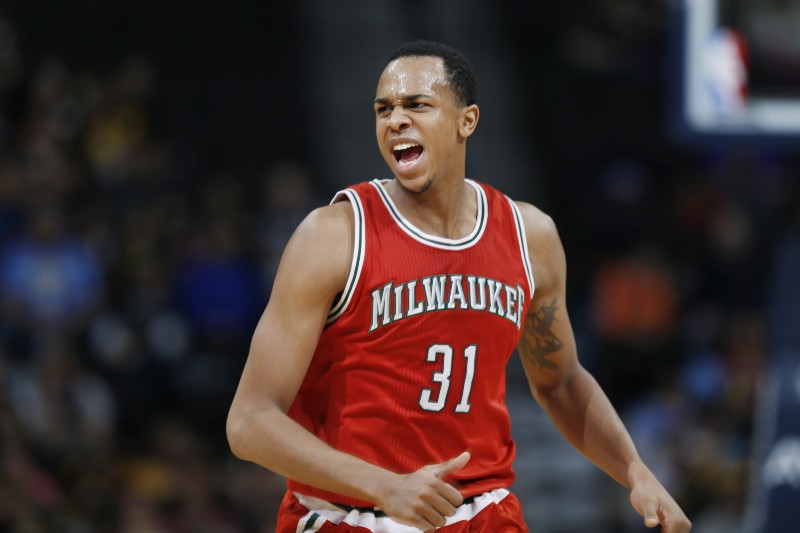
On Monday, NBA player John Henson — who signed a four year, $44 million contract extension with the Milwaukee Bucks during the offseason — went to a jewelry store in Whitefish Bay, Wisconsin, to look at a watch.
What happened next is now well known: As Henson approached the store, the jewelers locked the door and told him to go away. They didn’t answer when he rang the doorbell. They called the police, who proceeded to question Henson about his vehicle and intentions. They ran his license plates. Even after the police told the employees at Schwanke-Kasten Jewelers that Henson was an NBA player, they asked the police to stay around.
Henson recounted the entire incident in an Instagram post, and the story quickly went viral.
“This was one of the the most degrading and racially prejudice [sic] things I’ve ever experienced in life and wouldn’t wish this on anyone,” Henson wrote. “This store needs to be called out and that’s what I’m doing.”
What followed was a rather predictable stream of apologies and deflections. The owners of Schwanke-Kasten told reporters that it was a “misunderstanding” because Henson’s car was from the same dealer as a robbery suspect from one of the three armed robberies the store has encountered over the past 18 months. The store owner proceeded to meet with Henson in person to apologize, and Henson’s Instagram post was deleted.
The Bucks released a statement on Tuesday saying it was an “incredibly upsetting and frustrating experience for anyone to go through and the entire Bucks family supports him.” They continued by insisting that while “this illustrates a very real issue in our society, we know this incident isn’t reflective of the entire Milwaukee community.”
I was outraged but not surprised; this happens everywhere you go in Wisconsin.
In a statement to ThinkProgress on Thursday, Mark Rosenberg, the Bucks’ public relations manager, said that the team has “turned our focus back to basketball and don’t have any additional comment.” Rosenberg said that it was Henson’s decision to delete the Instagram post. “He said what he wanted to say, both on Instagram and in his comments to the media, and wants to leave it at that for the time being.”
While it’s understandable for the Bucks to want to focus on basketball — the NBA regular season starts next week, after all — characterizing this incident as an outlier doesn’t reflect the current reality across Wisconsin, particularly in Milwaukee, which is one of the most segregated cities in America. What happened to Henson is a regular occurrence for many black Wisconsin residents, observers say, and most never receive an apology.
“I was outraged but not surprised; this happens everywhere you go in Wisconsin,” Matthew Braunginn, the co-founder of the Young Gifted and Black chapter located in Madison, Wisconsin, told ThinkProgress. “That’s what happens when you’re black.”
Braunginn described the suburbs of Milwaukee as “very white, very affluent, and very racist,” adding that Whitefish Bay is colloquially called “Whitefolks Bay” by those in the surrounding areas.
According to 2010 census data, Whitefish Bay is 91.9 percent white and only 1.9 percent African American. These statistics are echoed in other suburbs of Milwaukee, such as Waukesha county, Ozaukee county, and Washington county, which are often referred to as the WOW counties. These three counties are less than two percent black and less than five percent Hispanic.
Milwaukee remained predominantly white for most of the 1900s, but since 1960 the black population there has increased from 10 percent to nearly 40 percent. As reported by The New Republic in a feature exploring the racial and political divide in Wisconsin and Scott Walker’s (R) governorship, the late arrival of blacks into the area is primarily to blame for the stark racial divide in the city today:
This delayed arrival would prove highly consequential. Not long after a substantial African American community took shape, Milwaukee’s industrial base began to collapse and its manufacturing jobs disappeared. This left almost no time for the city to develop a black middle class or a leadership elite. Within short order, Milwaukee had some of the most glaring racial disparities in the country. Today, it has the second-highest black poverty rate in the United States, and the unemployment rate is nearly four times higher for blacks than for whites.
“Your experience is a reminder to others that even status and popularity won’t serve as shields from the exigencies of blackness,” Robert Smith, an associate professor of history at the University of Wisconsin-Milwaukee, wrote in an article for Milwaukee Magazine entitled “A Letter of Fellowship to John Henson.”
“[Y]ou and those who see you know this won’t be your last encounter with racial profiling,” Smith continued. “As adult men who constantly navigate the treacherous realm between being feared and assumed to be criminal, we both know how tenuous these encounters can be, especially once the police are called.”
In a ranking of America’s most segregated cities in August, the website 24/7 Wall St. ranked Milwaukee No. 3 on the list, just behind Detroit and Cleveland, and reported that out of approximately 80 zip codes in the area, three are home to nearly 25 percent of the city’s black population, and more than half of Milwaukee residents live in a zip code where 80 percent of residents share their skin color.
“On average, three-quarters of all people that a white person sees on the street in the Milwaukee metro area are white, and 60 percent of people a black person sees are black, both indicating among the highest levels of isolation from other racial groups of metro areas reviewed,” 24/7 Wall St. reported.
This great divide has led to an extremely hostile environment in Milwaukee, which has been described as “the most polarized part of a polarized state in a polarized nation.”
Tensions in the city have been particularly high since April 2014 when 31-year-old African American Dontre Hamilton, a diagnosed paranoid schizophrenic, was shot 14 times and killed by a white police officer, Christopher Manney. Though Manney was fired, the district attorney declined to press charges, citing self defense. Milwaukee’s police chief, Ed Flynn, has been on Fox News recently talking about “the relentless propaganda war being waged against American police officers by our network television stations,” while Gov. Walker, who recently dropped out of the race for the Republican presidential nominee, has refused to meet with Black Lives Matter activists.
So, while Henson told reporters that he found the apology from the jewelry store owner sincere, and while the Bucks attempt to bring the focus back to basketball, others continue to emphasize that what happened to Henson did not happen in a vacuum.
Jason Kidd, the coach of the Bucks, hopes that this will be a learning experience for everyone involved.
“It’s an issue worldwide, not just here in Milwaukee. We have to do a better of job of addressing it and also learning from it. Our guys here have learned a life lesson at a very young age. “We see it on TV every day. Then, when it hits home to one of our family members, it becomes real. It’s nothing new; it just happened to a member of our family.”