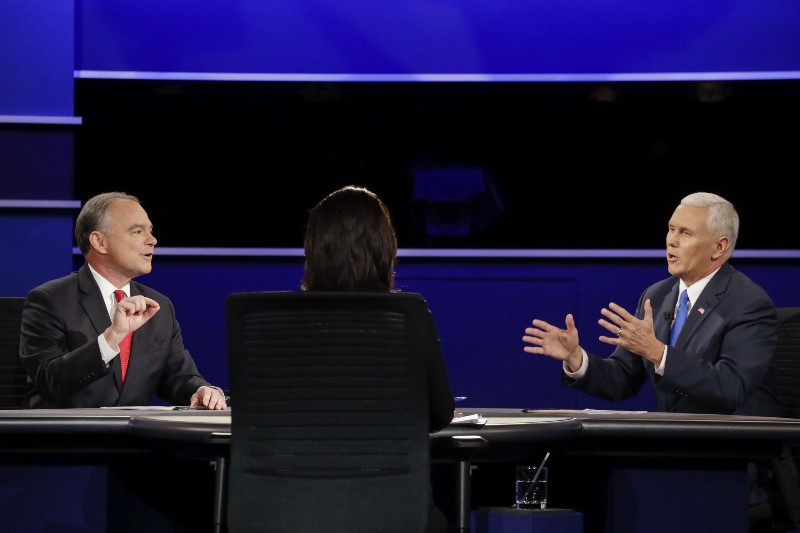
During Tuesday night’s vice presidential debate, both candidates threw their support behind a Syria policy similar to what many Syrian voices in civil society are calling for, suggesting the United States should create a no-fly zone.
“The United States of America needs to be prepared to work with our allies in the region to create a route for safe passage and then to protect people in those areas including with a no-fly zone,” Indiana Gov. Mike Pence (R) said.
Syria’s civil war has raged since 2011, when peaceful protesters were violently put down by the Syrian Army. Five years and more than 450,000 lost lives later, Syria’s Assad regime continues to bomb civilians in areas like Aleppo. Russia intervened in Syria last year under the guise of fighting ISIS, but instead has helped bolster the Syrian regime.
The United States recently negotiated a ceasefire with Russia on behalf of all warring sides, but incidents including an allegedly accidental American attack on Syrian regime troops and Russia and Syria’s failure to stop targeting hospitals in Aleppo led the U.S. to break off cooperation with the Russians.
With no end in sight to the fighting, many Syrian civil society organizations have spent the last year calling for a humanitarian-driven, no-fly zone.
“Failure to do [this] will prolong the suffering and the loss of innocent Syrian lives, and will allow the direct security threat to the region and the world to become ever more imminent,” Dr. Najib Ghadbian, Special Representative to the U.S. and U.N. of the National Coalition of Syrian Revolution and Opposition Forces, told Middle East Eye last year.
Pence’s call for a no-fly zone would be welcomed by many Syrians, however, it seems to contradict his running mate Donald Trump’s comments on Syria to date. Last year, Trump said, “Let Russia fight ISIS.”
Trump did entertain the idea of a safe zone once, but his comments placed the onus for enforcing it on the Arab nations straddling the Persian Gulf.
“What they should do is, the countries should all get together, including the Gulf states, who have nothing but money, they should all get together and they should take a big swath of land in Syria and they do a safe zone for people, where they could to live, and then ultimately go back to their country, go back to where they came from,” Trump said.
#pts: @GovPenceIN with *huge* about-turn for #Trump policy:
– Need "American" strikes vs. #Russia & #Assad
– Advocating need for safe zones pic.twitter.com/35lOoFzpCs— Charles Lister (@Charles_Lister) October 5, 2016
Trump’s oldest son, Donald Jr., allegedly approached Gov. John Kasich (R) as a running mate before Pence and told him he would determine the administration’s foreign policy, the New York Times reported in July. It is possible the same deal was offered to Pence.
Regardless, when asked about America’s involvement in a no-fly zone last year, Trump said he would rather watch from afar. “That does not sound like me very much,” he said. “I want to sit back, I want to see what happens.”
The Obama administration has been predominately opposed to a no-fly zone or setting up any other safe zone in Syria through use of the American military. In a recent closed-doors discussion with Syrian civilians, Secretary of State John Kerry was recorded expressing his frustration that the administration’s advocates for using force against the Syrian regime were few.
Opposition to a no-fly zone is often based on the notion that it could start a greater war with Russia. Syria experts, however, believe that Russia has little to gain by declaring war on the United States in Syria.
Intervention skeptics’ most common “veto” is that doing so => WW3 with #Russia.
Let’s flip it…
– Why on earth would #Moscow *want* WW3?
— Charles Lister (@Charles_Lister) September 29, 2016
Worth noting that #Russia has *nothing* that could concretely prevent US military action in #Syria.
S-400 & SA-23 = entirely suppressible.
— Charles Lister (@Charles_Lister) October 4, 2016
But on Tuesday night, the Democratic nominee, Sen. Tim Kaine (VA), also said he supported safe zones, though he didn’t get into specifics.
His line is more similar to his running mate, Hillary Clinton, who has publicly supported a no-fly zone in the past. “I do still support a no-fly zone because I think we need to put in safe havens for those poor Syrians who are fleeing both Assad and ISIS and so they have some place they can be safe,” Clinton said during a debate with Sen. Bernie Sanders (I-VT) in April.
Regardless of the specifics, Syrians will be buoyed to hear more talk of a safe zone coming from both sides of the aisle. As the Syrian regime and Russia continue to ruthlessly bombard Aleppo, history will likely not look kindly on how the world let the Syrian people suffer.
Kaine told a Senate Armed Services Committee hearing last December he initially supporter the administration’s position on opposing safe zones but later changed his mind. He told the hearing, “the absence of the humanitarian zone will go down as one of the big mistakes that we’ve made.”