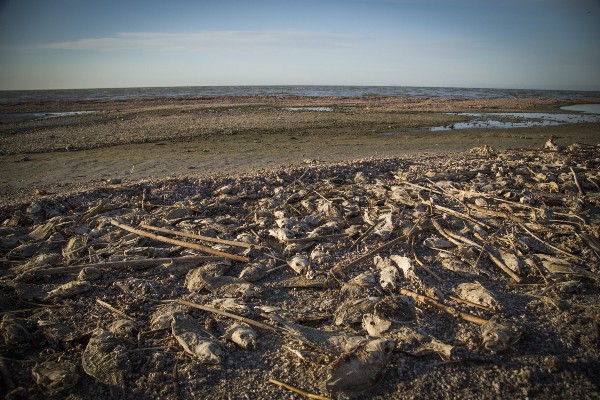
California’s largest lake, the Salton Sea, is evaporating quickly. This may now have pushed it to a tipping point for fish and hundreds of bird species that live there.
The Desert Sun reported this week that Salton Sea Refuge managers have in the past few months seen indications of a lack of juvenile fish and a sudden decline of some bird species around the 100-year-old man-made lake, both signs of ecological demise.
Refuge managers have even found dead birds around the shores that lab analysis showed starved to death.
“Maybe we’re at the point where salinity is limiting fish reproduction,” said Chris Schoneman, Sonny Bono Salton Sea National Wildlife Refuge manager. “The impact on birds from having a repressed or eliminated fish reproduction capability out here is devastating. That means the productivity of the Salton Sea is drastically reduced.”
Located about 150 miles southeast of Los Angeles, the Salton Sea is an ancestral lake basin with no recent natural water sources that was accidentally flooded in the early 1900s. As the 20th century unfolded it became a prime resting place for migratory birds on the Pacific Flyway that extends from Alaska to Patagonia, and a major wildlife refuge since more than 90 percent of California wetlands have been drained for human development. Now more than 400 bird species use the Salton Sea to rest, breed, or forage.
But the Salton Sea has been receding fast since the largest agricultural-to-urban water transfer in the nation went into effect more than a decade ago. Rich in salt from native sources and agricultural runoff, the lake’s salinity has recently ballooned due to evaporation and decreasing water inflows to the point that only tilapia fish has been able to endure.
Experts have long said that if left unattended, the lake will become too salty even for tilapia to survive, which means birds would lose a major food source. “We are at 57 to 58 parts [of salt] per thousand right now,” Bruce Wilcox, assistant secretary for Salton Sea policy, told ThinkProgress earlier this year. “Once we get to sixty parts or thereabout, we think [the tilapia] reproduction will stop.”

Wilcox, who couldn’t be reached for comment, told the Desert Sun bird declines in the Salton Sea could indeed stem from dwindling populations of fish or other prey, or could be the result of unrelated issues elsewhere on the Pacific Flyway. Still, he said concerns raised by refuge managers are valid, though their observations don’t necessarily mean fish have started to disappear.
His comments come as there haven’t been regular fish, pile worm, or other invertebrate survey in the Salton Sea in recent years, which means experts’ observations are worrisome but lack scientific measurements.
This isn’t the first time die-offs have been reported in the Salton Sea. In the past, algae blooms have hogged sunlight and oxygen, killing fish and putting large amounts of decomposing carcasses on the shores that have sickened birds. However, this is the most recent indication that salinity is reaching a tipping point for the remaining tilapia.

Restoring the Salton Sea as it once was is pretty much out the question. Doing that would cost billions of dollars. So the plan now is to mitigate salinity and suppress exposed playa dust with a series of projects.
After more than a decade of neglect, California has moved to partially remedy the problem with much-awaited project financing. This year it approved $80.5 million to build marshes around the Salton Sea to lower salinity and provide some bird and fish habitat. These projects are part of a larger unfunded plan to manage wildlife and control dangerous exposed dust now reaching nearby communities every time the winds pick up.
“The state’s own scary predictions of more than a decade ago have come to pass — but its conservation projects are still not up and running,” said Michael Cohen, senior research associate at the Pacific Institute, to the Los Angeles Times. “Our patience with the state is largely evaporated.”
But the tipping point of ecological disaster now looming over the Salton Sea is just one of many others now approaching large natural areas in the western hemisphere, as climate change policy and wildlife management often fall short to the needs.

In the north, boreal forests — which represent around 30 percent of the planet’s forests — could reach a tipping point by the end of the century if global warming continues at the present rate, according to published reports. And in the south, the World Wildlife Fund has raised similar dire prediction about the Amazon rain forest, an ecosystem that faces not just global warming, but also deforestation, oil spills, and mining disasters.
Meanwhile, the International Fund for Animal Welfare recently said the world spends about $50 billion a year on the protection of nature, when the actual need is closer to $200 billion.