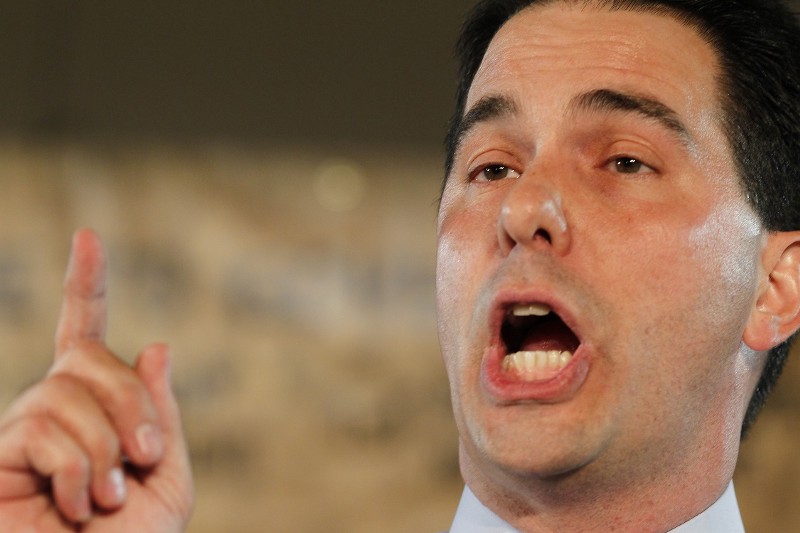
In an op-ed for The Des Moines Register, Wisconsin Gov. Scott Walker (R) talked up his record on education, saying that his decisions to get rid of teacher tenure and seniority and encourage the growth of more charter schools is responsible for better graduation rates and higher third grade reading scores.
Walker said in this op-ed Tuesday:
“Best of all, the reforms are working. Schools are better. Graduation rates are up. Third grade reading scores are higher. Wisconsin students now rank 2nd best in the country for ACT scores in states where more than half the students take the exam.”
Scott Walker’s claim that Wisconsin’s ACT scores are the second best in the country where more than half the students take the exam is accurate but not many Americans know how many states that included. Wisconsin ranks second compared to 29 other states, but the state’s “raw score” is 17th out of 50 states. The state’s ACT participation rate for 2013–2014 was 63.5 percent.
The data is skewed a little by the fact that the ACT test is largely taken in the Midwest and not on the east coast, and is required in certain states and not in others. Walker only recently clarified that this didn’t include all states at a Florida Economic Growth Summit speech this month after making the claim in a February speech at the Conservative Political Action conference.
The rate of improvement for fourth grade reading in Wisconsin, according to The Nation’s Report Card, is almost the same as before Walker came in as governor, with an average score of 220 in 2009 to 221 in 2013.
Walker also boasted about the improvement in the graduation rate. Wisconsin’s graduation rate was 85.7 percent in 2009–2010 before Walker began as governor and the 2012–13 graduation rate was 88 percent, which tied with three other states for second place, according to Politifact’s 2014 analysis. That’s certainly an improvement, but the graduation rates were already fairly high. However, the biggest school district in the state, Milwaukee Public Schools, had a drop in its graduation rate from the class of 2011 to the class of 2013. Graduation rates for the entire country have improved markedly as well.
Nearly 49 percent of Wisconsin public school students scored either proficient or advanced in math and close to 37 percent of students were found proficient or advanced in math in the fall of 2013, which was a small improvement from last year’s scores. Looking back further, reading scores have improved from 32.8 percent proficient and advanced in 2005–2006 to 34.6 percent in 2013–2014 but have dipped slightly in between those school years.
The percentage of students in poverty rose 5 percentage points over the past five years to 42 percent of students, and there was a stark difference in which children qualified for free or reduced-price lunch. Almost 82 percent of black students, 78 percent of Hispanic students and over 68 percent of Native Americans qualified, compared to slightly over 30 percent of white students.
The achievement gap issue was raised during the latest gubernatorial campaign, when the Democratic challenger, Mary Burke, said Walker was responsible for black students’ poor graduation rates in Madison. Only 53.7 percent of black students in Madison graduated in four years compared to a slightly better 58.3 percent graduate rate for black students in Milwaukee.
The test score gap has also remained fairly wide between white students and students of color. While white students were 56 percent proficient or advanced in math and 43 percent proficient in reading, only 18 percent and 14 percent of black students’ scores fell into those categories, respectively.
Critics of Walker’s education policies say these performance gaps, as well as an increase in impoverished students, are exacerbated by the governor’s cuts in education spending as well as cuts to social safety nets and additional requirements for programs such as federal nutrition assistance.
According to the U.S. Census Bureau’s report, which was issued in May 2014 and covers the fiscal year of 2011–12, Wisconsin’s decrease in per pupil spending from the 2010–11 year was the highest of all 50 states. That is compared to a 3.6 percent rise in 2010–11, a 2.6 percent rise in 2009–10 and 3.6 percent rise in 2008–09 before Walker was sworn in as governor. Walker proposed a 15 percent cut in funding for universities and public primary schools will lose $127 million in education aid next year.
At the same time, Walker has pushed for relaxing oversight and increasing funding for charter schools. Funding for new charter schools would amount to $8,075 per student and would be taken from general school district state aid.