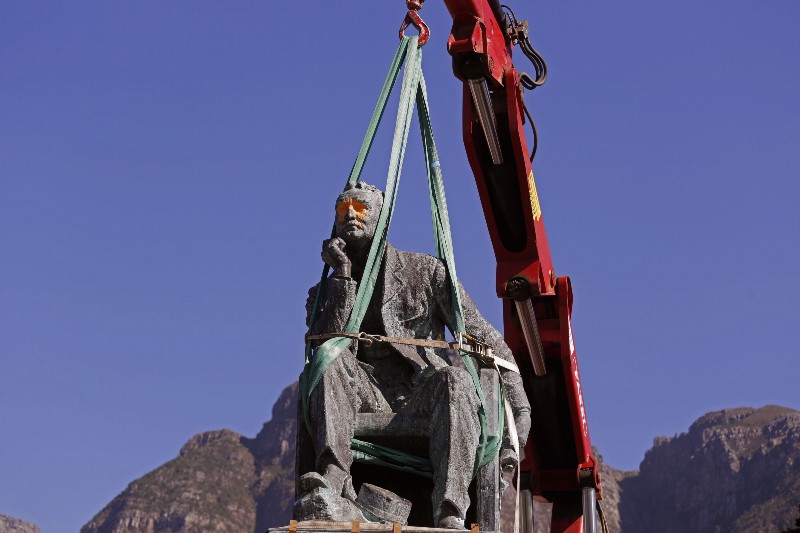
A century-old statue of the Queen Victoria was doused in green paint on Friday in the latest of a series of protests around how South Africans see their past — and their future. The vandalism follows the removal of a statue of Cecil Rhodes, a British colonialist leader, from the University of Cape Town campus on Thursday and a demonstration led by a controversial Afrikaans singer who, on Wednesday, chained herself to a paint-splattered statue of a man known as the father of the Afrikaner nation.
Sunette Bridges, the singer, is Afrikaners — or the descendant of Dutch colonialists — within the country. She related the vandalism of the statue of Paul Kruger, a former president of South Africa who fought for South African independence from Britain and promoted the place of Afrikaners, to vandalizing a statue of the anti-Apartheid leader and former president, Nelson Mandela. “If I told my followers to deface Nelson Mandela’s statues and there was as much as a spot of paint on them I would have been in prison,” she told a group of cheering supporters.
Many object to the comparison, especially black South Africans who point to Paul Kruger and Rhodes as people who exploited local resources and enshrined racism into law. Rhodes was a British colonial politician who acquired Rhodesia and Zambia as British colonies and headed the De Beers Mining Company through which he made his fortune. The toppling of his statue at University of Cape Town is a hugely symbolic gesture not least because it was constructed on land he donated.
Just over 20 years after the end of Apartheid’s forced racial segregation ended, young people are largely leading the charge to remove the relics of those who, they believe, perpetuated a system of inequality that still persists in the country. University students today are the first generation to have come of age in the post-Apartheid era, and yet, make up only a tiny fraction of the students and professors at universities across the country.
Although the average income of black-led households tripled between 2001 and 2011 according to census figures, black South Africans still trail far behind their white counterparts in terms of income –- and the divide appears to be growing.
As noted by the New York Times, white-led households earned nearly $17,000 more than black-led households in 2001, in terms of current exchange rates. In 2011, they earned almost $30,000 more.
“We still operate in the unequal and bigoted socio-economic conditions generally talked about in the past tense,” Greg Nicolson, a political analyst wrote in a Daily Maverick column.
“The specific legacies of Rhodes and Kruger are largely meaningless,” he added. “The statues are a symbol of all that remains to be done, of real transformation.”
The dozens of students at the University of Cape Town (UCT) who spearheaded the #Rhodesmustfall campaign made just that argument against the presence of Rhodes’ statue on campus. The movement gained momentum after students hurled a bucked of excrement on the statue in late March.
“Down with white supremacy!” a group of students who occupied the UCT council chamber chanted before that organization eventually succumbed to their demands and unanimously agreed to remove the statue.
“This represents a good step forward for transformation and it shows if something is wrong you really do have the power to change it,” Tinashe Sibeko, a UCT student told Reuters as the graffiti-strewn statue was lifted away by a crane. “For the black mentality in general it says that you don’t just have to accept the status quo, you can transform and change things for the better.”
Not everyone saw it that way.
“This is racism in disguise,” Ernst Roets, deputy chief executive of mainly-Afrikaner civil rights group AfriForum said, arguing that removing colonial relics is an affront to Afrikaners.
While the ire around the statues has struck a chord with young South Africans, some note that the public outcry over the statues might be misplaced.
Well played #SAStatueFight #Rhodes #RhodesHasFallen #UCT pic.twitter.com/zPNLxQo7QE
— tanian goliath (@tanian4real) April 10, 2015
But for others, thee statues represent points to contemporary fissures in South African society that were not resolved by the country’s largely black leadership since the end of Apartheid.
“That statues, concrete and bronze conjurings of the past, should provide a rallying point for an ever-shifting national conversation about ‘becoming’ should not come as a shock,” according to Marianne Thamm of the South African news outlet the Daily Maverick. She further wrote:
In an increasingly atomized and virtual public arena in South Africa these physical manifestations of history have become a rallying platform for the aggrieved. Both for the black students who are part of the #RhodesMustFall movement and for those, like Sunette Bridges, burdened by the weight of a past that haunts the present.
Many English-speaking white South Africans have fewer spaces — both physical and creative — in which to engage with their history and future. Young, white UCT students have claimed that Rhodes “means nothing to me” and “does not represent me.” To which black students have replied, “If he means so little to you and so much to me, he should go.”