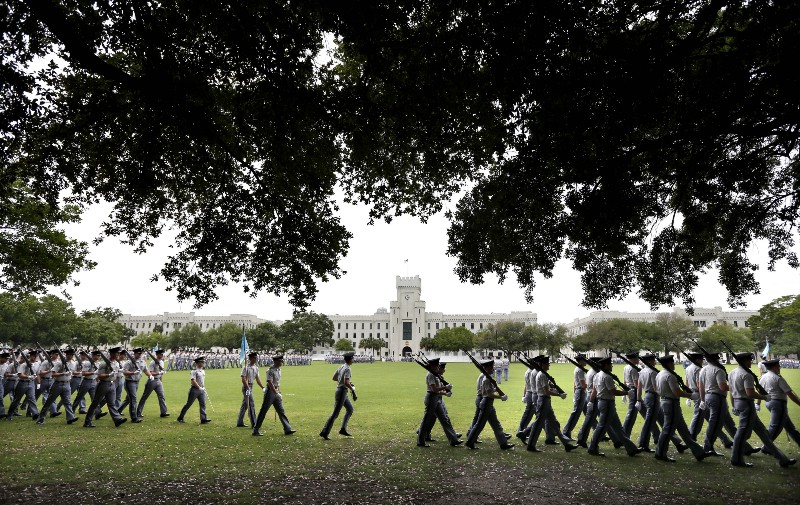
A South Carolina military college has refused to allow a female Muslim cadet to wear a hijab while attending the school, sparking debate over the limits of religious freedom on college campuses and in the military.
On Tuesday, Citadel President Lt. Gen. John Rosa released a statement announcing that school officials had agreed to deny a request from an admitted student to wear her hijab, or Muslim headscarf, while attending the military college. The student was accepted to the school in Charleston, SC earlier this year, but hoped to don her religious headgear while there — a shift that would have marked the first such alteration in the school’s uniform in 174 years.
The American military already allows for religious accommodation, why not the Citadel?
“While we hope the student will enroll in the college this fall, the Commandant of Cadets, after considerable review, determined the uniform exception cannot be granted,” the president’s statement read. “As the Military College of South Carolina, the Citadel has relied upon a highly effective educational model requiring all cadets to adopt a common uniform. Uniformity is the cornerstone of this four-year leader development model.”
Council on American-Islamic Relations (CAIR) spokesperson Ibrahim Hooper, whose organization is representing the young woman and her family, told ThinkProgress she was distraught to hear the news — and likely won’t attend the college unless the administration reverses its decision.
“I spoke with her father this morning,” he said. “When the Commandant called to tell her, she was distraught and in tears.”
The Citadel is not an official U.S. Military Academy, and graduates are not required to enter into military service of any kind. But Hooper noted that the president’s justification for denying the perspective student’s request — the need to prepare graduates for “a life committed to principled leadership in military service and civilian life” — seemed out-of-step with the U.S. military, which already grants religious accommodations for servicemen and women.
“The American military already allows for religious accommodation, why not the Citadel?” Hooper said.
Indeed, the Citadel’s announcement comes just weeks after the U.S. Army granted a decorated Sikh soldier the right to grow a beard and wear a turban while on active-duty, a landmark accommodation they also offered to three other Sikh men a few weeks later.
Whether or not these same policies extend to government-run military academies is unclear, however. When ThinkProgress contacted the United States Military Academy, also called West Point, to ascertain their policy regarding religious accommodations, a representative explained via email that cadets are generally only allowed to wear religious items that “are not visible or apparent when in duty uniform,” and that any breaks from that policy “are thoughtfully and carefully considered on a case-by-case basis.”
Still, Hooper insisted that the student’s fight to wear hijab at the Citadel was not over, and that CAIR is “working with the family to determine what legal action will be taken now.” He added that even if existing dress code policy is upheld for the sake of tradition, the Citadel, like many colleges, has changed in the past: the school admitted its first African American cadet in 1966, and didn’t allow women to enroll until 1996.
“The concept of tradition was also used to deny African Americans and women the right to enroll,” Hooper said. “Traditions change.”