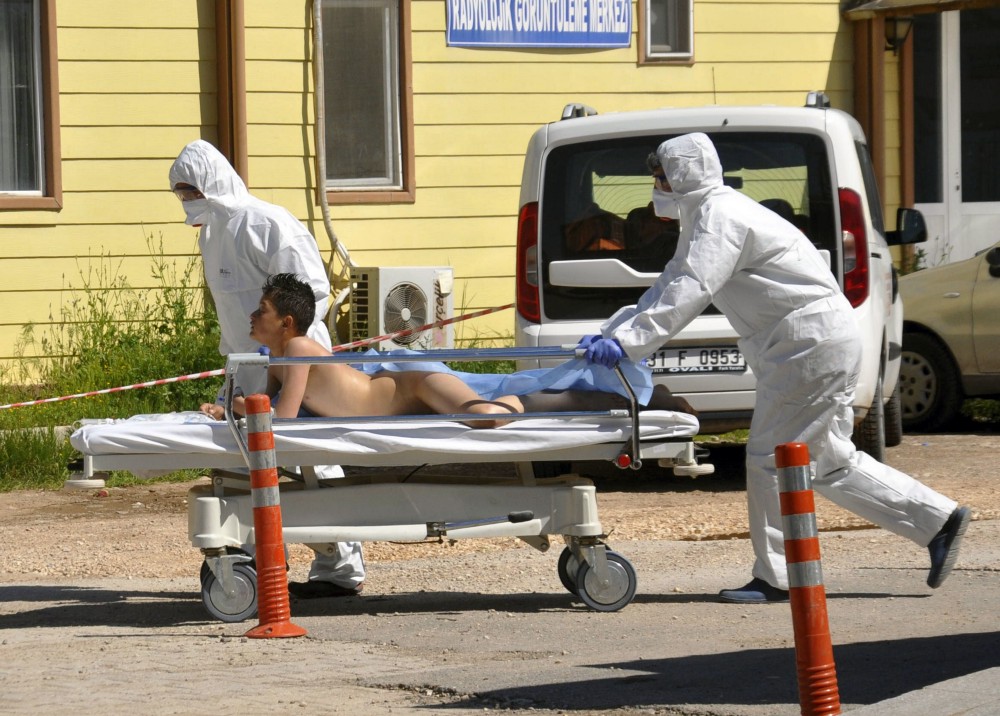
On Tuesday morning, a rebel-controlled Syrian city in northwestern Idlib province was hit with what activist groups are calling a “poisonous gas” attack. At least 58 were left dead — many of them children — and hundreds wounded.
“The Syrian Observatory for Human Rights reported that strikes on Khan Sheikhoun by Syrian government or Russian jets had caused many people to choke,” the BBC reports, adding that the substance used in the attack appears to be sarin. “Later, aircraft fired rockets at local clinics treating survivors, medics and activists said… The Syrian Observatory (SOHR) quoted medics as saying that they had been treating people with symptoms including fainting, vomiting and foaming at the mouth.”
Both Syrian and Russian forces deny any involvement in the atrocity, but as CNN reports, “Idlib province is largely controlled by an alliance of Syrian rebel forces and is regularly targeted in airstrikes by the Syrian government and its ally, Russia.”
“The Syrian Coalition, an umbrella opposition group, referred to the suspected chemical attack as a ‘crime similar to that in Eastern Ghouta in 2013 that the international community allowed to pass without accountability or punishment,’” CNN adds. After the attack in Eastern Ghouta, in which over 1,000 people were killed, Syrian President Bashar al-Assad agreed to a U.S.-Russia deal to destroy the country’s stockpile of chemical weapons. Tuesday’s attack is the deadliest chemical attack since that agreement.
The attack was promptly condemned by world leaders. United Nations Syria envoy Staffan de Mistura described it as “horrific” and said the perpetrators must be held accountable. French President Francois Hollande accused the Syrian regime of a “massacre.” U.K. Secretary of State Boris Johnson went as far as to suggest Assad may be guilty of a war crime.
“Bombing your own civilians with chemical weapons is unquestionably a war crime and they must be held to account,” Johnson said, according to the BBC.
But the Trump administration stopped far short of Johnson’s statement. Secretary of State Rex Tillerson — who received the Russian Order of Friendship from Vladimir Putin in 2013 — refused to even comment on the incident.
BREAKING: US secretary of State refuses to comment when asked for response to chemical attack massacre in Syria.
— NBC Nightly News (@NBCNightlyNews) April 4, 2017
Sec. of State Tillerson greets Jordan's King Abdullah, doesn't answer questions on suspected Syria chemical attack https://t.co/u83myClKRh pic.twitter.com/yfq03WiXZx
— ABC News Politics (@ABCPolitics) April 4, 2017
While Tillerson’s wasn’t willing to offer a condemnation, a State Department official did so anonymously.
Senior State Dept official says ON BACKGROUND that chemical attack in Syria was "reprehensible."
— Nancy Youssef, نانسى (@nancyayoussef) April 4, 2017
White House Press Secretary Sean Spicer pinned responsibility for the attack on Assad, but also blamed former President Obama for not being tougher.
“Today’s chemical attacks in Syria against innocent people including women and children is reprehensible and cannot be ignored by the civilized world,” Spicer told reporters on Tuesday. “These heinous actions by the Bashar al-Assad regime are a consequence of the past administration’s weakness and irresolution.”
But Spicer repeatedly refused to comment on the possibility Russian forces might’ve been involved in the attack. He also overlooked the fact Trump was strongly and vocally opposed to the Obama administration’s threat of military action after the Ghouta attack.
President Obama, do not attack Syria. There is no upside and tremendous downside. Save your "powder" for another (and more important) day!
— Donald J. Trump (@realDonaldTrump) September 7, 2013
Later Tuesday, Trump released a statement echoing Spicer’s comments.
Trump statement on Syria chemical attack brings up Obama's “red line” pic.twitter.com/WUl3GPeYCo
— Bradd Jaffy (@BraddJaffy) April 4, 2017
On Monday, U.S. ambassador to the United Nations Nikki Haley characterized Assad as “a war criminal.” But just days earlier, Haley and Tillerson told reporters that the Trump administration, unlike Obama, will no longer prioritize removing Assad from power.
“Do we think he’s a hindrance? Yes. Are we going to sit there and focus on getting him out? No,” Haley told reporters last Thursday. “What we are going to focus on is putting the pressure in there so that we can start to make a change in Syria.”
In the wake of what happened Tuesday, Sen. John McCain (R-AZ) linked Haley and Tillerson’s acknowledgement of Assad’s ongoing rule with the reported attack on his own people.
.@SenJohnMcCain: Tillerson and Haley comments on Syria "motivating" for Assad to gas Syrian children.
— Josh Rogin (@joshrogin) April 4, 2017
Another vicious chemical attack in #Syria – how do the Syrian people determine their own future while they are being slaughtered? pic.twitter.com/GfgVtklHxO
— John McCain (@SenJohnMcCain) April 4, 2017
Trump has made clear that eliminating ISIS — not Assad — is a priority in the conflict in Syria. He has expressed support for working with the Russian government, which sees Assad as an ally and has repeatedly bombed rebel-held areas in Syria.
“I say it’s better to get along with Russia than not,” Trump told Fox News last month. “And if Russia helps us in the fight against Isis [so-called Islamic State], which is a major fight, and Islamic terrorism all over the world — that’s a good thing.”
UPDATE: Secretary of State Tillerson released a statement Tuesday afternoon condemning the atrocity. He called on Russia and Iran “to exercise their influence over the Syrian regime and to guarantee that this sort of horrific attack never happens again.”
NEW: Sec. of State Tillerson on Syrian chemical attack: "We call upon Russia and Iran…to exercise their influence over the Syrian regime." pic.twitter.com/LXBsbGlmum
— ABC News Politics (@ABCPolitics) April 4, 2017