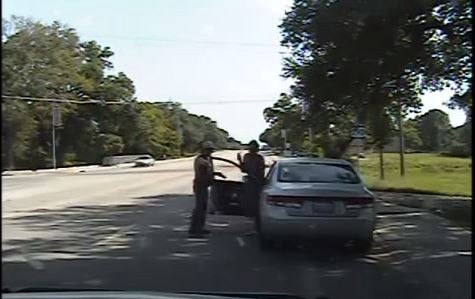
One day after prosecutors confirmed Sandra Bland’s death will be treated as a murder investigation, officials from the Texas Department of Public Safety announced they are looking into alleged edits to dash cam footage of Bland’s traffic stop.
Earlier this month, Bland was pulled over by Texas Department of Public Safety trooper for failing to use her signal while changing lanes. Three days later she was found dead in her jail cell, which the sheriff’s office labeled a suicide. But between the video and circumstances leading up to her death — Bland had attempted to post bail and was about to start a new job days later — relatives believe the cause of death was not suicide.
In a dash cam video uploaded by police department officials on YouTube, a tow truck driver exits his vehicle and walks around State Trooper Brian Encinia’s car. Within seconds, the truck driver is seen making the same exit and walk, but Encinia, who can be heard recalling the traffic stop encounter in detail, is uninterrupted. Minutes later, a white car appears on the screen and disappears two times, before reemerging and making a left turn. Audio of Encinia’s voice continues without interruption.
Both discrepancies were discovered by journalist Ben Norton on Tuesday night. One explanation could be that the equipment was faulty, but authorities have agreed to investigate whether or not officers tampered with the evidence.
Watch the two clips:
In the full video, Encinia asks Bland to put her cigarette out, but she refuses. Encinia orders her to step out of the vehicle several times, but Bland contends he does not have the right to make her get out. The situation escalates when Encinia yells, “get out of the car or I will light you up” and points a gun at her. Off camera, minutes later, Bland cries out that the officer is going to break her wrists. Muffled cries are heard before Bland yells, “you knocked my head in the ground and I got epilepsy” and Encinia responds, “good.” The officer tells her to stand up, roll over, and tuck her knee in, but Bland says, “If I could…I can’t even feel my fucking arm.”
Bland was eventually taken to jail and charged with assault. Watch the full video:
The newly released dash cam footage raises additional concerns about the effectiveness of police cameras to hold officers accountable. Critics of body cam implementation argue that officers can easily edit the videos since the footage is in their possession. And cameras can be ill-positioned to capture an event in its entirety.
“Often, you can’t see the cop, and sometimes the video is really close up. The camera isn’t in position, and there’s no way to use the footage,” David Whitt, a leader of We CopWatch in Ferguson, previously told ThinkProgress.”[And] cops are in control of all of that. The people stopped by police are always the bad guys.”
Indeed, proponents of police reform throughout the country are wary of footage controlled by law enforcement. After D.C. Mayor Muriel Bowser announced in March that every Metropolitan Police Department officer would be equipped with a camera, Philip Fornaci of the Campaign Against Police Abuse in Washington, D.C. explained, “cameras are worn by police, so they are, by definition, not going to capture police conduct. They’ll capture the people who they interact with.” Cops, he argues, can optimize the footage to benefit themselves. Bowser has also said police videos would be exempt from public record requests.
“Those tapes never surface except for at the convenience of the officers or system. They turn off cameras, they forget it, and we’ve heard things like ‘there’s no film,’ as if there’s film in video cameras these days.”