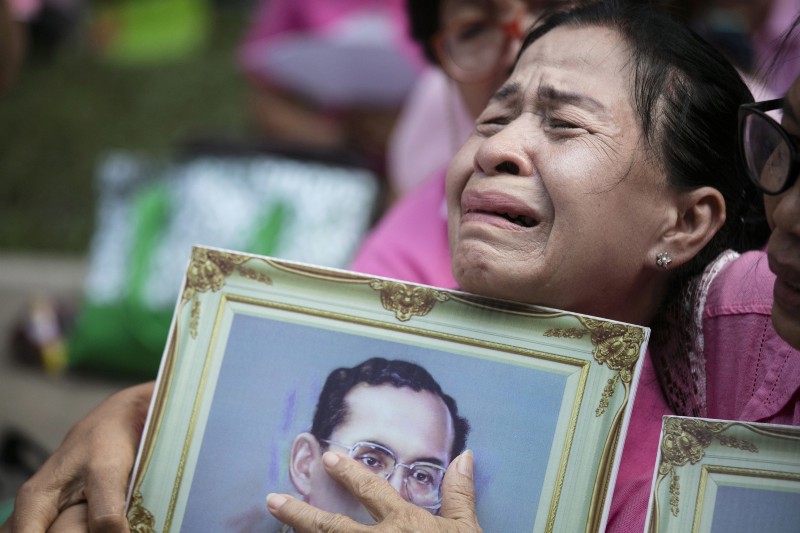
King of Thailand Bhumibol Adulyadej, the longest ruling monarch in the world, died Thursday at 88 after a seven decade reign. News of the death of the American-born monarch, widely beloved in Thailand, was met with tears and displays of public grief. A cause for the death was not given.
“I feel so saddened by this news,” Apinut Jaroonpipatkul, a 25-year-old medical student told Reuters. “He has given so many things to the country.”
Bhumibol, (pronounced poo-me-pon) according to the New York Times, was appointed king in 1946 at the age of 18 and survived ten government coups (the most recent in 2014) and more than 25 prime ministers. He was widely respected by the Thai people for his travels around the country, where he would meet with the poor and other common folks in remote regions of Thailand.
“To the people in general, the Thai monarchy is not an abstract or irrelevant concept, but a responsive, caring and indispensable institution that is an integral part of their lives,” Anand Panyarachun, a former prime minister, told the Foreign Correspondents’ Club of Thailand in 2007.

In 1932, a bloodless coup transformed Thailand from an absolute monarchy to a democratic one. And despite having all the markers of a successful democracy — like modern factories, strong banks, and a growing middle class — it has struggled with military intervention and violent political strife since its transformation.
When Bhumibol came to power, it was as a figure head, but he still pushed to have 3,000 royal development projects completed, often in remote villages. His early rule was characterized by military interference with his attempts to modernize the country, so he focused his efforts on development. He was widely perceived as maintaining humble values despite a 2010 Forbes estimate rating him as the world’s wealthiest monarch. “Some say it is the poor man’s rice. I too am a poor man,” the leader once valued at $30 billion said about eating cheap, unmilled rice.
Under his rule, Thailand moved from an agricultural based economy to a modern economy with “industry and commerce and a growing middle class,” the New York Times reported. He expanded democracy, though it still struggles.
During the Vietnam War, he sided with the United States and criticized anti-war demonstrators as “brainwashed.” He hosted President Nixon in 1969 and was given a ticker tape parade by President Eisenhower when he visited the United States in 1960. In 1967, he was hosted at the white house by President Lyndon B. Johnson.
Bhumibol’s son is expected to inherit his throne. Crown Prince Maha Vajiralongkorn is 64 years old and the most likely to follow Bhumibol, though the lèse-majesté laws that forbid criticizing the king or discussing his successor have cast some doubt. The military junta supports the Crown Prince, but the king’s second daughter, Princess Maha Chakri Sirindhornn, 61, is more popular among the Thai populace for her charitable work. The Crown Prince is thought of as a jet-setting playboy, the New York Times reported.
Those lèse-majesté laws in Thailand can send a person to jail for up to 15 years and they were enforced under Bhumibol. Nonetheless, the punishments were often reduced. “Because if you say the king cannot be criticized, it means that the king is not human,” he said in his annual birthday speech in 2005.
The 2014 military coup changed the leniency given toward criticism though. General Prayuth Chan-Ocha said in a television interview in 2013, “If you are living in Thailand and feel uncomfortable with the existence of the monarchy and certain laws, you must find somewhere else to live. Any place where you feel more comfortable.”

In late years, Bhumibol kept a low profile, only addressing the nation on his birthday. His health was fragile and he had been in the hospital for years.
While initially traveling frequently to the West during his younger years, he only left Thailand once in the last 40 years. His sister died in 2008 and the country mourned for 100 days. Her body was cremated after 10 months.
Bhumibol’s mourning period is expected to last for up to a year. Before his death, Bhumibol was asked about his legacy. “If they want to write about me in a good way,” he said, “they should write how I do things that are useful.”