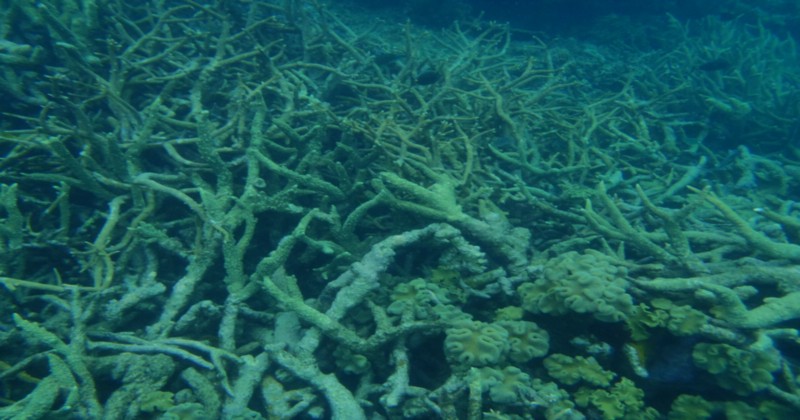
There are a billion reasons to feel optimistic about Australia’s Great Barrier Reef.
Prime Minister Malcolm Turnbull, now seeking reelection, announced Monday the creation of $1 billion fund to protect the Great Barrier Reef from the bleaching events that climate change and water pollution cause, the Sydney Morning Herald reported. An Australian dollar is about 74 cents in the United States.
The announcement comes three months after Australia’s government raised the bleaching threat for the World Heritage site to its highest level, as scientists said in March that bleaching off the coast of northern Australia was the worst they had ever seen. Meanwhile, Australia has been experiencing high summer and fall temperatures. In early March, high temperatures were about 4 degrees Celsius hotter than normal.
Coral Bleaching Hits The Great Barrier Reef After Australia Temperatures Break RecordsClimate by CREDIT: shutterstock Record-breaking temperatures in Australia have triggered a severe coral bleaching event…thinkprogress.orgLocated on the northeastern coasts of Australia, the Great Barrier Reef is the world’s largest collection of coral reefs. Some 1,500 species of fish and 4,000 types of mollusk thrive there. Reefs are living ecosystems made up of coral, solid limestone, coral sands, algae, and other organic deposits. But the Great Barrier Reef — similar to others across the world — has had a tough time in the last two decades as warming temperatures, more acidic water, overfishing, chemical runoff, and disease have sparked massive coral die-offs.
This year it’s been particularly catastrophic for corals, with reefs around the world suffering from the third recorded global coral bleaching event. This bleaching started in 2014 and is the longest recorded in history. To make matters worse, bleaching was exacerbated this year by a strong El Niño, which heated up ocean temperatures around the world, all while greenhouse gas-driven climate warming continues.

Similar to humans’ internal body temperature, all corals have a narrow temperature tolerance range before things start to go wrong. For corals that temperature range does not exceed 1°C to 1.5°C. As a result, fairly moderate temperature changes damage corals. “Climate change is the greatest long-term threat to the Great Barrier Reef and to all coral reefs around the world,” Turnbull said. “Australians are passionate about the Great Barrier Reef and the Turnbull government is committed to protecting it for future generations.” This is the first major environmental policy Turnbull has offered during his campaign. Turnbull, who belongs to the ideologically conservative Liberal Party, is facing Labor Party leader Bill Shorten in the upcoming election.
Labor announced its own reef rescue plan last month, promising to spend $500 million over five years, including $123 million already pledged by the government’s coalition and $377 million of new money. For his part, Turnbull says the proposed fund will build on $461 million in reef funding already committed. So far Turnbull has yet to deliver the robust climate change actions that many environmentalists had hoped for. Though he is considered an improvement from former prime minister Tony Abbott, who once called climate change “absolute crap,” Australia has lagged in its actions to the point that its emissions are growing, and will likely not peak before 2030. http://archive.thinkprogress.org/climate/2016/04/26/3769440/great-barrier-reef-bleaching/
But while emissions are for the most part invisible and easier to dismiss, damage to corals and water quality isn’t. This may explain why the fund aims to finance projects that reduce run-off of pollutants, fertilizer, and sediment into the oceans. Projects could include installation of more energy and water-efficient irrigation systems on agricultural land, which send runoff to sea and have been known to harm coral reefs worldwide. Other projects may include more energy efficient pesticide sprayers and fertilizer application systems, the Sydney Morning Herald said. The hope is to improve the resilience of the reef to climate change, bleaching events and crown-of-thorns starfish outbreaks through improved water quality. So far, water quality improvement has been insufficient, according to Australia’s ABC News.
However, studies suggest proper management can help corals heal, though any recovery is a fragile process tied to global weather trends. Globally, reef cover has in the last 30 years dropped by half, according to a World Wildlife Fund report published last year. Unless swift action takes place, the world’s reefs could disappear completely by 2050. The report singled out human-caused climate change and overfishing as the main culprits. The demise of corals would affect as many as 850 million people around the world who depend on reefs for food.
Australia’s elections are set for July 2.