The Syrian Army retook control of the entirety of Aleppo on Thursday, signalling the end of a four year standoff in Syria’s largest city. But while the battle for Aleppo is over, the war still rages on. And the capture of the city means the bloodshed could soon get even worse.
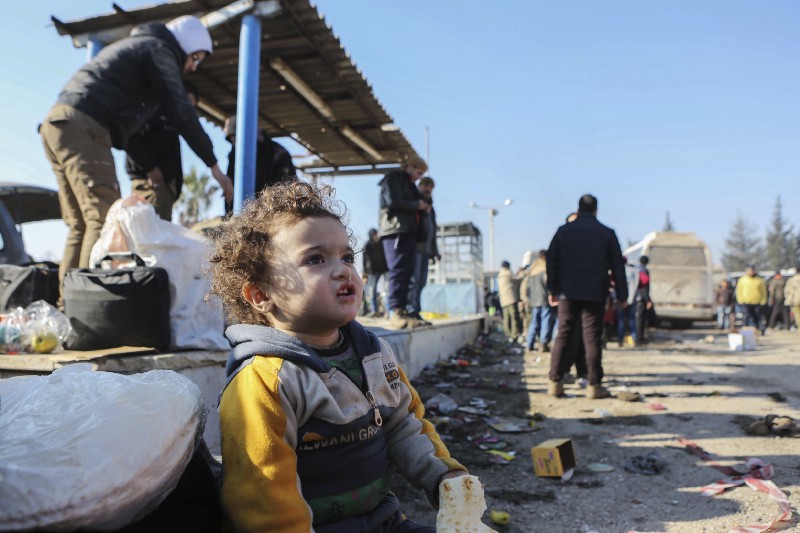
The last of the rebels and civilians inhabiting east Aleppo evacuated Thursday, traveling west to the Idlib province, which borders Turkey. Many fighters told media outlets that the loss of Aleppo signaled a major blow in their efforts.

“For the revolution, it is a period of retreat and a difficult turning point,” Yasser al-Youssef of the Nureddin al-Zinki rebel group, one of many opposition factions in Aleppo, told AFP.
Some of the fighters and other displaced people will surely try to cross the border into Turkey and start life over as refugees. Bana al-Abed, a 7-year-old Aleppan who shot to Twitter stardom in recent months, was recently photographed with Turkish President Recep Tayyip Erodgan. Some supporters of the revolution criticized Erdogan for the photos, accusing him of taking advantage of a vulnerable young girl for a shameless publicity stunt.
Now, with the opposition on the backfoot, Syrian President Bashar al-Assad’s regime could expand its war of attrition into other areas where rebels reside.
“The regime victory is a fatal blow to the opposition, at least in the sense that the rebels can no longer claim to represent a political and military alternative to the government of Bashar al-Assad,” according to a report from the Washington Institute entitled “Will Assad Target Idlib After Aleppo?” “The outcome will also strengthen the army and its allies by freeing up large numbers of troops, artillery, and Russian air capabilities, both to launch the next offensive and to better protect existing regime zones.”
Around 50,000 rebel fighters are currently thought to be in the Idlib province, a large area west of Aleppo that had a prewar population of 1.46 million people. The heavy rebel presence could make it a key target for the regime’s advances, but there are also other options on the table.

“Assad could be looking at several different fronts right now, including around Idlib, but also elsewhere,” Aron Lund, a nonresident fellow in the Carnegie Middle East Program who specializes in the Syrian opposition’s movement and military dynamics, told ThinkProgress. “Most pressingly, he has to do something about the loss of Palmyra and the risk of further Islamic State advances there. There are also tempting opportunities and pressing problems to address around Aleppo, like in the area to the northeast of the city where Turkey has intervened, and in the Eastern Ghouta region east of Damascus, and in the area near Homs.”
No matter which direction the regime and their allies decide to send troops or airstrikes, the war is far from over.
Syrian intellectual and author of the forthcoming book, The Impossible Revolution: Making Sense of the Syrian Tragedy, Yassin al-Haj Saleh said the fall of Aleppo signals a new stage of the Syrian crisis.
“[T]he Syrian opposition is weakened,” al-Haj Saleh told Democracy Now on Thursday. “We have still some [Free Syrian Army] FSA groups, but they are weakened and sidelined. And we need now, in my opinion, a different dynamic for inclusion, for reconciliation, for moderation, that — and this requires real and substantial change in the political environment in Syria, something that cannot be achieved while Bashar al-Assad is still in power.”
Russia and Assad’s regime leveled much of east Aleppo through a bombing campaign targeting hospitals and other civilian targets. Human rights groups have accused Russia and Syria of committing war crimes.
While bombing Aleppo, the regime and Russia used certain rhetoric to defend its actions. The regime called all members of the opposition terrorists, while pro-Kremlin mouthpieces like RT claimed civilians in east Aleppo were being used as human shields. (The Israeli government used a similar tactic to justify its indiscriminate attacks on Gaza in 2014).
Aleppo had no ISIS presence (they were expelled nearly three years ago) and only a minimal presence of Jabhat Fateh ash-Sham (JFS, formerly the Nusra Front) — no more than 200 and maybe fewer than 100 fighters, per Reuters. But that didn’t stop the regime and allies from launching relentless attacks on the city.
Should the regime attack the Idlib province, the international outcry may be more subdued than during the siege and bombardment of Aleppo. In Idlib, JFS — once considered Al Qaeda’s major Syrian affiliate, although whatever ties it has to the group are murkier now — has a stronger presence.
“We need now a different dynamic for inclusion, for reconciliation, for moderation, that cannot be achieved while Bashar al-Assad is still in power.”
With Aleppo now firmly back in the regime’s hands, the battle for the city is over. And according to al-Haj Saleh, the end of this battle brings other, more serious, implications.
“I think we are seeing a situation that will put an end to any political solution,” al-Haj Saleh said. “It is not the beginning; it is the end. It is a step further in putting an end to any political — any hopes for a political solution in Syria.”