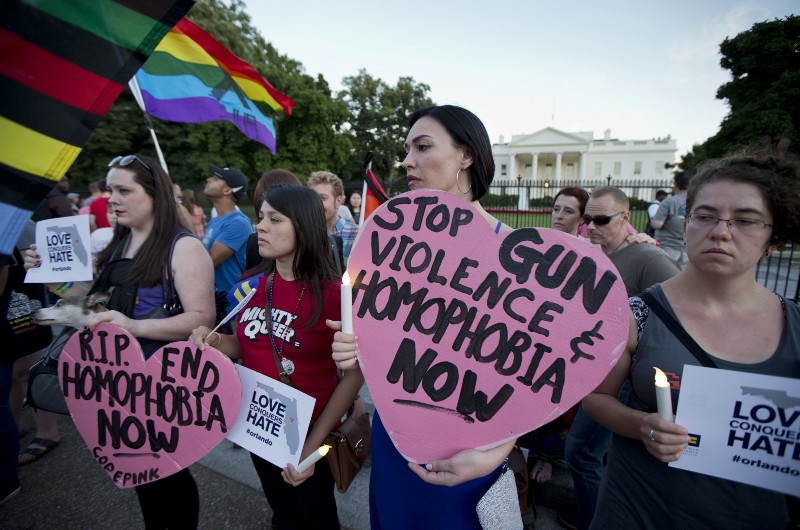
Just one day after a shooter targeted the LGBT community in Orlando, killing 49 people with legally obtained firearms, a Democratic senator is introducing legislation that would ban anyone convicted of a misdemeanor hate crime from purchasing a gun.
Sen. Bob Casey’s (D-PA) Hate Crime Prevention Act, the first gun control measure introduced after the shooting at Pulse nightclub, would add federal and state hate crimes to the list of convictions that prevent people from buying firearms. The ban would include anyone convicted of a misdemeanor motivated in part by hate or bias related to race, color, religion, national origin, gender, sexual orientation, gender identity, or disability, according to Casey’s office.
“If you have proven you will commit criminal acts based on hate, you absolutely should not have access to a gun,” Casey said in a press release. “It’s common sense.”
Only three states — Minnesota, Oregon, and New Jersey — currently prohibit people convicted of all hate crime misdemeanors from owning guns. Casey’s bill would extend that protection to the entire country.
More than 6,400 hate crimes were committed in the United States in 2014 and close to 6,000 in 2013, according to the FBI. Though the FBI is required to collect statistics on hate crimes, not all state and local law enforcement agencies provide it with data, so the actual number of hate crimes may be far higher. According to Casey, the National Crime Victimization Survey has recorded roughly 259,700 hate crimes per year.
In February, the Center for American Progress (CAP) released a report looking at the connection between hate crimes and guns, and found that firearms were used or threatened to be used in 43,000 hate crimes from 2010 through 2014 (Disclaimer: ThinkProgress is an editorially independent site housed at the Center for American Progress).
CAP also found that the majority of the more than 1.2 million hate crimes reported in the National Crime Victimization Survey from 2010 through 2014 were racially motivated and about a third were driven by ethnicity. Sexual orientation, religion, and gender also topped the list of most common motivating factors.
The same day that the report was released, Rep. David Cicilline (D-RI) introduced the Hate Crimes Prevention Act in the House, legislation that like Casey’s, would bar people convicted of hate crimes from obtaining guns.
“If you threaten a black family because of their race, you shouldn’t be allowed to buy a gun,” said Cicilline said at the time. “If you paint a swastika on the door of a synagogue, you shouldn’t be allowed to buy a gun. If you beat a gay person because they’re gay, you shouldn’t be allowed to buy a gun.”
Cicilline noted that misdemeanor hate crimes are often “a precursor for more severe attacks.”
Though the father of Orlando shooter Omar Mateen said in an interview that his son had expressed anti-gay sentiments after seeing two men kissing months ago, Mateen had no criminal record and would not have been barred from purchasing a firearm under Casey and Cicilline’s proposed legislation. Dylann Roof, who killed nine African American churchgoers in Charleston almost a year ago, had been arrested and charged with misdemeanor drug possession but had not been convicted of any hate crimes.
Nevertheless, the CAP report noted the number of gun crimes that could be prevented by prohibiting those with hate crime convictions from purchasing firearms, saying that the legislation is required “to help ensure the safety of groups that have historically been targeted because of their race, ethnicity, national origin, religion, gender, gender identity, sexual orientation, or disability.”