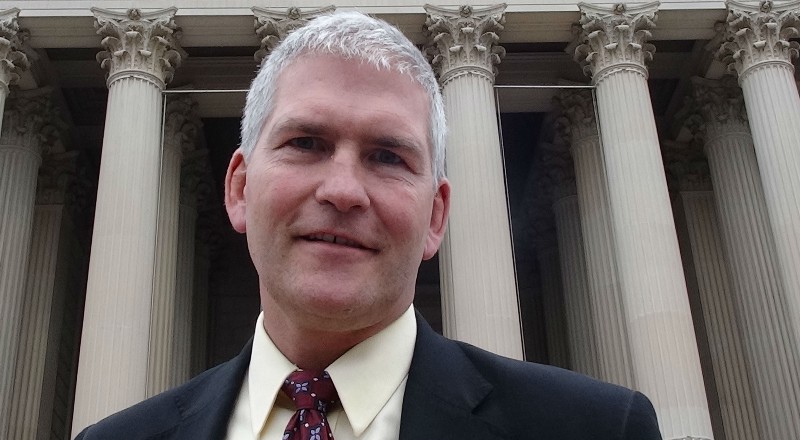
Unless you are a part of a certain legal community in Washington, D.C., you probably haven’t heard of Doug Kendall. Doug was a litigator, a public policy advocate and a nonprofit executive — jobs that meant he spent more time reading documents or meeting with groups of attorneys then he did earning national celebrity. But Doug, who died this weekend of colon cancer, was also one of the most significant constitutional thinkers in the nation. He identified a key flaw at the heart of liberal constitutional rhetoric, and, possibly more than anyone else in the nation, charted a path away from this flaw. American lawyers, or, at least, the American legal left, speak quite differently about the Constitution than we did fifteen years ago, and it is because of Doug Kendall.
For many years, liberal constitutional rhetoric fixated on two words: the “living constitution.” As early as 1912, Senator Albert Beveridge, the Senate’s leading proponent of child labor laws, spoke of how “the Constitution is a living thing, growing with the people’s growth.” During his 1967 confirmation hearing, Justice Thurgood Marshall explained that “the Constitution was meant to be a living document,” citing nineteenth century decisions holding that it should be “interpreted and applied as of the time that a particular factual situation came up.”
By the twenty-first century, however, this rhetoric had begun to wear thin, not necessarily because it was wrong — but because, by couching their arguments in a “living constitution” framework, liberals seemed to be conceding that the text and history of the Constitution was not on their side. In 2005, Slate’s Dahlia Lithwick noticed that the words “living constitution” were used as a slur far more often than they were in earnest. “A Nexis search for the words “living Constitution” turns up literally dozens of stories by conservatives bashing the premise into a hopeless pulp,” Lithwick wrote. “But it’s hard to find a creditable recent defense of the Constitution as something greater than the span of its own four corners.”
Which brings us back to Doug Kendall. Doug’s insight was that liberals can make the Constitution-as-written the centerpiece of their rhetoric, without having to give up on their preferred outcomes (or, at least, without having to give up on them most of the time). He founded and ran the Constitutional Accountability Center (CAC), which describes itself as “dedicated to fulfilling the progressive promise of our Constitution’s text and history.” Under Doug’s leadership, CAC, filed briefs arguing that marriage equality, Obamacare and broad civil right protections, among other things, are all consistent with the framers’ vision for the Constitution.
CAC’s Obamacare brief relies heavily on the writings of George Washington. Their marriage equality brief quotes the Federalist Papers.
Doug was not the first person to recognize that progressive values can be aligned with the text-and-history approach to the Constitution that, at least in recent decades, has come to be associated with conservatives. Nor did he claim to be the first to this insight. In its press release announcing Doug’s death, CAC credits Yale Law Professor Akhil Amar for laying the intellectual framework for the idea “that the text and history of the whole Constitution point our Nation and its courts in a progressive direction.”
Yet, while Amar’s undoubtedly made massive contributions to constitutional scholarship, the academy often functions as a windowless warehouse where ideas are stored but rarely seen by the outside world. Doug took Amar’s ideas and operationalized them. And he also offered progressive lawyers a way to talk about the Constitution that didn’t require them to sound like they were constantly trying to change it.
Admittedly, this new way of speaking about the founding document has not always paid dividends at the Court. Several years ago, shortly after Doug founded CAC, he told me that he named his organization the Constitutional Accountability Center because he wanted to hold judicial conservatives accountable to their own rhetoric. Responding to Justices Antonin Scalia and Clarence Thomas, for example, who insist that they root their constitutional decisions in how the framing generation would have understood particular constitutional phrases, CAC promised to deliver these two justices a pile of evidence showing that their own purported method of deciding cases should point them in a progressive direction.
At a litigation tactic, this proved less than successful. Scalia not only voted against CAC’s position in two major challenges to Obamacare, he betrayed the views he’d previously expressed in his own judicial opinions in both cases. The two originalist justices voted against marriage equality — twice. And they remain two of the most reliably conservative votes on the Court.
Nevertheless, one of the most important lessons that liberal laywers learned between NFIB v. Sebelius, the first assault on Obamacare to reach the Supreme Court, and King. v. Burwell, the second one to do so, is that a strong legal case can fall apart if its supporters lose the battle for public opinion. NFIB was rooted in a legal argument so weak that one conservative federal appeals court judge dismissed it for having no basis “in either the text of the Constitution or Supreme Court precedent.” Nevertheless, Republicans ran a brilliant PR campaign to sell this legally unsound case to the American people. In the end, that was nearly enough to convince a majority of the Supreme Court to take out the law. It was enough to convince them to take a significant bite out of the law.
The Supreme Court’s decision in King v. Burwell, by contrast, actually left Obamacare on stronger footing than it would have been on if that case had never been filed. The difference between the two cases was that liberals won the PR war in King.
So it matters a great deal whether a political movement can offer a theory of the law that, even if it cannot sway a particular judge or justice, can at least create a political environment where the justices fear how they will be perceived if they go out on a limb in a particular case. Doug Kendall understood this fact. He understood that liberals had long ceded territory that we did not need to concede. He built and executed a playbook that would allow progressives to retake this territory. And he taught a new generation of liberal lawyers how to follow this playbook even now that he is gone.