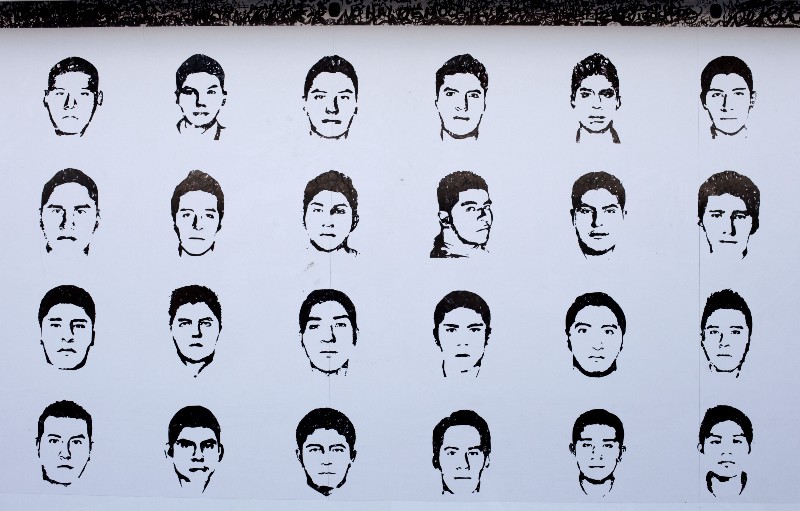
One year after 43 students went missing in Iguala, Mexico, Angélica González González still believes that her 18-year-old son is alive.
Her son, José Ángel Navarrete Gonzalez, was among the 100 students who traveled to Iguala on September 26, 2014 to raise funds for a protest against cuts to their state-financed teaching college, Ayotzinapa. Municipal police intercepted them, shooting and killing six students. Fifty-seven students were initially reported missing after the confrontation, though 13 eventually made it home and one name was accidentally counted twice. The attack has been described as one of the worst human rights tragedies in Mexico’s recent history.

“For me, my son is everything,” González González told ThinkProgress in a phone interview through a translator. González González was in the nation’s capital on a visit with other mothers of missing students to raise more awareness about their sons’ disappearance last year in Mexico.
“I love him deeply and what we’ve been living through has been very difficult and very sad,” she added. “But I have faith and hope that we’re going to find him. I talk with the other moms and I know that my son is alive. My heart tells me that he is.”
González González doubts the official Mexican government account of the attack on the Ayotzinapa students. The government claims that Iguala municipal police handed the students over to a local drug cartel known as the Guerreros Unidos, which later burned students’ bodies in a nearby garbage dump.
Amnesty International recently charged the Mexican government with deliberately covering up the attack on the convoy of buses. And a a six-month investigation by the Inter-American Commission on Human Rights concluded that the government’s account of the event was “scientifically impossible.” The Commission’s report suggested that the students were not attacked because they were on their way to protest government officials, but because the bus they took to Iguala was possibly filled with opium, as Iguala is a major heroin hub. It also suggested that Mexican federal police and military were involved in the disappearances of the Ayotzinapa students.
Although Iguala’s mayor José Luis Abarca Velázquez and his wife were arrested in connection with the forced disappearance of the students, many more who may have played a hand in their disappearance still have gone unpunished. The government’s response to the disappearances has been described as “limited” by Human Rights Watch and Amnesty International. Over the past year, protesters like González González have also taken to the streets calling for Mexican President Enrique Pena Nieto’s removal.
That was the last time I heard his voice and what we’re going through is just very hard.
González González said that she was given a special visa to come to the United States this month to speak with an unnamed congressional member about the findings in the new reported commissioned by the Inter-American Commission on Human Rights.
“We never lost hope,” González González said. “These reports help us keep on hoping and keep on having faith.” She said the congressional member was receptive to the findings in the report, though she also hoped to seek an audience with Pope Francis during his U.S. visit to urge him to intercede on the behalf of parents like her who are still waiting for answers.
“The last time I heard [my son’s] voice was on September 26,” she said. “I got a call from him during the attack. That was the last time I heard his voice and what we’re going through is just very hard.”