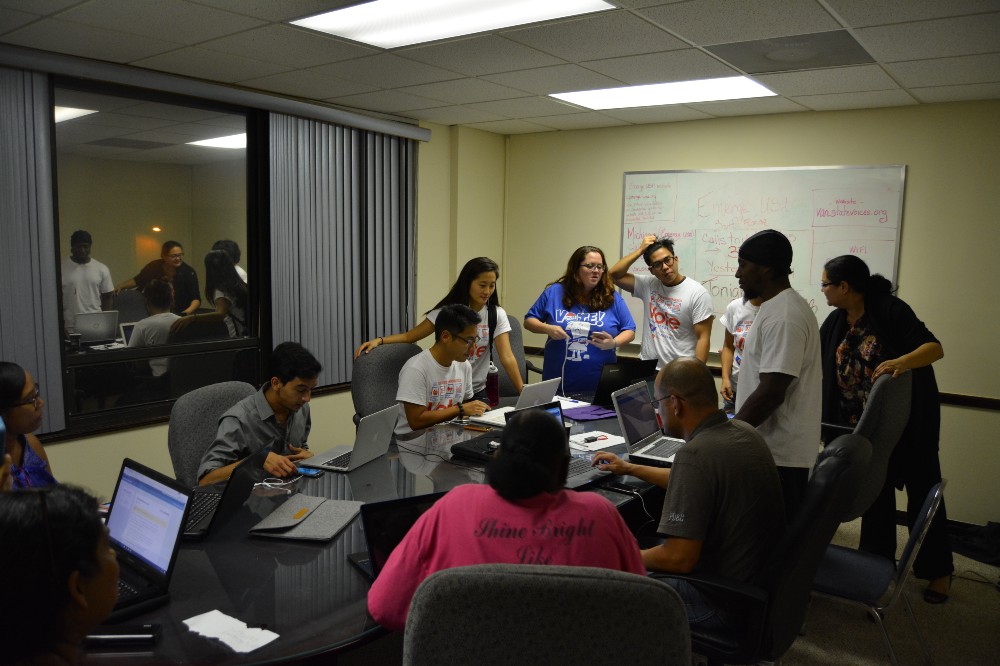
ALLENTOWN, PENNSYLVANIA AND MIAMI, FLORIDA — The Muslim community isn’t taking Donald Trump’s rhetoric sitting down, even if that’s the posture most conducive to phonebanking work.
On Saturday night in Miami, as the sun set on one of the final days of early voting, volunteers cycled in and out of one Muslim organization’s office, stopping for dinner and to place hundreds of calls asking other Muslims to get out and vote. Over a thousand miles away, volunteers in Lehigh Valley, Pennsylvania, did the same.
Five states have launched chapters of the national Emerge USA network, a non-profit working to engage Muslim, South Asian, and Arab Americans in local and national politics.
In Pennsylvania, where many Muslims trace their family roots back to countries in east Africa, the last weekend was crucial. Fatima Kermalli grew up in Fort Wayne, Indiana, after her family fled repression in Idi Amin’s Uganda. Now pursuing a Master’s degree in Pennsylvania, Kermalli said this election stands out from the past several with which she has engaged.
“They understand what he stands for. There’s no secret in it.”
“It’s bleak,” she said. “When you have candidates that are against minorities, with the Republican candidate Donald Trump and his outlook on certain groups of people, you have to be very vigilant and careful to make the proper choice because it will impact us.”
Kermalli says Trump’s rhetoric has her fellow Muslims “more tuned in” this year. “They understand what he stands for,” she said. “There’s no secret in it.”
Despite the ugliness at the top of the ticket, Emerge’s organizing work is grounded in a broader desire for civic engagement at all levels of public life.
“I tell people, vote your conscience. But make sure you vote the down-ballot, because that’s what affects locally,” said Emerge Pennsylvania board member Mohammad Khaku.
“We try to get young kids into a leadership program. Our kids, everybody wants to become doctors, engineers, nobody wants to be president,” Khaku said. “Maybe one day we’ll find a President Akbar, Mohammad is a president.”
Since moving to the area 36 years ago from London, the 65-year-old said he’s only personally experienced one frightening incident apparently triggered by his family’s religion and culture.

It was earlier this fall, and he couldn’t discuss it in detail because police decided to pursue charges despite his urgings to let it go. But the timing — after decades during which he, his four children, and his numerous nieces and nephews living in central Pennsylvania have felt in harmony with their community — doesn’t strike him as coincidence.
“Now, I go to the mosque and some people tell me stories,” he said. “I don’t know if it’s driven by Donald Trump or not, who can say. But it is on the rise. It is on the rise.”
More than a thousand miles away, in Miami, graduate student and Pakistani immigrant Mishka Ahmed said she has felt the entire country’s feelings about Muslim people change this year.
“The worst part of America is coming out,” she said. “Even if he doesn’t win, people will still be able to say things without a huge backlash.”
She highlighted the importance of the Muslim vote this year in swing states like Florida.
“We’re a significant part of the U.S. community and need to be represented,” she said. “If we really come out, it’ll push it over the edge.”

Olivia Cantu, who runs Emerge’s South Florida chapter, agreed. As the mother of a young daughter, Cantu said she wants to be able to raise her child in a country that honors her faith.
“This is not the America I grew up with, and this is not the America I want to raise my child in,” she said. “So I can complain, or I can do something about it.”
By working with Emerge, Cantu said she feels like she can change her community’s perceptions of Muslims. Her work has also allowed for some unique opportunities for her daughter, Mya Massoud, who was asked to recite the pledge of allegiance at a Hillary Clinton rally last month.
“She was just over the moon,” Cantu said. “She went with her hijab. I asked her what this means to her, and she said: ‘Mom, I’m a woman. I’m a Muslim. I’m Egyptian. I‘m Mexican. This means so much to me.’”
“I looked at her and I said this is why we do it.”