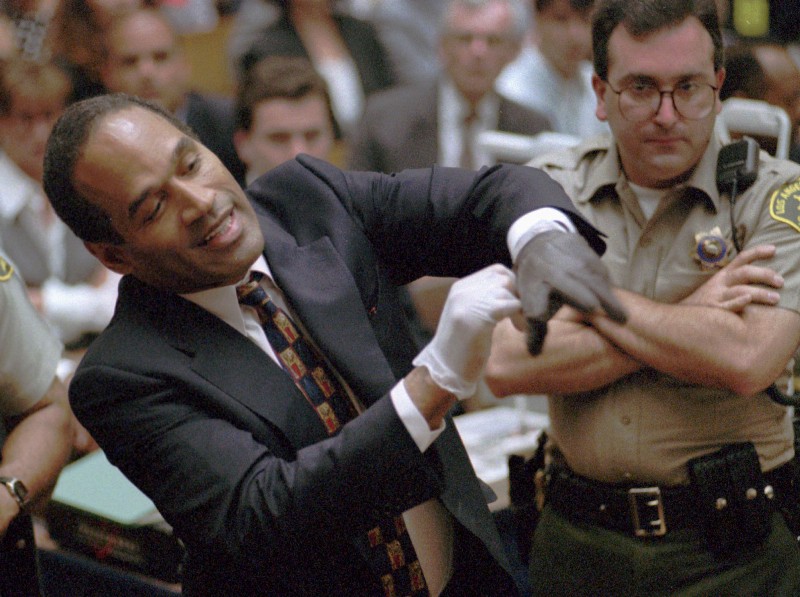
The five-part documentary O.J.: Made In America, which aired on ABC and ESPN last week, is harrowing from beginning to end. It goes into detail about the horrendous abuse by black people in Los Angeles by the hands of the Los Angeles Police Department in the early 1990s, thoroughly examines the privilege afforded to O.J. Simpson by his celebrity status, and shines a bright spotlight on the ways in which Simpson’s defense team overcame the damaging DNA evidence by exploiting the very real racial tensions of the time.
But, for me, the most impactful part of the documentary was its unflinching look at the perils of domestic violence. This film serves as a stark reminder of why it’s so important for all of us — police officers, lawyers, peers, family, friends, neighbors — to take the issue seriously, and to listen to women who say they’re in danger.
O.J. Simpson was a serial abuser, and all the warning signs were there.
If You’re Watching This, It’s Too Late: ‘We Are All Complicit’ In The O.J. Simpson CaseD o you remember how it felt to like O.J. Simpson? Not with a caveat, not with a qualifier, not with a we-can-never…thinkprogress.orgIn 1985, nine years before the murder, LAPD officer Mark Fuhrman — yes, that Mark Fuhrman — responded to a call to Simpson’s house. When he arrived, Simpson was on the left side of the driveway holding a baseball bat, while Nicole was sitting on the front of a car with the windshield smashed in, bawling uncontrollably. After coaxing Simpson to put down the bat, Fuhrman asked Nicole if she wanted to file a report. She didn’t. Fuhrman left the scene, but not before telling Nicole, “It’s your life.”
On January 1, 1989, Nicole called 911 in the middle of a huge fight with Simpson. Emergency dispatchers could only hear her screams on the call. When LAPD officer John Edwards arrived at the scene, Nicole ran out of the bushes wearing nothing but a bra and sweatpants, covered in mud, shivering to the bone, yelling, “He’s going to kill me.” That time, Nicole did want charges pressed against her husband — she told Edwards that officers had visited her house eight times before for domestic violence, but always just talked to Simpson and then left. She was worried for her life.
Simpson ended up pleading no contest to those charges, but still avoided jail time. He was “punished” with 120 hours of community service, which he completed by organizing and playing in a celebrity golf tournament.

Meanwhile, Nicole became stuck in a pattern that so many victims of domestic abuse find themselves in. She would try to leave, but she always came back. She thought she could change O.J. She wanted to keep her family together. She was afraid to leave the financial security he provided — not only for herself and their children, but for the rest of her extended family. She was afraid that if she did leave, everyone would side with Simpson.
Her fears were far from unwarranted — after all, the entire universe was telling her that Simpson still reigned supreme. The criminal justice system completely failed to inflict any punishment, and the media and Simpson’s family and friends reiterated the notion that Simpson was untouchable. Sponsors remained by his side. His sports commentating gigs remained intact. In one particularly cringeworthy ESPN interview showed in the documentary, Roy Firestone brought up the 1989 conviction to Simpson by saying, “So, the media is portraying you as a wife beater.” Simpson laughed off the incident as a mild fight between husband and wife, and Firestone quickly moved on.
Eventually, Nicole moved on herself, and Simpson didn’t take it well. On July 12, 1994, according to forensic experts used by the prosecution in the Simpson trial, he arrived at her apartment and knocked on the door. She opened it, expecting her friend Ron Goldman, and Simpson subdued her before she had a chance to react. He stabbed her four times on the left side of her neck. When Goldman arrived, he slit Goldman’s throat twice, before stabbing him repeatedly, then returning to Nicole and slashing her throat, nearly severing her neck. He then walked away — the pattern of footprints showed a steady gait.
One juror from the Simpson trial said she wasn’t sympathetic to the abuse Nicole suffered, because she had stayed in the relationship for so long.
OJ’s domestic violence was presented to the jury… Marcia Clark believed the jury "just didn’t care” #OJMadeInAmerica pic.twitter.com/rDwUIR8eWV
— ESPN Films 30 for 30 (@30for30) June 18, 2016
It’s tempting to dismiss this as a thing of the past, to say that if any of this happened today, things would be different. And, in some ways, that is true. Marcia Clark, the lead prosecutor in the case, told espnW that the reporting on the recent case of Stanford rapist Brock Turner — which sparked national outcry after Turner was sentenced to just six months in prison for sexually assaulting an unconscious woman — gave her hope that attitudes are changing.
Yes, they have. The fact they’re reporting on [Turner’s] case is a sign right there. The fact that the victim’s words were broadcast, that CNN is reporting on her statement, that wouldn’t have happened 15, 20 years ago. The fact that we’re talking about it today. Bad things happen still, but our awareness of the fact that they are bad and remarking on that is a sign of progress in my opinion. And I have seen a difference in the way we handle these rape cases, domestic violence cases.
It used to be if the victim recants, we walk away. [Now] we’ll put on the police officer to impeach her testimony. If she gets up and says nothing happened, I’ll put on the cop that took her statement and he’ll say, “That’s not what she told me, and at that time she was bleeding.” We no longer let those crimes get swept under the rug as much. That’s not to say things are perfect, but they’re better.
But the statistics surrounding domestic violence are still incredibly bleak. The National Coalition Against Domestic Violence reports that on average, nearly 20 people per minute are physically abused by an intimate partner in this country. One in three women will be the victim of domestic violence in their lifetime. About 4,000 women die each year because of domestic violence — and about 75 percent of the time this happens as the victims attempt to leave the relationship or after it ends.
And while things have improved somewhat since the video of Ray Rice punching his wife became public nearly two years ago and the sports leagues and media members started to become more informed on the subject, there is still a long way to go. Fans and reporters are still susceptible to being charmed by athletes — just two months ago, ESPN reporter Adam Schefter conducted an interview with alleged abuser Greg Hardy, and afterwards bragged about how the NFL star was a changed man, despite the fact that Hardy did not even admit to abusing his ex girlfriend.
Just last October, police pulled over former Cleveland Browns quarterback Johnny Manziel and his girlfriend while they were fighting in the car. Despite the fact that his girlfriend was heard saying she was “in fear for my life,” the police let Manziel drive off with her in the passenger’s seat, and no charges were pressed. Baylor University is still reeling from a sexual abuse scandal caused by police and school administrators repeatedly ignoring or discouraging reports of violence against women by esteemed football players.
And, while the media may have been smarter about covering the Brock Turner case, don’t forget — he’s still only serving a few months in prison.
If there is any progress, it’s slow. We still, for the most part, don’t want to believe women when they say they are in danger. We don’t want to believe that famous, beloved athletes or actors could be responsible for horrific acts of violence. We find it easier to excuse and move on.
As this documentary shows, we simply can’t afford to do that anymore. When it comes to violence against women, it’s very much a life or death situation.