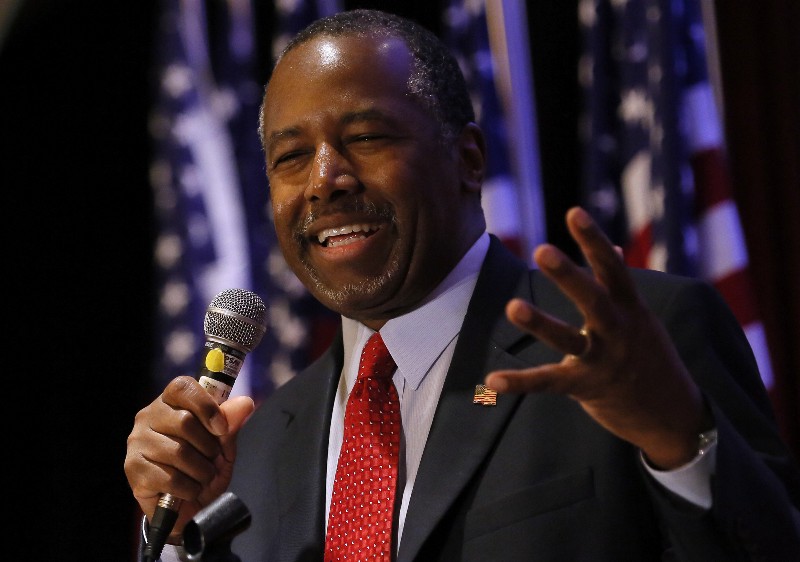
Lost amid the last night’s Republican presidential debate was a surprisingly progressive proposal to benefit minimum wage workers across the country.
Asked about the minimum wage, retired neurosurgeon Ben Carson expressed not only a willingness to increase it, but also supported a far more progressive idea than Republicans typically support: tying the minimum wage to inflation.
“I was asked should [the federal minimum wage] be raised, I said, probably, or possibly. I said we need to get both sides of this issue to sit down, and talk about it,” Carson said. “Negotiate a reasonable minimum wage, and index that so that we never have to have this conversation again in the history of America.”
Currently, the federal minimum wage is not tied to inflation; the only way it goes up is if Congress manages to overcome persistent gridlock and agrees to an increase. Though raising the minimum wage is exceedingly popular among the American public, Congress has only voted for one increase in the past two decades.
As a result, inflation has eaten into its purchasing power. For example, had the 1968 floor of $1.60 per hour been indexed to inflation, it would be $10.90 per hour today, more than 50 percent higher than the current minimum wage of $7.25.
Automatically raising the minimum wage wouldn’t just benefit low-wage workers, David Cooper, a senior economic analyst at the Economic Policy Institute, told ThinkProgress; it would also benefit businesses that employ them. “A lot of business owners are in support of indexing the minimum wage because it gives them a small, predictable increase in the minimum wage that they can plan and account for,” he said.
Though most Republican lawmakers support neither increasing the minimum wage nor indexing it to inflation, a few notable figures have broken with that orthodoxy. Mitt Romney, the 2012 Republican presidential nominee, backed automatic minimum wage increases, to the ire of rival Newt Gingrich. In addition, Rep. David Jolly (R-FL), who is vying for Sen. Marco Rubio’s (R-FL) seat in 2016, has proposed tying the minimum wage to inflation.
Still, Cooper cautioned, “the important thing to remember is you have to index it at the right level. Today’s minimum wage is a poverty-level wage, and indexing it at current levels would not be a smart thing to do.” In other words, indexing a $7.25 minimum wage would ensure that low wage earners don’t get poorer, but it would still keep full-time workers mired in poverty. “We need to raise the level to a minimum level and then index it from there,” Cooper said.
Carson’s minimum wage proposal wasn’t entirely progressive, though. The former neurosurgeon also advocated for a two-tiered minimum wage that would allow lower wages for younger workers, a problematic idea for the millions of young workers already earning sub-poverty wages. At the current $7.25 level, there is no state in the country where a full-time minimum-wage earner can afford a one-bedroom apartment, according to the National Low Income Housing Coalition.
But his support for automatic minimum wage increases is all the more surprising considering his rivals’ opposition to the mere existence of a federal minimum wage. Former Florida Gov. Jeb Bush and former Hewlett-Packard CEO Carly Fiorina both want to eliminate the federal minimum wage, while Wisconsin Gov. Scott Walker took the more moderate position that he doesn’t “think it serves a purpose” but wasn’t “going to repeal it.”