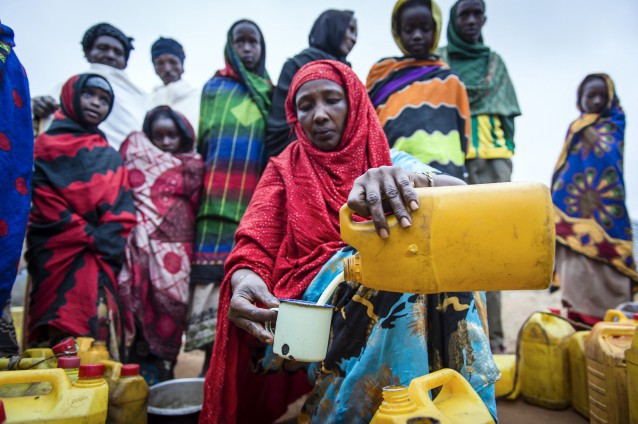
Goats bleat in the background as two college friends banter in the opening of a new radio series for rural Ethiopian communities that’s part soap opera and part public service announcement. Launched last month, the “edutainment” project is combined the development know-how of the Portland-based aid organization Mercy Corps with the entertainment prowess of Warner Bros.
“I can see that you have already finished all your job for the day,” Anihabba, a medical student told his friend Asiya in the first episode of the series. Seeing that she had finished vaccinating livestock, he toyed with her, asking for a hello — or just some attention. “And now it my turn to be saluted by ‘Good Morning,’ Asiya.”
“Whose duty [do] you think [it is] to salute first? Is it the one who comes [wandering up] or the one who is at work?” Asiya answered with a jab against her friend for lazing around while she worked. The two haven amicable relationship that Asiya wants to be something more, but only brings up in friendly banter to guard her feelings.
The playful tone faded as the two began to talk about some of Anihabba’s family’s livestock, who Asiya said look sickly. She’s working for the summer as a veterinary apprentice and part of her job is to provide medical care for sick livestock. That’s welcome for Anihabba who is training to be a doctor himself — and wants as little to do with the herds as possible.
As college students, Anihabba and Asiya are more educated than most of those around them. Their formal learning puts them at odds with some in the village, who feel that their experiential understanding of livestock is more important than what the two have learned in books. One of the most hostile to veterinary and medical care is Anihabba’s father.
“Who told you to give vaccines and medication to my herds?” Anihabba’s father said as he stormed in on a lunch Anihabba and Asiya shared. “Who do you think you are? You think you know so much about animals after three years when I have had my herd for 30 years?”
The importance of caring for livestock — and debates over how best to do so — are familiar to many in rural Ethiopia. Around 80 percent of rural Ethiopians rely on livestock for their sustenance. The products and sale of animal products account for an average of 80 percent of their income. In such a situation, losing even a single milking animal can be devastating.
As important as livestock is to the livelihoods to the vast majority of Ethiopians, their well-being extends well beyond financial concerns alone. In fact, taking proper care of one’s livestock so often means taking care of one’s family, or even community — and not just in an economic sense.
Most human infections and diseases are acquired from livestock. That transferal is known as zoonoses, and Ethiopia is a hotspot for them according to a 2010 study by the International Livestock Research Institute.
“From cyst-causing tapeworms to avian flu, zoonoses present a major threat to human and animal health,” Delia Grace, a veterinary epidemiologist and food safety expert who headed the zoonoses study said. “Targeting the diseases in the hardest hit countries is crucial to protecting global health as well as to reducing severe levels of poverty and illness among the world’s one billion poor livestock keepers.”
Along with Nigeria and India, Grace put Ethiopia in the top three countries affected by zoonoses — which also happen to be countries with the highest numbers of poor livestock keepers and malnourished people. And there’s a clear connection between zoonoses, malnourishment, and poverty.

For example, one-third of diarrhea cases around the world have zoonotic causes. More than 38,500 Ethiopian children under five die of diarrhea each year. Since the perceived cost of treatment and distance from healthcare facilities are the top reasons why Ethiopians go without medical care, the cycle of infection, ailment, and lack of treatment comes full circle.
The radio series informs listeners of how to care for their livestock while also teaching them how to stave off malnutrition while also hitting on the sorts intergenerational conflicts and star-crossed relationships that reel in listeners. By doing so, it works to break the cycle of illness and poverty in Ethiopia — in a way that’s engaging.
So far, it’s been a hit.
“I am happy about this drama, because it is our story — of the pastoralist people, and of our children,” Jarso Barako, who attended a listening group session of the series’ first episode in the Oromia region. “The story talks about the education of our children, particularly [Anihabba] — how he earned a good grade during his education, and how [Asiya] praises him. We also want others to follow like [Anihabba] and [Asiya], to make good grades in school and do well in their lives.”
“This initiative taps into the strong Ethiopian tradition of oral storytelling and harnesses the power of stories to entertain and educate,” Dominic Graham, the Ethiopia Country Director for Mercy Corps said. “Our goal is to help people facing repeated drought, hunger and poverty improve their long-term health through better decision making. Healthy and well-nourished people are better equipped to care for themselves, their families and their communities.”
The series zeroes in on key issues like vaccinations for animals, eating well during pregnancy, and even touches on notions of gender equality through incorporating strong female characters. The radio series has aired in three different parts of Ethiopia in the three different languages spoken in the country’s Afar, Oromia, and Somali regions. The characters were slightly modified for each of these regions so they would be relatable — and seem to have come out of the context the series aimed to address. Warner Bros. led the script-writing process, and developed posters and other promotional materials on a pro bono basis. It similarly collaborated with Mercy Corps on a two-year long campaign called “We Can Be Heroes” to address hunger in the Horn of Africa.

For many at Warner Bros. this meant applying the skills they already had to a very different task.
“Working at Warner Bros. in the TV marketing department, a lot of times we put our knowledge and experience to use in marketing a TV show and our goal is to get better ratings, and to get more viewership.” Albert Bugoff, Warner Bros.’ Director of Digital Media said in an interview shared with ThinkProgress. “When this project came along — and it was sort of the same thing: to get viewership, to get people to listen, but there was an educational element to it, there was a moral element to this [by] making people aware of nutrition and better livestock.”
“These are the kinds of things that make the world a better place, make people healthier and happier. It gave me a sort of excitement,” he said, “[To think that] that I could be using my skills as a marketer to make the world a better place in some way.”
I think we should always be in the business of enacting change in how we do our work as well as in the world.
The partnership helped some at Mercy Corps think about their jobs in new ways as well, and realize that grassroots information campaigns and service distribution may not be the best way to reach people.
“If it’s not [new and exciting and scary then] you need to take a breath and do it again because if not, then we’re not pushing forward and we’re not pushing the envelope,” Allison Morris, who directs corporate partnerships at Mercy Corps said. “I think we should always be in the business of enacting change in how we do our work as well as in the world.”
And the new approach seems to be working.
“Our people around here are pastoralists, and many don’t have formal education. They don’t know everything the need to know about their lives and livelihood. So this drama is entertaining people, but also has strong messages that teach our people. So it will help us to support one another,” Galma Teche, who attended a listening session in the Oramia region said. “It tells us about the health of our family, and health of our livestock. It teaches us about our future, so we can reflect, and see ourselves, so we can improve our lives.”
Some, may be hostile to new veterinary techniques at first. But like Anihabba’s father, they may well come around to them.