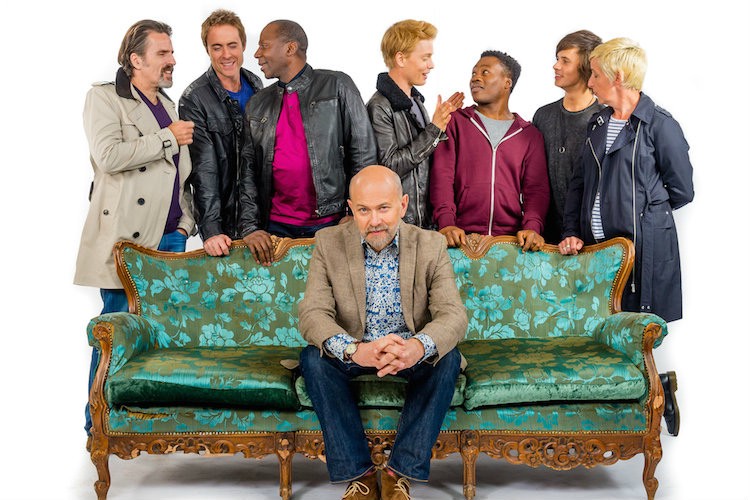
Two new gay-focused television shows from creator Russell T. Davies, Cucumber and Banana, will premiere Monday night on LOGO TV. The two shows originally aired on Britain’s Channel 4 earlier this year, alongside a web series called Tofu. All three take their names from the Erection Hardness Scale developed based on research on erectile dysfunction.
Cucumber is an hour-long serialized dark comedy — or perhaps whimsical drama is more accurate — that features a middle-aged gay man, Henry, who hits a significant bump in his nine-year relationship that forces him to confront some issues he still has with his identity. He connects with a group of young LGBT people, whose own stories are further explored in non-serial vignettes on the half-hour Banana. Tofu, though not airing in the U.S., offers short real-world conversations about the culture of sex, featuring actors from the series as well as other members of Britain’s LGBT community.
Davies is perhaps now best known in the U.S. for devising the 2005 reboot of Doctor Who and its spin-off, Torchwood, but he is also responsible for the original Queer As Folk that aired in Britain before being adapted into the U.S. version. He spoke with ThinkProgress Thursday about the current state of gay television, how attitudes about sex are changing, the visibility of intersecting identities, and his next big project.
I want to start by asking you about a different show, HBO’s Looking, which was just canceled here in the states. Many said it was boring or unrepresentative of the experiences of gay men. How would you describe the current state of gay television?
I loved Looking… It was a subtle piece of work, and I think, frankly, now that it’s over I can just be blunt and say that it went over people’s heads. And if you didn’t get it, you’re a bit dumb. Because it was really subtle, really beautiful, really cleverly written, and seriously, I would suggest that if you didn’t get it, take a deep breath, go back and watch it again. You know, if you’re looking for cliffhangers and great big chase scenes and explosions, you’re not going to get it. It’s a story in which if someone chooses to have mac & cheese instead of a salad, they’ve just made a very big decision in their lives. I thought it was brave and beautiful and wonderful and beautifully acted and written and I’m so glad they’re going to close it up with a movie. Anything that gives us an Andrew Haigh movie is brilliant. So I hope it’s well remembered, and it is relevant, because it’s well-remembered by me, and that’s all I care about.
I kind of think we seem to always be on an upward path. It might be a slow upward path, but there are people doing brilliant work. I spent last night catching up with How To Get Away With Murder from the Shonda Rhimes stable, which has a fantastic gay man in it who’s so beautiful. Please will he go out with me!? I love that character. He’s cheeky and selfish and venile and a murderer as well. I just love it; I think it’s a gorgeous piece of work. And you know, to see that on a major network is slowly but surely, step-by-step, a major breakthrough. I love it. There will always be stuff that will disappoint us; there will always be stuff that makes us roll our eyes. But that’s exactly the same with straight people! Straight people are completely used to watching dramas and going, “Oh, that’s rubbish.” So there will always be moments of that, and actually, we’ll always keep moving onward.
There are so many gay writers out there — so many gay men and gay women typing away at their keyboards right now. They’re demanding to be heard and… the thing about the world these days — this digital, multi-platform world — is that they will get heard. Everyone is finding their own platform. If they can’t see it on the networks, they make their own up, and that’s brilliant. Good day, Zack! Exciting day!
In Cucumber, the main character, Henry, struggles with a significant aversion to anal sex, which seems to largely symbolize his generation gap from the younger characters on the show. How do you think that young gay men think differently about sex given they didn’t live through the height of the AIDS crisis? How does the echo of that affect how they build their sex lives?
It’s kind of ongoing. We’ll find out as the generations move on. I haven’t got any magic answers to that. But also I think there have been men like Henry for thousands of years. He does have an aversion to anal sex. He does have a certain amount of fear and a certain amount of shame that he carries with him, and that’s what a lot of the program explores, with a lot of comedy and fun as well.
But I think it’s almost too easy — he mentions the AIDS crisis himself, he brings it up in episode 4 as a formative part of his youth — but I think if that hadn’t come along, I still think Henry would have the problems that he’s having. I think it’s an easy solution to say, “That was the problem,” because we’re a minority, because we’re captive, we haven’t got the language, we don’t quite know our own identity. So, whether that’s going to disappear with younger generations, I don’t know, because it’s a bit too easy to assume that just because young people have the law on their side, because they have equality (in theory), means that all their problems are over. And that’s all physical hangups, emotional hangups, relationship hangups — that’s the human race.
The straight people have had equality, and marriage, and they’ve been allowed to join the army for thousands of years. And they’re not fine. The whole of drama is marvelously fueled by the fact that straight people have problems, doubts, anxieties, and lacks of self-confidence or too much self-confidence, or they’re heartbroken or lovelorn or whatever. That’s the foundation of straight drama since forever. I think gays are now just catching up with that and so I think that’s our territory too. It isn’t just about the politics, it isn’t just about the laws, it isn’t about the state passing legislation that allows us to do something in public. It’s about life; it’s about who we are. So, I think one thing that comes out of Cucumber and Banana, which between them, do explore different generations, is that no one is perfectly happy, and never will be. And that’s where drama is always at it’s richest, I think.
Cucumber and Banana prominently feature several lesbian storylines, a prominent bi character in Freddy, and also a transgender character, who was the first on British television to be portrayed by a transgender actress, Bethany Black…
Indeed, I think it might be the first network drama ever in the world to have a trans character played by [a trans actress], as opposed to a digital platform or something, so we’re very proud of that! Bethany Black, who plays Helen.
How do these experiences fit in with the gay male focus of the shows, and why did you feel it was important to include them?
Well, when I wrote Queer As Folk 16 years ago — the original British Queer As Folk — when that went out, there was a great chorus of voices from other parts of our community protesting that they weren’t included in the drama. Quite fairly! You know, it wasn’t really a surprise to me. Quite naturally, lesbian voices raised up, saying, “We’re not represented.” Some trans voices raised up — less so 16 years ago, I have to say. But, you know, older people and younger people feeling they weren’t represented by it, and that’s a long argument there about whether gay dramas should represent us all or not. But nonetheless, that always happens any time a gay character, a gay drama, a gay story comes along, there will be those powerful voices, many voices, looking for representation of themselves.
So when I was young, when it was Queer As Folk, I kind of shrugged it off. Sixteen years later, I’m a bit older, a bit wiser, and have a bit more of a wider view of the world, and I kind of thought, “This will happen again.” Instead of just shrugging that off, maybe I could do some good work by answering that, by including lesbian stories and trans stories. And I had those stories I wanted to write myself! So this isn’t just — I’m not being nice and fair. For example, episode 2 of Banana is one of the nicest things I’ve ever written, if I may say so myself. It’s about a lowly, insecure 19-year-old black lesbian, and I think I wrote that very very well. The last episode of Banana, which I wrote, is about a 62-year-old lesbian. So I had these stories myself that I wanted to write that couldn’t fit into Henry’s story, or it would just be a pinball to popular interests. They have to be valid stories in their own right.
So I’ve got Banana as a separate show to Cucumber in which to tell these stories. It’s a nice mosaic in the end. It’s a nice view of the world. It’s quite a snapshot of 2015, I hope.
There are a number of prominent characters of color, like Lance and Dean, and Scotty on Banana, but aside from a few references to stereotypes, there isn’t a lot in these shows about their experiences as people of color. How did you go about casting roles like Lance and Dean, and do you have any plans in the future to explore the intersections of race and sexuality?
Sure! Yes! I’m up for any sort of story, and it’s an absolute policy of mine to include people of color — actors of color and characters of color — in these things, because as a middle-aged white man, I know that I can too often present a middle-aged white world on screen. And I think as you get older, you have to be more careful and represent these things.
I know what you mean about, “there aren’t any specific race stories,” and such, but that was absolutely deliberate, because I think you do see those stories on screen. They’re done very well in lots of dramas, but actually it’s also time to see characters simply living their lives, simply having boyfriends, falling in love — not the same old stories that you see about culturally trouble with the parents, culturally being from a more repressed background, you might want to say if you’re dealing with a stereotype, certainly. I think by ignoring specific racial origins — actually, I hope it’s taking a step forward. We’ve all got the same problems, every single one of us, it doesn’t matter where you’re born. You could be from the North Pole but you’ve got this problem. You, and your lover, and your sex life, and your sexuality — let’s talk about that. So I hope it’s a step forward.
What is something you were able to write into Cucumber or Banana that you could never have gotten away with in Queer As Folk?
That’s interesting. I think a large tentpole of what Cucumber is about is Henry’s fear of anal sex and fear of gay sex and fear of penetration — as a human being, never mind just as a gay man. The man is frightened of being penetrated in any way, shape, or form! Sixteen years ago, I’m not sure politically we would’ve been ready to talk about that. I think that then, given how underrepresented gay men were onscreen, that would have been a very odd portrayal of a gay man, to have been one of the outliers of our representations.
So I think mainly Henry. That took me another 16 years to kind of think about that, and to find men like that and talk to them, and research them, and get to analyze why they are like they are. Maybe it’s not so much a question of the world being ready, just of me being ready to write about that.
What can you tell us about The Boys, the next project that you’re working on?
Maybe I can tell you that not a word has been written yet! It’s kind of this year’s project and I’m sitting right in front of a stack of books, every word of which must be absorbed. It’s about AIDS, it’s about AIDS in Britain, it’s about the 80’s, HIV and AIDS, and the emergence of that. There seems to have been a lot of American dramas about that — The Normal Heart, Angels in America, and even Tales of the City — and apart from cropping up in our soap operas, it really hasn’t been told much here. That, obviously, is the generation that I lived through and I experienced. I’m thinking very much about my own reactions to those times. We’re all still thinking about our reactions to those extraordinary times. They seem more extraordinary the further away we get from them, to be honest. We survived a war.
That’s going to be a big project. I hope it’ll be good! I promise everyone that I’ll work hard on it and that’s all I can promise right now.
Cucumber and Banana premiere Monday, April 13 at 10pm/9pm CT on LOGO TV.