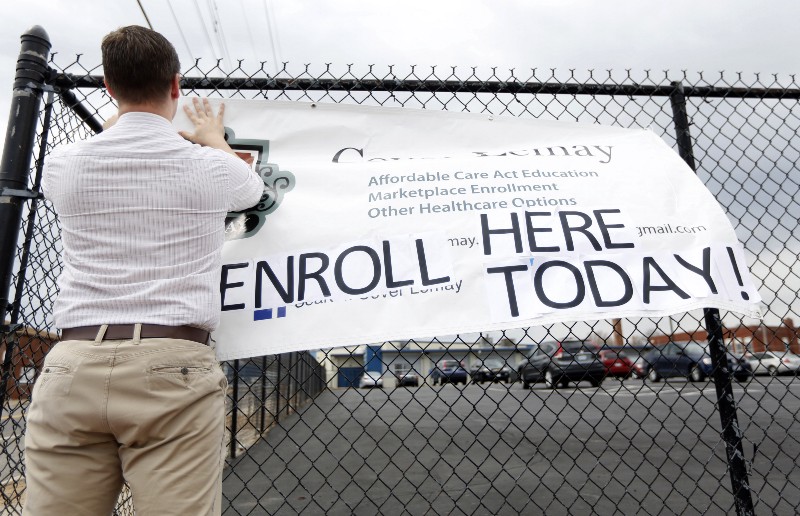
Five years ago, President Obama signed the landmark Affordable Care Act into law. Since then, the law that’s come to be known simply as “Obamacare” has survived a Supreme Court challenge, stumbled through a rocky website rollout, weathered massive political misinformation campaigns, withstood dozens of repeal attempts, and ultimately extended health care to millions of Americans who used to be uninsured.
But even after five years under Obamacare, widespread misperceptions remain about what exactly the law does. And according to new polling conducted by Vox, the people who don’t understand how Obamacare works are less likely to know how it’s affecting them. Unsurprisingly, some of this information gap tends to fall along party lines.
So, on Obamacare’s fifth birthday, here’s how health reform is faring:
More than 16 million people have gained insurance.
According to the most recent data from the Obama administration, about 16.4 previously uninsured Americans have gotten coverage under the law, either by purchasing private plans on the new state-level marketplaces or by gaining public insurance through the Medicaid expansion. That translates to a 35 percent reduction in the national uninsured rate, which is the largest drop in the number of Americans going without health care over the past four decades.
You don’t have to take the Obama administration’s word for it. In addition to the federal government’s data, multiple outside surveys have confirmed dramatic drops in the uninsured rate thanks to Obamacare.
Health reform is costing less than expected.
Earlier this month, the Congressional Budget Office (CBO) announced that implementing Obamacare over the next ten years will cost $142 billion less than the nonpartisan agency had previously predicted. That represents an 11 percent reduction from an earlier CBO projection released at the beginning of this year — and stands in sharp contrast to Obamacare opponents’ dire predictions about how the law was going to cripple the economy.
CBO officials have repeatedly slashed their cost projections for the law, largely because of a historic slowdown in national health care spending over the past several years that’s resulted in slower premium growth. There are multiple factors contributing to the dramatic slowdown in annual medical costs, and it’s unclear exactly how big of a role the Affordable Care Act has played. But the cost saving provisions included in Obamacare certainly haven’t hurt.
Employers aren’t cutting their workers’ benefits.
Over the past several years, several high-profile restaurants and corporations have blamed Obamacare for their decision to cut back on workers’ hours, leading to serious concerns over the health care reform law’s potential impact on hourly workers. But the dire predictions that Obamacare would lead to a “part time economy” haven’t come to fruition.
Employers have not cut benefits due to the health law, according to a new survey conducted by benefits consultant Mercer that was released this week. Mercer found that the average enrollment in company’s health plans was essentially unchanged between 2014 and 2015, hovering around 74 percent of all workers. And previous research from the Center for Economic and Policy Research has confirmed that employers aren’t cutting back on workers’ hours to avoid the law’s coverage requirements for full-time employees.
Americans aren’t getting their plans cancelled.
Obamacare opponents claimed that the law was going to result in tens of millions of Americans receiving cancellation letters. It’s true that some private market enrollees were required to purchase more substantive plans, since their former policies didn’t meet the minimum standard for benefit requirements established by the health reform law. But — in contrast to the dire predictions that every American who liked their plan would not be allowed to keep it — they ended up representing just a tiny portion of overall insurance policyholders.
Just about 2.2 percent of the Americans who purchased coverage on the private market had their policies cancelled last year, according to a report from the nonpartisan Urban Institute that was funded by the Robert Wood Johnson Foundation. That works out to be about 400,000 people. The researchers said there was no evidence to suggest a “significant number of policy cancellations” in 2014, and they don’t expect this to be a big issue moving forward, either.
Early evidence suggests the law is making people healthier.
According to a recent analysis from the New York Times, there isn’t enough data yet to definitively say that Obamacare is making the nation healthier, which is perhaps the law’s “loftiest and hardest to demonstrate” goal. But there is some preliminary evidence that this is starting to happen among some populations.
Young people who have been able to remain on their parents’ plans until the age of 26, for instance, are reporting better mental and physical health in the aftermath of health reform. Research suggests that young Americans have been able to increase their use of mental health services under the law. A different study released this week found that the states that agreed to expand Medicaid to extend coverage to additional low-income Americans are seeing a huge surge in diabetes diagnoses, suggesting that the law is allowing previously uninsured people to go to the doctor and get screened for health conditions that otherwise would have gone unchecked.