“Ramadan is not a time for bloodshed,” a recent article featured online by The Atlantic declares. Caner K. Dagli, the religious studies professor who wrote the piece, rightly asserts that most Muslims attempt to cultivate a sense of inner peace and practice spiritual reflection during their daylight abstention from food, water, and sex. His comparison of mainstream adherents view of Ramadan, however, as a time of tranquility to militant extremists’ calls to increase attacks reflects a shortsightedness that implies that groups like ISIS, which calls itself the Islamic State, only overstep the decree of Islam by infringing on the holy month’s sanctity, when in fact, their transgressions are far more dire than that.
“For most Muslims around the world, the month of Ramadan marks a yearly renewal, a time to turn inward in spiritual reflection, upward to God in worship, and outward toward other human beings in acts of charity,” Dagli writes.
That’s true. But by citing the fact that ISIS bids its militants to engage in “cruelty and aggression” during Ramadan implies that everything else ISIS does is perfectly permissible. Without recognizing that the entire modis opperandi of the militant group is their own tainted strain of the faith, Dagli implies that ISIS’ only sin is to have refused to keep their inner cool during the holy month when they are guilty of so much worse than that.
By continuing to bring discussions of ISIS’ theology into conversation with the beliefs of most Muslims, militancy is brought into the fold of Islam in a way that only serves militants by offering a nod to their claims to being the rightful guardians of a religion they have in fact bastardized beyond recognition.
As Dagli himself notes, the point isn’t whether or not the actions of ISIS can be deemed Islamic or not. That debate was had in so many words in The Atlantic earlier this year. Dagli, who teaches at the College of the Holy Cross offered his own perspective at that point, and notes that there’s a big difference between those who invoke Islam and the actual precept of Islam.
“The first thing I teach my undergraduates is that the English word ‘Islam’ has two distinct but related meanings: the ‘Islam’ that corresponds to Christendom (the civilization) and the “Islam” that corresponds to Christianity (the religion),” he writes in his article on Ramadan.
He goes on to say that ISIS and its fellow Islamist extremist groups might draw from Islamic teaches, but they do so very selectively in order to meet their own aims:
What distinguishes the interpretive approach of groups like ISIS from others is not its literalism (Sufis are indeed the most “literal” of all such interpreters of the Quran) but its narrowness and rigidity; for the adherents of ISIS, the Quran means exactly one thing, and other levels of meaning or alternate interpretations are ruled out a priori. This is not literalism. It is exclusivism.
It’s that very “exclusivism” that Dagli cites which ISIS deploys to specifically overstep the bounds of the tradition it invokes as its lineage by murdering civilians, enslaving women, and looting villages.
While the Quran does offer clear rewards to those who die fighting to defend Islam (although many interpret the “fight” as a non-violent struggle), religious tradition outlines very clear restrictions on the causes Islam deems acceptable to fight over as well as the sorts of actions that are permissible on the battlefield. While the instances in which Muslims are permitted to take the offences vary, there are clear protections for civilians, property, and prisoners of war outlined most clearly by the first Caliph of Islam — the very man from whom the head of ISIS draws his authority.
Abu Bakr al-Siddiq, the first Caliph told his troops:
When you meet your enemies in the fight, behave yourself as befits good Muslims….If Allah gives you victory, do not abuse your advantages and beware not to stain your swords with the blood of one who yields, neither you touch the children, the women, nor the infirm, also men, whom you may find among your enemies.
The premise of Dagli’s article is also a bit flawed.
“The idea of Ramadan as a season of cruelty and aggression is not just incorrect but unthinkable,” Dagli asserted.
War is prohibited during four months of the Islamic calendar. Ramadan is not one of them. In fact, the Prophet Mohammad led an attack on a caravan from the city of Mecca in Saudi Arabia after he and some of the earliest Muslims fled that city for safe-haven in Medina.
The Quran, which was first revealed during the month of Ramadan, mentioned the historic battle which the Prophet’s forces won despite being hugely outnumbered.
“Allah had helped you at Badr, when ye were a contemptible little force,” the Quran reads. “Then fear Allah; thus May ye show your gratitude.”
That battle many Islamist extremists invoke when they call for increased attacks during the holy month.
“Muslims everywhere, we congratulate you over the arrival of the holy month,” Abu Muhammad al-Adnani, a spokesperson for ISIS, said in an audio message. “Be keen to conquer in this holy month and to become exposed to martyrdom.”
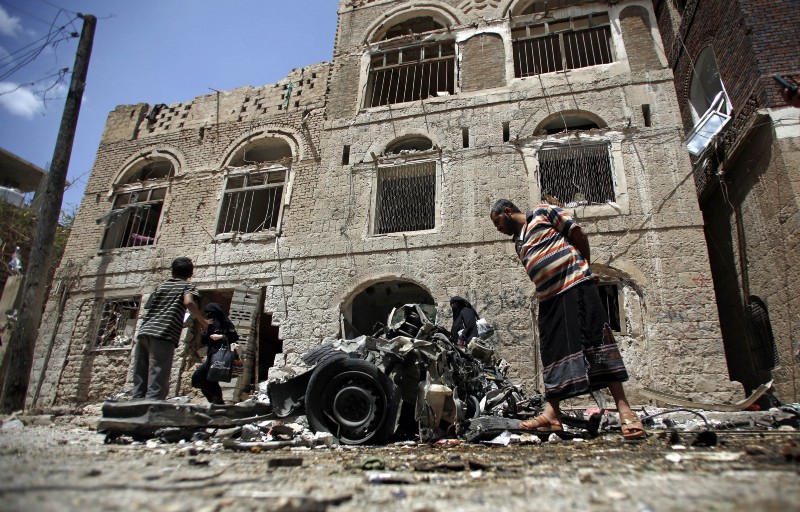
With attacks linked to ISIS in Tunisia, France, Kuwait, and Yemen on the first Friday of Ramadan, it seems that that call to arms is being heeded across the world.
While there isn’t an outright prohibition on aggression during Ramadan, at least in the military sense, there are repeated calls for Muslims to maintain an air of calm whilst fasting. Dagli makes note of this when he cites a Prophetic decree to avoid raising one’s voice or returning insults, and instead to respond to personal attacks by saying, “I am fasting. I am fasting.”
Although Islam does not formally prohibit the fighting during the holy month. It does, however, clearly prohibit many of the barbarities militant groups like ISIS perpetuate — and attempt to pass off as religiously acceptable.
What is unthinkable in terms of Islam is the sort of aggression — and indeed, horrific cruelty — carried out by militant groups which invoke Islam in order to cultivate power and amass followers. By leaving out that key point, Dagli’s article seems to offer credence to ISIS’ as representative of Islamic teachings.