The dissents in Obergefell v. Hodges, the Supreme Court case that just brought marriage equality to all fifty states, had a lot of negative things to say about same-sex marriage and its proponents. What’s perhaps most revealing about them, however, is what they did not say.
Here is a look at some of the truths about the lives of gay, lesbian, and bisexual people that Justices Antonin Scalia, Clarence Thomas, Samuel Alito and Chief Justice John Roberts had to ignore or set aside in order to rule against same-sex marriage.
We simply know more now about same-sex orientations.
The dissenting Justices’ rely on an historic reading of marriage, arbitrarily defining it as always having been between one man and one woman and disregarding the many ways it has changed over time. Roberts’ reference to the Han Chinese’s understanding of marriage, for example, ignores the fact that the dynasty defined marriage as a hierarchical relationship between a master, his wife, and his concubine. They also ignore the fact that same-sex relationships have been recognized by numerous cultures over the centuries.
Roberts claims that “marriage [his definition] did not come about as a result of a political movement, discovery, disease, war, religious doctrine, or any other moving force of world history — and certainly not as a result of a prehistoric decision to exclude gays and lesbians.” This argument from tradition disregards the emergence of psychology as a field of science, one that has revealed incredible amounts of information about the nature of sexuality at quite a rapid pace. After all, homosexuality was widely considered a mental illness until as recently as 1973 and was still a crime in some states until 2003. That surge in knowledge helped facilitate the visibility of the gay community and their advocacy for themselves. Writing for the majority, Justice Anthony Kennedy mentions the “immutability” of homosexuality twice, but the word appears nowhere in the dissents — nor does any reference to the inherent nature of sexuality for gay, lesbian, and bisexual people.
In fact, Roberts actually challenges the notion that sexuality is such a characteristic, juxtaposing it against race to show that they are not similar in that regard. Defending his definition of marriage against past changes, he explains, “Removing racial barriers to marriage therefore did not change what a marriage was any more than integrating schools changed what a school was.” His comparison to plural marriages also reflects this rejection of immutability. Though he clarified, “I do not mean to equate marriage between same-sex couples with plural marriages in all respects,” his comparison between homosexuality and polyamory cannot be so easily explained away. Why doesn’t same-sex marriage lead to plural marriage? As Jon Stewart succinctly explained Monday night, “Because people aren’t born polygamists!”
Whatever was assumed about marriage in the past, it’s irrefutable that the laws passed over the past 25 years — the very bans challenged in Obergefell — reflected society’s growing understanding of sexuality. They were a backlash to the growing visibility of same-sex relationships, targeting them for second-class status — as Kennedy himself pointed out in Windsor two years ago when overturning the Defense of Marriage Act.
Acceptance of same-sex marriage will continue to increase along with visibility.
In his dissent, Chief Justice Roberts reiterates a claim he made during oral arguments: that “closing debate tends to close minds” and marriage equality advocates’ success persuading others “ends today.” They have “lost, and lost forever,” he writes, “the opportunity to win the true acceptance that comes from persuading their fellow citizens of the justice of their cause.”
As ThinkProgress previously pointed out, there is nothing to suggest that this is true. Public opinion on interracial marriage was incredibly low before Loving v. Virginia, but jumped significantly after the Court resolved that issue, proceeding to increase since then.
The trajectory for same-sex marriage support has already been consistently upward, and if anything, it may even increase further as a result of the decision. Visibility of gay, lesbian, and bisexual people has been crucial to increasing that support, and Obergefell undoubtedly contributes to a culture that is more accepting of that community. Furthermore, the gay community is simply not going to stop advocating for itself and the legitimacy of same-sex relationships. The upward spiral of support will thus likely continue thanks to the Court’s ruling, not in spite of it.
Debating the legitimacy of homosexuality and gay rights hurts the gay community.
Roberts would rather cheer on the gay community in a continued public fight for acceptance. “Those whose views do not prevail at least know that they have had their say, and accordingly are — in the tradition of our political culture — reconciled to the result of a fair and honest debate. In addition, they can gear up to raise the issue later, hoping to persuade enough on the winning side to think again.”
Thomas goes even further in his dissent, dismissing the idea that same-sex couples’ dignity in any way depends on equal treatment under the law. “The government cannot bestow dignity, and it cannot take it away,” he writes, offering those who experienced slavery or internment camps as comparisons. Ironically, the Supreme Court infamously upheld slavery in Dred Scott v. Sandford back before there was a Fourteenth Amendment and internment camps more recently.
These arguments about the viability of debate on matters of social justice ignore the toll they take on the affected community. The history of gay rights has been rife with countless fights via the democratic process, and researchers paid attention. They repeatedly found that elections on issues like same-sex marriage have a negative impact on the mental health of LGBT people, their children, and their family members — even for individuals who do not directly engage in campaigning. There is also, of course, a huge financial cost for the community that has to fight for its own rights.
When it comes to ongoing debate, Obergefell will both advance public understanding and support the gay, lesbian, and bi people who now have access to marriage.
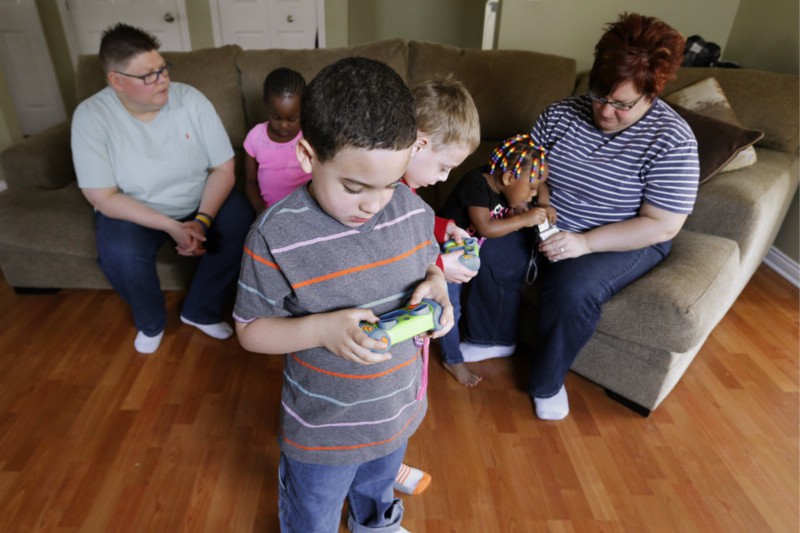
Same-sex couples raise children too.
The dissenting justices also cite children as a concern for marriage, but apparently only children who live with their biological parents. According to Roberts, “When sexual relations result in the conception of a child, that child’s prospects are generally better if the mother and father stay together rather than going their separate ways.” Alito also incorporates conjugation into his definition of marriage, asserting, “For millennia, marriage was inextricably linked to the one thing that only an opposite-sex couple can do: procreate.”
Roberts passingly acknowledges that same-sex couples remain free “to raise their families as they see fit,” as does Thomas, who points out that they “have been able to cohabitate and raise their children in peace.” But none of the dissenting justices acknowledges the two inherent conflicts in their procreation-centered definition of marriage: that the children of same-sex couples benefit equally when their parents’ relationship is afforded the status of marriage and that fertility or the desire to have children has never been a prerequisite for marrying.
Fortunately, Kennedy does, writing, “The marriage laws at issue thus harm and humiliate the children of same-sex couples. This does not mean that the right to marry is less meaningful for those who do not or cannot have children. Precedent protects the right of a married couple not to procreate, so the right to marry cannot be conditioned on the capacity or commitment to procreate.”
LGBT people are religious too, and have many religious supporters.
Religious liberty is another concern for the Court’s minority. In fact, they seem to assert that simply because some people oppose marriage equality for religious reasons, that is reason enough to disallow it. Thomas writes, “Religious liberty is about freedom of action in matters of religion generally, and the scope of that liberty is directly correlated to the civil restraints placed upon religious practice.” He worries that the majority’s decision “short-circuits” the legislative process that might have created exemptions, “with potentially ruinous consequences for religious liberty.”
Alito also expresses skepticism on behalf of same-sex marriage opponents as to whether “their rights of conscience will be protected.” Like Thomas, he imagines a timeline in which “some States would tie recognition to protection for conscience rights. The majority today makes that impossible.” He worries that this “facilitates the marginalization of the many Americans who have traditional ideas.”
None of the dissenting justices acknowledges the many people of faith who support marriage equality, let alone the many LGBT people who are people of faith themselves. An increasing number of denominations are blessing same-sex marriages, and many people of faith support same-sex marriage in spite of their church’s beliefs. The Catholic Church, for example, is a fierce opponent of marriage equality, but Catholics themselves tend to support marriage equality at rates higher than the national average. (This trend does not seem to hold true for the Court, given four of the six Catholic justices dissented.)
The Court’s decision only affects the legal recognition of marriage and does not force any religion to change its beliefs. For the dissenters, religious liberty is apparently a one-way street, protecting only those who do not want to recognize legal same-sex marriages for religious reasons with little concern for those whose religious beliefs instruct them to celebrate them.
Opposing same-sex marriage is bigotry.
The minority is particularly concerned that they, along with anyone who ever voted for or advocated for a ban on same-sex marriage, will be considered bigots for their positions. “It is one thing for the majority to conclude that the Constitution protects a right to same-sex marriage,” Roberts writes. “It is something else to portray everyone who does not share the majority’s ‘better informed understanding’ as bigoted.”
Alito similarly worries about how “the majority compares traditional marriage laws to laws that denied equal treatment for African-Americans and women. The implications of this analogy will be exploited by those who are determined to stamp out every vestige of dissent.” Again rejecting the immutability of homosexuality to justify his position, he assumes that “those who cling to old beliefs will be able to whisper their thoughts in the recesses of their homes, but if they repeat those views in public, they will risk being labeled as bigots and treated as such by governments, employers, and schools.”
Scalia simply blasts the majority for being presumptuous. “These Justices know that limiting marriage to one man and one woman is contrary to reason; they know that an institution as old as government itself, and accepted by every nation in history until 15 years ago, cannot possibly be supported by anything other than ignorance or bigotry.” He proceeds to call the decision “pretentious” and “egotistic.”
But just like campaigns against same-sex marriage hurt the gay community, so too do the bans themselves. Researchers have found that lesbian, gay, and bisexual people who lived in states with bans experienced a significant increase in psychiatric disorders, including mood disorders, alcohol use, and in particular, generalized anxiety disorders. The American Psychological Association has long supported marriage equality for same-sex couples, noting the significant impact of “minority stress” on gay, lesbian, and bisexual people as a consequence of stigma, discrimination, and violence. Legal recognition aside, the stigma itself will likely continue to a negative impact on their mental health.