The cost of carbon is having a moment, with economists, environmentalists, and even the pope supporting a price on carbon emissions.
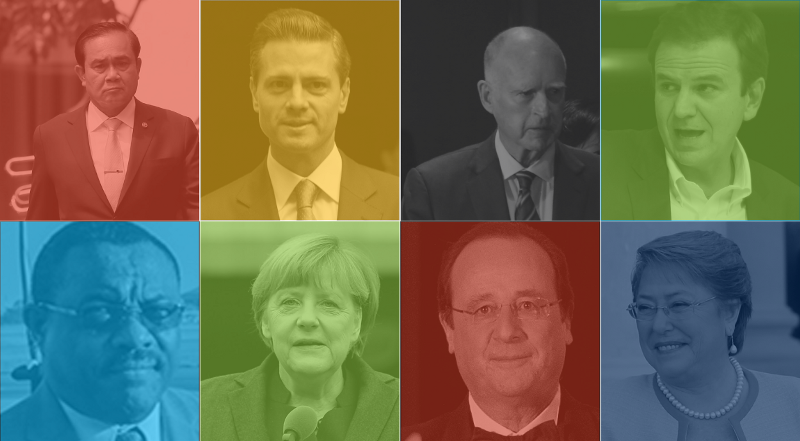
And on Monday, the World Bank announced a high-level group, the Carbon Pricing Panel, which brings together heads of state, local leaders, and business executives. The luminaries, including German Chancellor Angela Merkel, Philippines President Benigno Aquino III, and California Gov. Jerry Brown, are calling on policymakers and negotiators to use carbon pricing mechanisms, setting the stage for strengthening emissions reduction plans expected at the United Nations conference in December.
“There has never been a global movement to put a price on carbon at this level and with this degree of unison,” World Bank Group President Jim Yong Kim said in a statement.
The only approach that would work is an across-the-board rising carbon fee covering every fossil fuel at the source
Putting a price on carbon uses a standard economic tool and is broadly favored by economists as an efficient and effective way of reducing emissions. How it would be implemented worldwide, though, remains to be seen. Some climate activists worry that some programs will push emissions down far too slowly to prevent the most catastrophic effects of climate change.
“The only approach that would work is an across-the-board rising carbon fee covering every fossil fuel at the source — the first sale at the domestic mine or port of entry,” Jim Hansen, a leading climate scientist, told ThinkProgress. “If the collected funds were distributed to the public, an equal amount to each legal resident, the economy would be stimulated, most people could make money, and fossil fuel use would go down rapidly. I call this fee-and-dividend, as opposed to cap-and-trade. It is not a tax, because the government gets no money, the government does not grow bigger.”
In fact, there are a number of ways carbon pricing can be leveraged to reduce carbon emissions. A carbon tax — or fee — requires emitters to pay, usually into a dedicated fund, for each ton of carbon they put out. That money can be redistributed to offset higher energy costs (revenue-neutral) or can be redirected towards efficiency and clean energy programs, further lowering emissions.
Cap-and-trade schemes, another mechanism, place limits on emissions but allow entities to trade their credits, creating an emissions credit market. Cap-and-trade generally involves more government oversight.
“The hokey cap-and-trade system allows graft and giveaways and necessarily brings big banks into the multi-trillion dollar energy industry. Big banks add nothing — every single dollar that they make comes out of the public’s hide in higher energy prices — but once you have trading they are in the game,” Hansen said.
Domestically, the Regional Greenhouse Gas Initiative, RGGI, has been a successful example of cap-and-trade, lowering how much participating states pay for electricity while bolstering clean energy development. An international scheme developed under the Kyoto Protocol served to lower emissions in Europe, but also exposed itself as a victim of corruption and limited oversight.
It’s often posited that, globally, there is no one-size-fits-all design that will work for all economies. This means different approaches will likely be required and different outcomes will be valued.
One key element of the World Bank panel — and the Carbon Pricing Leadership Coalition, an advisory group which will officially launch at the beginning of the United Nations Climate Change Conference in Paris on November 30 — is that it represents a broad range of interests.
Joe Robertson, the global strategy director at Citizens’ Climate Lobby, said that the structure of the coalition lends itself to offering better solutions.
“It’s been an incredibly inclusive process,” Robertson told ThinkProgress. “It’s a breakthrough where you have nonprofits like Citizens’ Climate Lobby and [the Environmental Defense Fund] sitting at the table with Shell.”
Having all these voices can help develop the best approaches for pricing carbon, he said. Not only can different localities share their expertise with other economies, but different viewpoints could help develop more acceptable plans. “You can’t change things if four billion people in the world have some vested interest in fossil fuels,” Robertson said.
It’s a breakthrough where you have nonprofits like Citizens’ Climate Lobby and [the Environmental Defense Fund] sitting at the table with Shell
In fact, in June, six massive European oil and gas companies called for a carbon tax. Ostensibly, that’s a huge step forward, but some have expressed doubts about the group’s sincerity.
“If they are serious, they should be turning their considerable political interests toward eliminating subsidies,” Alden Myer, director of strategy and policy for the Union of Concerned Scientists, told ThinkProgress.
Worldwide, fossil fuel subsidies cost governments $5.3 trillion a year, according to the International Monetary Fund. In the United States, fossil fuel subsidies go largely to producers — oil and gas exploration costs are hugely written off, for instance. And American oil and gas companies are not in the practice — so far — of lobbying against their financial interests.
But in many other nations, including developing nations and places that have huge oil reserves, subsidies are at the consumer end, which means reducing subsidies can lead to public outcry. These existing subsidies make it more difficult to accurately price carbon — since the market is already distorted.
But Myer applauded the formation of the Climate Pricing Panel. “Obviously, carbon pricing is a very important tool. It’s not the only tool, but it’s an essential tool,” he said.
And as more and more leaders — from the Philippines to Germany, and from Shell to the World Bank — speak out on carbon pricing, the targets expected out of the Paris conference may become more in reach.
“What would be great to see from this initiative would be much greater activation of those political and business leader voices… talking about the need for carbon pricing,” Myer said. “Lord knows there is enough on the other side.”