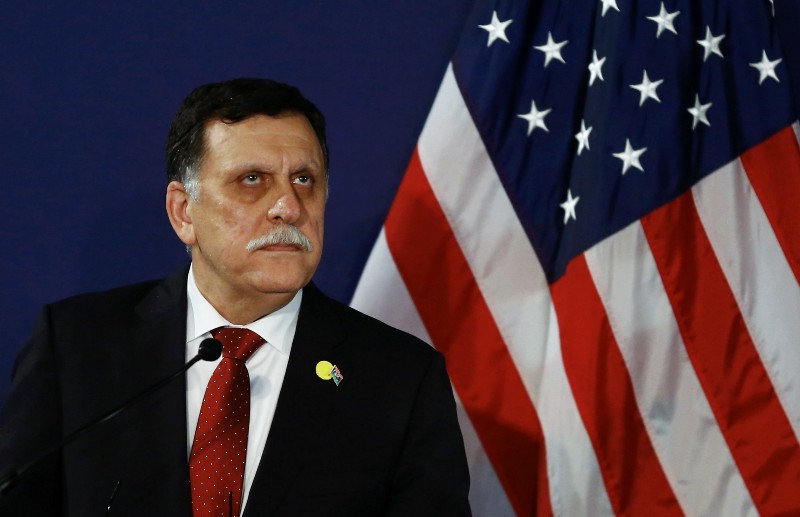
The White House is backing a United Nations plan to ease the arms embargo to Libya in an effort to counter the volatile spread of ISIS.
The UN Security Council initially placed an arms embargo on Libya during the 2011 revolution. Libya’s then-leader Moammar Qaddafi was trying to violently repress the popular uprising. Since Qaddafi’s fall, the country has been divided and subject to violent clashes by militias, and a growing ISIS presence. Control over Libya was split between a secular fighting force in control of the country’s east and Islamist militias with hegemony over Tripoli and the west. But a UN-backed unity government arrived in Tripoli this past March, giving world powers new hope that a peaceful resolution can be reached to the country’s infighting.
Now, the international community is considering arming the unity government in its fight against ISIS.
ISIS is based primarily in Syria and Iraq. But while the United States has sent more military advisers to the Levant and continues to consider how to counter ISIS forces there, ISIS is growing in Libya at a rapid rate. Europeans are joining ISIS in Libya, as are many Africans from the subcontinent.
“If the Libyan government prepares a detailed and coherent list of things that it wants to use to fight ISIL and responds to all the requirements of the exemption, I think that [Security] Council members are going to look very seriously at that request,” a senior administration official told AFP, using a different acronym for the militant group. “There is a very healthy desire inside of Libya to rid themselves of ISIL, and I think that is something we should be supporting and responding to.”
While the arms embargo has been in effect for five years, weapons have not ceased crossing Libyan borders.
#Libya weapons never stopped flowing into #Libya even when there was an arms embargo. Weapons come from Egypt, Turkey, UAE & Qatar.
— Mohamed Eljarh (@Eljarh) May 16, 2016
Government officials say that providing Libya’s new unity government with the proper arms to push back ISIS could be crucial to halting it spread in North Africa. But U.S. arms have found their way to ISIS before in Syria and Iraq.
“Decades of poorly regulated arms flows into Iraq as well as lax controls on the ground have provided the armed group calling itself Islamic State (IS) with a large and lethal arsenal that is being used to commit war crimes and crimes against humanity on a massive scale in Iraq and Syria,” Amnesty International said in a report released last December, adding that the weapons used by ISIS were often stolen from Iraqi army outposts and from “more than two dozen countries, including Russia, China the USA and EU states.”
There is still a worry among some experts that such scenarios could repeat in Libya. With Libya’s government still new and without total control over the nation, there’s fear that providing arms could further complicate infighting.
“There is no unified chain of command, there are still factional armed forces that are still more focused on fighting each other than on fighting ISIS,” Frederic Wehrey, a Libya expert at the Carnegie Endowment for International Peace told AFP. “The real danger is that these factional militias would use the arms against each other.”