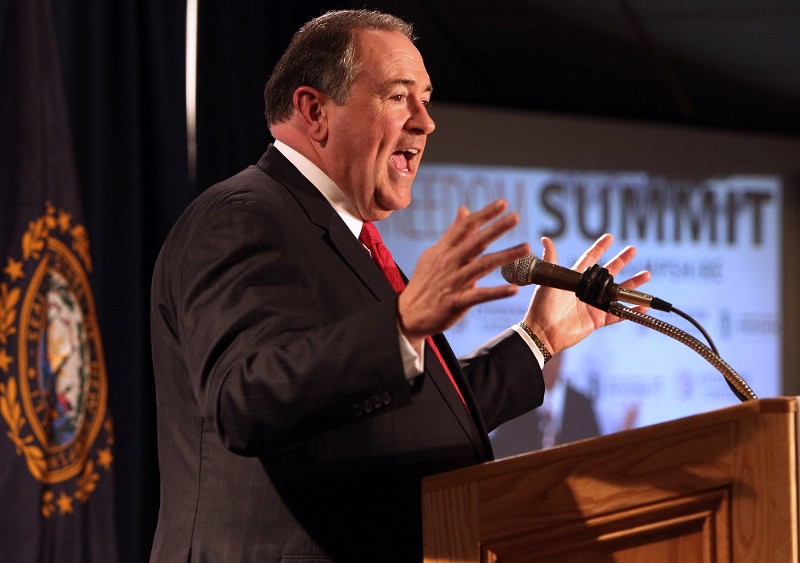
Former Arkansas Gov. Mike Huckabee (R) should be careful what he wishes for. On Tuesday, the ex-governor suggested that states are free to ignore Supreme Court decisions they would prefer not to follow. He’s wrong. But it is unlikely that a conservative like Huckabee would be happier — or that his political opponents would be unhappier — in a world where the conservative Roberts Court’s decisions were merely optional.
The Supreme Court is expected to decide, most likely this June, whether the Constitution guarantees that gay people enjoy the same marriage rights as straight people. In an interview with conservative radio host Hugh Hewitt on Tuesday, former Arkansas Gov. Mike Huckabee (R) labeled the “idea that a judge makes a ruling on Friday afternoon, and Saturday morning same sex marriage licenses are being given out” as “utter nonsense.” He went on to suggest that states could thwart marriage equality by simply refusing to pass marriage equality legislation — even if they would be openly defying the Supreme Court in the process — “if the law in that state does not already have a mechanism to support same sex marriage, the legislation [sic] and only the legislature can create the law that says a marriage license can be given to two men or to two women.”
Huckabee’s comments were echoed by Bob Vander Plaats, head of the Family Leader, an influential social conservative group in Iowa. Citing, of all people, Dr. Martin Luther King, Jr., Vander Plaats claims that “should SCOTUS render an opinion not in line with natural law, we should not recognize or obey it.” Lest there be any doubt about how he views the matter, Vander Plaats adds that “a law or court opinion recognizing so-called ‘same-sex marriage’ as equivalent to procreative marriage violates natural law.”
Now, let’s be perfectly clear. Huckabee and Vander Plaats are simply wrong about what the Constitution allows. Indeed, Vander Plaats’s decision to invoke Dr. King is particularly ironic, since Vander Plaats is calling for a kind of defiance that actually did occur at the height of the Civil Rights Era. Three years after the Supreme Court handed down its landmark Brown v. Board of Education decision, Arkansas’s governor and attorney general declared that their state was not bound by this decision. Famously, this resistance to Brown culminated with the governor calling out the Arkansas National Guard to keep African Americans from entering Little Rock Central High School.
The Supreme Court responded to this defiance in Cooper v. Aaron, which explained that “the federal judiciary is supreme in the exposition of the law of the Constitution, and that principle has ever since been respected by this Court and the Country as a permanent and indispensable feature of our constitutional system.” When the Supreme Court hands down a decision, the nation is bound by it.
It’s worth noting that, though Brown is remembered as a turning point in civil rights history, it was not itself effective at ending segregation in the deep South. Thanks to a white supremacist campaign of resistance to the Brown decision, only one in eighty-five Southern black children attended an integrated school ten years after Brown was handed down. The most important thing the Supreme Court did to advance civil rights was not Brown, it was its decision to do absolutely nothing when segregationists asked the justices to strike down the Civil Rights Act of 1964 and the Voting Rights Act of 1965. These two laws, not Brown, finally broke the back of Jim Crow.
Sixty years after Brown, however, the Roberts Court seems much more interested in dismantling the legacy of the Civil Rights Era than they are in preserving its vibrancy. If Supreme Court decisions actually were optional, then the Voting Rights Act would still be fully operational, and a 2007 decision striking down two school desegregation programs could be ignored.
Moreover, as I explain in my book, Injustices: The Supreme Court’s History of Comforting the Comfortable and Afflicting the Afflicted, the left-leaning Court that decided Brown, and that later reinvigorated the Constitution’s provisions protecting dissenting voices and the criminally accused, was an historic accident. President Dwight D. Eisenhower once told Chief Justice Earl Warren, who authored the Brown decision, that Southern whites “are not bad people. All they are concerned about is to see that their sweet little girls are not required to sit in school alongside some big overgrown Negroes.” He later described his decision to place Warren on the Supreme Court as the “biggest damned-fool mistake I ever made.
Nor was Eisenhower’s “damned-fool mistake” the only historic accident that allowed Brown to come down the way it did. To the contrary, if it wasn’t for a former chief justice’s fatal heart attack, an avowed segregationist’s decision to leave the Court, a former Ku Klux Klansman’s dramatic change of heart and numerous other unpredictable events that I lay out in Injustices, then it is likely that Brown would have come down the other way.
The conservative Roberts Court is not an outlier in Supreme Court history. Indeed, if anything, past justices were often much less sympathetic to the rights of the unfortunate and the downtrodden than the Court’s current members. In coal mining towns throughout much of the country, children as young as eight used to work in rooms filled with black coal dust as an endless stream of crushed coal poured down below their feet. Their job was to reach into this sea of flowing rocks and pick out stray pieces of slate, and they earned as little as forty cents a day for ten hours of labor.
Yet when Congress banned child labor — rescuing children not only from coal mines, but also from cotton mills and shrimp canneries and factories throughout much of the country — the Supreme Court struck this law down, relying on reasoning that the justices of another era said “was novel when made and unsupported by any provision of the Constitution.”
When lawmakers in Virginia sought to eradicate “defective persons” by sterilizing them against their will, the Supreme Court ushered in a eugenic era when surgeons cut open unwitting or unwilling women and removed their Fallopian tubes. In New York City’s bakeries, workers worked as much as 126 hours a week in squalid conditions where they had to sleep on the very same tables where they mixed and kneaded the dough. Yet when the state legislature tried to prevent bakeries from overworking their workers, the Supreme Court struck that law down as well. The Supreme Court of the United States stood with segregation and Japanese American detention camps. It was the scourge of workers and the staunch ally of America’s wealthiest men.
So when Chief Justice John Roberts and his conservative brethren gutted the Voting Rights Act or when they weakened anti-discrimination law they aren’t defying any grand tradition of justice in the Supreme Court of the United States. Similarly, when anti-Obamacare activists were so encouraged by the Robert Court’s record that they asked it to tear health care away from 8 million people in a case that is currently pending before the Court, they weren’t seizing upon a rare moment of Republican judicial dominance. They were asking the Court to revive its longstanding role as a vanguard against democracy. Should the Roberts Court decide to gut the Affordable Care Act, the will have to ignore the law’s text, but they will act within the Supreme Court’s tradition of protecting the powerful at the expense of the powerless.
Huckabee and Vander Plaats, in other words, might want to rethink what they are asking for. If Supreme Court decisions actually were something that could be ignored, as these two men suggest, American history would have been much less friendly to conservatives and far better for workers — and, at times, women and racial minorities. Many of the voter suppression tactics preferred by modern day conservatives could be halted by the Voting Rights Act. And the Affordable Care Act — and the thousands of lives that it protects — would be safe from the seemingly never-ending efforts to convince the justices to repeal it.