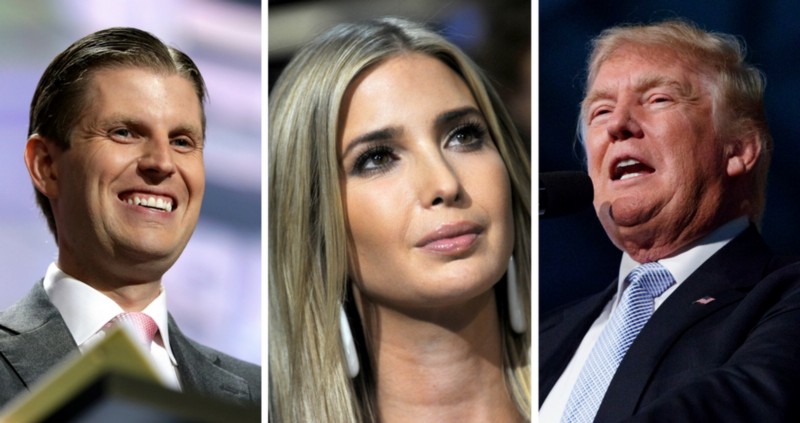
If a woman is sexually harassed at work, Donald Trump says she should leave and find a new job. Eric Trump thinks it means she allowed it to happen to her.
Both of these statements are the fallout of the sexual harassment allegations against former Fox CEO Roger Ailes, whom Trump has largely defended. In July, former Fox News host Gretchen Carlson brought suit against the CEO, alleging that he sexually propositioned her, harassed her, and penalized her for turning him down. Since then, multiple women multiple women have come forward to accuse former Fox executive Roger Ailes of harassment, including Megyn Kelly and Laurie Luhn, a former booker at Fox who described decades of “psychological torture” and sexually predatory behavior from Ailes.
Last week on Chuck Todd, Trump said that the allegations were “very sad,” saying that Ailes had “helped” the women and was a “very, very good person.” Then, columnist Kirsten Powers at USA Today made it personal: She asked Donald Trump what he would think if it was his daughter Ivanka who had been harassed.
“I would like to think she would find another career or find another company if that was the case,” Trump told her over the phone.
On CBS News Tuesday morning, Eric Trump offered his own perspective on his sister’s hypothetical harassment.
“I think what he is saying is Ivanka is a strong, powerful woman. She wouldn’t allow herself to be objected [sic] to it. And, by the way, you should certainly take it up with human resources and I think she definitely would as a strong person. At the same time I don’t think she would allow herself to be subjected to that.”
The Trump family’s reactions place the blame for the harassment squarely on the victim’s shoulders — and perpetuate the very culture that prevents women from coming forward and ending their harassment.
I don’t think she would allow herself to be subjected to that
Ivanka Trump, as an heiress, has options many women don’t have — including, presumably, the economic freedom to leave a hostile work environment. But even besides the specifics, the underlying message of both responses is straight out of the victim-blaming handbook.
Taken together, father and son are implying that if sexual advances are made to a woman against her will, it’s her fault. The onus is on the victim to change her behavior and sacrifice her career, not the person who was actually acting illegally.
Trump’s own campaign is being sued for gender discrimination, by a former female staffer filed a complaint alleging that men and women with the same titles were paid unequally. She also noted that Trump had made comments about her looks, saying that she and another female staffer “could do a lot of damage,” comments which Trump denied.
If every woman who experienced sexual harassment switched careers, the labor force may well descend into chaos. In surveys with representative sampling, 40 percent of women say they’ve experienced unwanted sexual attention or sexual coercion in the workplace. Sixty percent report having experienced sexist or offensive behavior. Yet according to a major report from the Equal Employment Opportunity Commission, very few victims come forward or take formal steps against abuse. Many say they fear that they won’t be believed, or will suffer retaliation — exactly what is happening to the Fox women, who are being questioned by Trump and others with the same tack used 25 years ago to discredit Anita Hill.
“We put these double standards out there for how women are supposed to speak up and tell their stories,” Jennifer Reisch, legal director at Equal Rights Advocates, recently told ThinkProgress. “And yet when they do, everything they’ve decided to do and every reaction is questioned.”
It’s little wonder many women choose to keep their heads down and endure abuse, when they’re constantly told that it’s their fault, that they’re the ones that will suffer for reporting it, and that they will be met with skepticism if they do speak up. High-profile comments like Trump’s only cement that culture further.