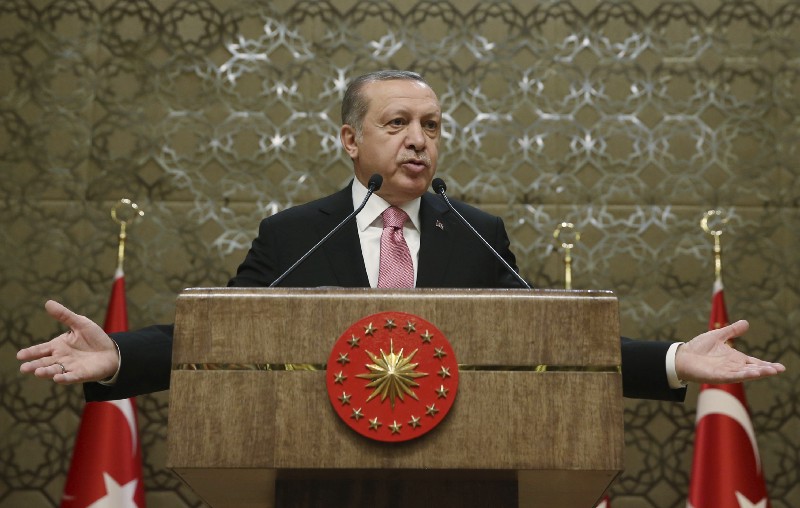
President Donald Trump’s disdain for liberal democratic norms is something he shares with authoritarian Turkish president Recep Tayyip Erdogan, a Turkish opposition leader told ThinkProgress.
“During the election process [Trump] was polarizing and scandalizing, but he convinced people to vote for him,” said Turkish MP Hişyar Özsoy, vice co-chair the left-leaning Peoples’ Democratic Party (HDP). “Erdogan also.”
Özsoy said Trump has sent a message that human rights, democracy, and the rule of law aren’t among his top priorities. Erdogan has taken a similar stance over the course of his 12 years in power, as he consolidated his rule over Turkey by dismantling the democratic process and disregarding human rights.
Özsoy, who taught anthropology for a period at the University of Michigan, assumed a top role in the HDP after party co-chairs Selahattin Demirtas and Figen Yuksedag were thrown in jail by the increasingly tyrannical Erodgan.
The comparisons with Erdogan are not meant to be flattering, despite the Turkish leader’s political longevity. Erdogan is the world’s top jailer of journalists, according to the Committee to Protect Journalists, and many of Özsoy’s colleagues in the HDP are currently in jail or banned from traveling abroad.
During much of his tenure, Erdogan has tried to position himself as a leader of the Muslim world. He’s stood up for Islamist movements like Hamas and Egypt’s Muslim Brotherhood in the past, was an early supporter of the Syrian uprising, and has addressed marginalized or persecuted Muslim minority communities like the Rohingya in Myanmar and the Uighurs in China.
Yet when Trump enacted his Muslim ban, Erdogan was mute. A couple weeks before the ban was put in place, Erdogan praised Trump for putting CNN reporter Jim Acosta “in his place” by shouting him down at a press conference. Özsoy believes Erdogan’s flattery was born of political calculation.

He’s hoping Trump will drop the policy of supporting the Kurds vis-a-vis Rojava,” Özsoy said. Rojava is an autonomous region in northern Syria that is predominately Kurdish.
The Turkish government has long suppressed minority rights, particularly those of the Kurdish minority that makes up between 15 and 20 percent of the total population. Turkey fears an autonomous Kurdish region on its southeastern border. The largely Kurdish southeast is currently under siege, and certain cities have been decimated by government military force. Around 85 Kurdish mayors have been replaced by the central government (approximately 60 of whom have been thrown in jail) since an attempted coup last July.
Under President Obama, the U.S. saw the Kurds in northern Syria as an effective fighting force. In an effort to placate Ankara, the U.S. said it would only fund Arab elements in the anti-ISIS Syrian Democratic Forces, a multi-ethnic and multi-religious military unit whose largest partner is the Kurdish People’s Protection Unit (YPG).
The YPG is the military branch of the Democratic Union Party (PYD). Turkey considers the PYD, and thus the YPG, to be a terrorist group due to their direct connection the Kurdistan Worker’s Party (PKK), a group both Turkey and the U.S. have labelled as a terror organization.
“Turkey put lots of pressure on the U.S. and the coalition to terrorize the Kurds, but Obama resisted,” Özsoy said. “He didn’t surrender or recognize the PYD as a terror organization.”
Turkish-Russian relations have thawed in recent months, despite the downing of a Russian military jet near Turkey’s border with Syria in December 2015 and the assassination of the Russian Ambassador to Turkey late last year. The thaw has had regional implications.
“Erdogan is flirting with Russia and [renewed] relations with [Syrian President Bashar] al-Assad to avoid a political Kurdish structure in northern Syria,” Özsoy said. Erdogan recently backed down on his prior stance that Assad needed to be removed from a leadership role in Syria.
“There are deep divisions between Iran, Russia, and Turkey so the alliances are tactical,” said Özsoy. He added that Erdogan and others in Turkey were disappointed with the U.S. and the West’s continued support of the Kurds. As a result, they’re flirting with other alliances, such as with the Shanghai Cooperation Organization — a European Union-like group for Eurasian nations whose members are Russia, China, Uzbekistan, Kazakhstan, Kyrgyzstan, and Tajikistan.
But Özsoy said the prospect of Turkey actually joining the SCO was “unrealistic.”
Erdogan is, however, using Turkey’s geographic location as leverage against the European Union and the West. In exchange for stemming the migration of refugees into Europe, Western nations are letting Erdogan’s human rights violations slide.
“Turkey has a key position between the Middle East and the European Union when it comes to security and migration,” said Özsoy. “Europe is turning a blind eye [to his authoritarian tendencies]. We see that he is blackmailing them.”