There’s a lot to unpack in Donald Trump’s latest campaign finance disclosure. For one, his campaign doesn’t have a lot of cash. For another, some of his individual expenses are pretty sketchy.
But perhaps the most fascinating thing about the presumptive Republican presidential nominee’s financial report is how much money his campaign is spending on himself.
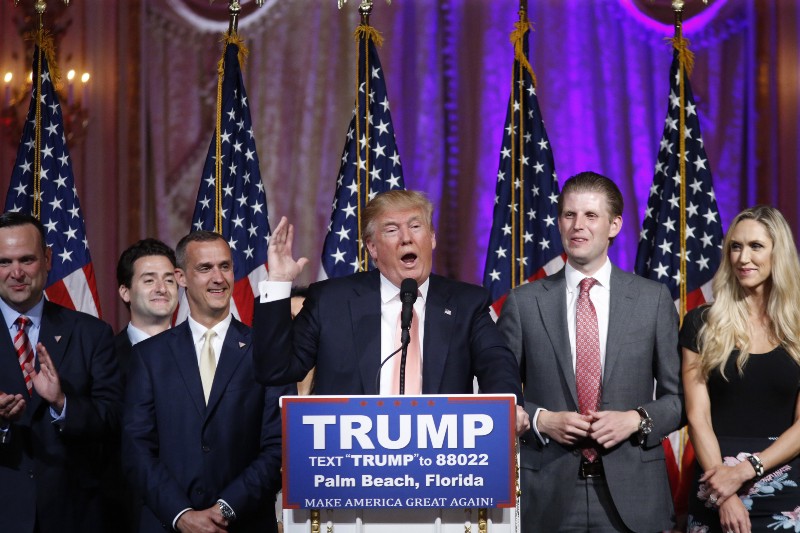
In the month of May, Trump spent more than $1 million in campaign cash on his own businesses. Put another way, nearly 20 percent of Trump’s campaign spending last month went to benefit Trump-owned companies.
Recipients of payments from Trump campaign with “Trump” in name, through May 31. Doesn’t include Mar-a-Lago/planes. pic.twitter.com/JF6skaWYGF
— Derek Willis (@derekwillis) June 21, 2016
Since Trump’s financial disclosure form was released on Monday, a good number of journalists have pointed out Trump’s propensity to spend campaign funds on his own companies.
But what’s been less explored are the ethics behind this practice. Is it right for Trump to use his campaign’s money on his own businesses? Is it normal? Is it legal?
It’s certainly not normal, according to Noah Bookbinder, the executive director of Citizens for Responsibility and Ethics in Washington, a government ethics watchdog group.
It’s highly unusual to have a campaign paying a candidate’s businesses on anything like this scale.
“It’s highly unusual to have a campaign paying a candidate’s businesses on anything like this scale,” he told ThinkProgress on Tuesday. “It’s not that unusual to have some office space rented from the candidates’ business, but to have so many different businesses for so much of the campaign’s work, with the money essentially going to the candidate, that’s extremely unusual.”
Richard Painter, the former chief ethics lawyer for President George W. Bush, agreed that Trump’s persistent practice of paying himself was not normal for a presidential candidate. As for whether it’s legal, Painter told ThinkProgress that it might be — but Trump has to walk a fine line when it comes to how much he’s charging himself.
“If I were advising somebody in his situation, who had a campaign that owned a lot of hotels and other facilities, I’d say that you could use those facilities if you had an arms length transaction — if you were renting the facility for market value,” Painter said.
How Trump Could Make A Mint Off The White HouseIf the presumptive Republican nominee Donald Trump wins the presidency this November, it will be a historic result for…thinkprogress.orgIn other words, Painter said, if Trump wants to avoid breaking the law or being unethical, he must charge himself exactly the same amount of money as he would charge any other customer for use of his facilities. For example, if a Trump-owned hotel room goes for $400 per night, Trump must charge his campaign $400 per night if he wants to use that facility.
There are a few reasons for this. Most of Trump’s businesses are corporations, which by law cannot make direct contributions to political campaigns. So, if Trump charged himself too little — say, if he only charged himself $300 per night for a $400 room — that would amount to a $100 contribution from his own corporation. That contribution would be illegal.
Conversely, Bookbinder said, it would be unethical and possibly illegal if a Trump corporation charged the Trump campaign too much, because Trump would be essentially making money off of donations from other people.
If [Trump’s businesses] are being overpaid, that could be an illegal personal use of campaign funds.
“If [Trump’s businesses] are being overpaid, that could be an illegal personal use of campaign funds,” Bookbinder said. “Basically, the candidate would be financially benefiting from his campaign improperly.”
The problem, both Bookbinder and Painter said, is that it’s very hard to figure out how much exactly Trump is charging his campaign for use of his own facilities, and whether those charges line up with market value. The campaign only provides a lump sum for how much it paid each of Trump’s businesses — it doesn’t provide detailed individual expenditures.
Based on an initial look at the disclosure form, Painter said he doesn’t believe Trump is currently at a Jesse Jackson Jr.-type level of campaign fund misuse. What Painter does believe, however, is that Trump’s disclosure indicates that the candidate won’t part ways with his lucrative business holdings should he become president.
“What this does illustrate is that [Trump’s] very closely tied with his real estate holdings — he does not plan to get rid of them,” Painter said. “And that means all his conflicts of interests are not going to go away if he’s president.”
Indeed, Trump’s financial conflicts of interest would engorge if he was elected to the White House. The big difference is that, if Trump is elected president, conflict of interest laws that currently apply to him as a candidate will no longer be in effect.
In the end, Bookbinder said, it will all come down to whether Trump honestly wants to use his campaign and the presidency for the public interest, and not his own personal financial gain.
“Are campaign decisions being made for the financial interest of the candidate, rather than for the best interest of the campaign, or in any sense the public interest? Is this campaign essentially partly a way to enrich Mr. Trump and his businesses? It’s very hard to know,” Bookbinder said. “And that raises some potentially troubling questions.”