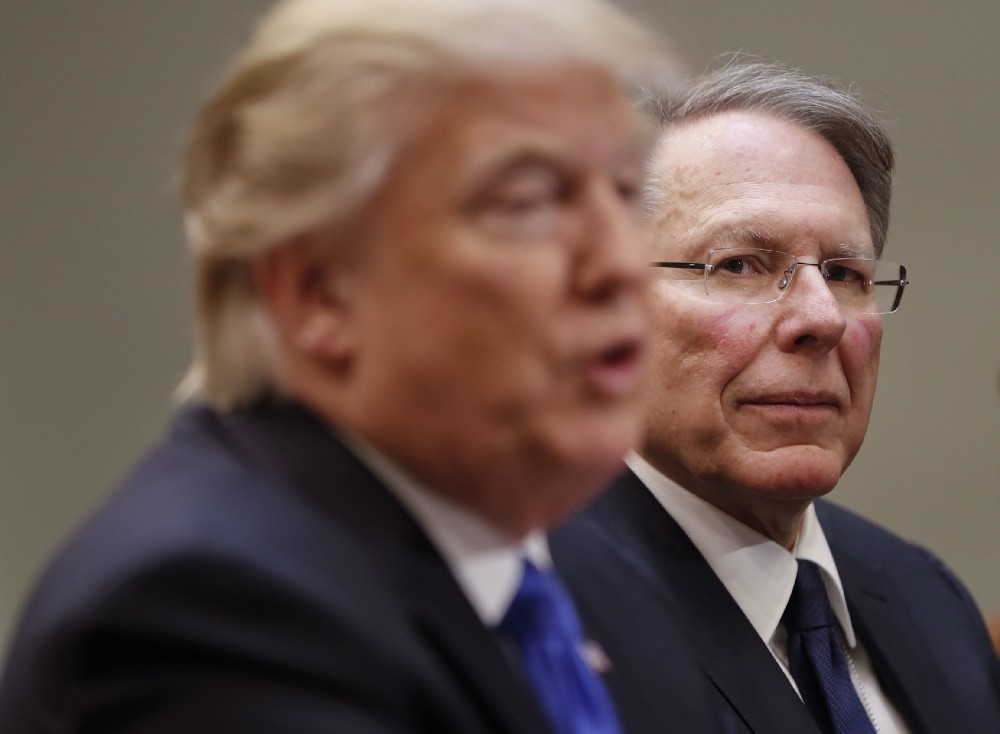
ATLANTA, GEORGIA — President Trump will address the National Rifle Association’s annual meeting in Atlanta on Friday, becoming the first sitting president to address the country’s largest gun lobby in more than three decades.
Former president Ronald Reagan last spoke to the group’s convention in 1983, at a time when the NRA supported expanding criminal background checks and reasonable limits on where people should be permitted to carry firearms in public. But since Executive Vice President Wayne LaPierre took over the NRA in 1991, the group has become far more extreme and more out-of-step with both Americans and most gun owners.
Nevertheless, Trump as a candidate enthusiastically accepted the group’s endorsement at the convention last year. The NRA went on to spend more than $30 million on Trump’s campaign, almost three times as much money as it gave Mitt Romney in 2012.
John Feinblatt, president of Everytown for Gun Safety, the country’s largest gun control group, told reporters Thursday that Trump is more extreme on guns than recent Republican presidents.

“Over time, the NRA’s partisan political leaders took the organization far to the fringe,” he said, pointing out that Reagan supported the Brady Bill to expand background checks and require waiting periods before the purchase of firearms.
In a New York Times editorial in 1991, Reagan strongly endorsed the bill, saying it would have prevented the shooting that seriously injured his press secretary Jim Brady.
“If the passage of the Brady bill were to result in a reduction of only 10 or 15 percent of those numbers (and it could be a good deal greater), it would be well worth making it the law of the land,” wrote Reagan, an NRA member.
That year, the NRA approved a resolution at its annual meeting opposing the Brady Bill, showing the first signs of its radical shift. Members noted, however, that the organization was not entirely opposed to requiring immediate criminal background checks.
Within a decade, that position would change and LaPierre — who once called background checks “reasonable” — had changed his tune.
Since that shift, Republican presidents have actively avoided the NRA’s annual meeting and have made efforts to distance themselves in other ways from the group’s radical agenda. In 1995, President George H.W. Bush tore up his NRA membership card when LaPierre called federal agents who enforce gun laws “jack-booted thugs.”
“Please remove my name from your membership list,” Bush, a life member of the organization, wrote in a public letter.
Over the two decades since, the NRA has continued to move even more toward partisan politics, getting heavily involved in elections and working harder to get Republicans in office. As a result, it has lost touch with both Americans in general and the average gun owner.
A study released this week found that 67 percent of gun owners believe the NRA has moved from an organization dedicated to gun safety to one “overtaken by lobbyists and the interests of gun manufacturers and lost its original purpose and mission.”

While the NRA fights what many people call common-sense gun safety legislation on the state and federal level, studies show that 92 percent of gun owners support background checks before all gun sales. Research also shows that gun owners strongly support creating a federal database of all gun sales, prohibiting people convicted of domestic violence from purchasing firearms, and preventing people with mental illness from buying guns.
In his first 100 days in office, Trump has already shown that he aligns more with the radical NRA than with the average gun owner. Even before speaking to the convention Friday, Trump has signed a bill and supported a Department of Justice memo that made it easier for the mentally ill and fugitives to buy guns.