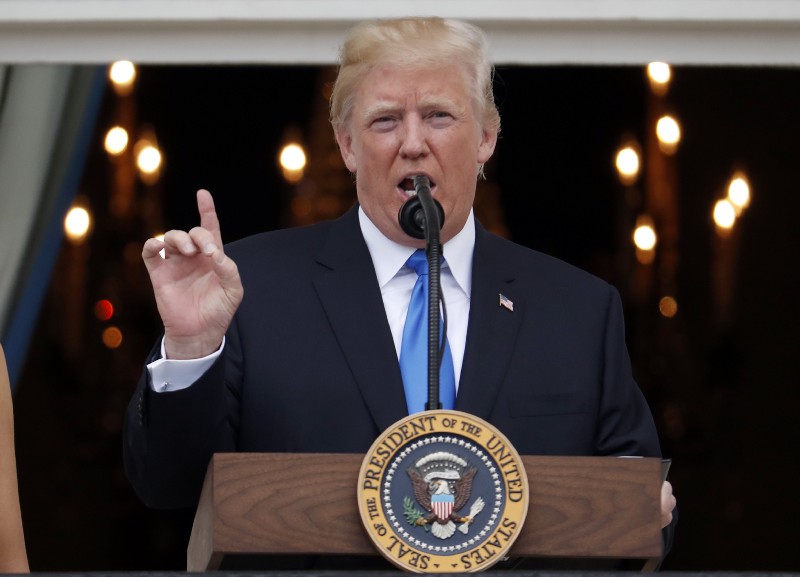
President Donald Trump will have a face-to-face meeting with Russian President Vladimir Putin in Germany on Friday. The formal bilateral meeting between the two leaders comes as questions swirl around alleged collusion between Russia and the Trump campaign in the 2016 U.S. presidential election.
The content of the meeting is largely a mystery. Trump’s national security adviser H.R. McMaster stating last week, “there’s no specific agenda.”
The meeting between the two leaders follows Trump’s regular praise of Putin as a strong leader, despite the Kremlin’s autocratic tendencies and bulldozing of liberties and freedoms. As a presidential candidate, Trump said Putin was a stronger leader than President Barack Obama, adding that he expected to have a “very, very good relationship with Putin.”
Ahead of the meeting which will take place around the G20 Summit, here are some key questions.
1. Have Trump and Putin met before?
The U.S. president has gone back and forth on the claim that he has never been in direct contact with Putin. In 2013 and 2014, Trump embraced the close relationship he shared with the Russian leader. More recently, on the heels of the Russian hack of Democratic National Committee computers, Trump has backed away from the claim, denying the pair has a relationship.
Trump’s comments before the hack seem to suggest that he is close with Putin. He supported this claim in public statements, stating, “I do have a relationship [with Vladimir Putin],” that “Putin even sent me a present,” and that “I spoke, indirectly and directly, with President Putin.” Last year, Trump began denying he had any contact. In an interview with ABC host George Stephanopoulos three months after the hack, Trump denied meeting Putin, having a relationship with Putin or ever talking on the phone with Putin.
Adding to the confusion, Putin said that the pair has never met. “Why, did we have some special relationship with him?” the Russian president asked last month. “We didn’t have any relationship at all. There was a time when he used to come to Moscow. But you know, I never met with him. We have a lot of Americans who visit us.”
2. Will Trump raise the issue of Russia’s intervention in the 2016 political campaign?
Trump has publicly doubted the findings from major U.S. intelligence agencies, which agreed that Russia tried to influence the 2016 election through hacking and the systematic distribution of propaganda. In a press conference in Poland on Thursday, the U.S. president continued his refusal to definitively point fingers at Russia. “It could have been other people in other countries,” Trump said.

3. Will Trump lift sanctions on Russia after its annexation of Crimea?
In March 2014, Russia annexed Crimea, a territory on southern Ukraine’s peninsula. Under the Obama administration, the U.S. government swiftly authorized sanctions “to impose a cost on Russia” for violating Crimea’s sovereignty and territorial integrity.
Trump has not taken a hard-line on the topic in either direction. As candidate, Trump insisted the people of Crimea preferred Russian control last year and promised he was “gonna take a look at” whether to consider Crimea as Russian territory. But in an effort to criticize his predecessor as “too soft on Russia,” he called out Russia earlier this year for taking Crimea.
Crimea was TAKEN by Russia during the Obama Administration. Was Obama too soft on Russia?
— Donald J. Trump (@realDonaldTrump) February 15, 2017
4. Will Trump and Putin bond over fake news?
According to the New York Times, White House aides say the pair will bond over so-called “fake news,” a label the aggrieved president uses to characterize mainstream media outlets that criticize his policies. Trump has gone on a tweetstorm over the past few weeks lamenting such “fake news” media, including lashing out against the CNN channel and MSNBC anchors.
It’s possible that the two leaders can bond over this topic since there’s some evidence that genuine “fake news,” like the kind of conspiratorial stories that stir people to shoot up pizza shops, are peddled out of Russia. Bill Priestap, the FBI’s top counterintelligence official, told the Senate Intelligence committee that it’s likely Russia used fake news and propaganda to help meddle in the 2016 election.
5. Can Trump and Putin get on the same page in Syria?
Putin supports Syrian president Bashar al-Assad, which funds its military to kill people it believes to be terrorists associated with the Islamic militant group ISIS. Under the Obama administration, the U.S. government agreed to a Geneva communique in 2012 supporting a transitional government that includes both members of the Syrian government and opposition groups. The U.S. government supports the rebel groups Free Syrian Army and the Kurdish Popular Defense Units (YPG and YPJ).
It’s unclear now how the United States would support rebel groups following Trump’s purported intentions to thaw the U.S. government’s frosty ties with Russia. The Russian government has accused Syrian opposition forces in April of staging a chemical attack to receive U.S. support of airstrikes. In response, the U.S. government authorized an airstrike against a Syrian airfield near the site of where the attack was launched.
In recent days, the Trump administration has already laid down the groundwork to cede the fate of Syria to the Kremlin. As confirmed by three diplomatic sources to Foreign Policy, Secretary of State Rex Tillerson told U.N. Secretary General Antonio Guterres during a private State Department meeting that the U.S. government would limit its work in Syria to defeating ISIS. The question of whether Assad stays or goes would be left up to the Kremlin.
“What happens to Assad is Russia’s issue, not the US government’s,” one diplomatic source told the publication.