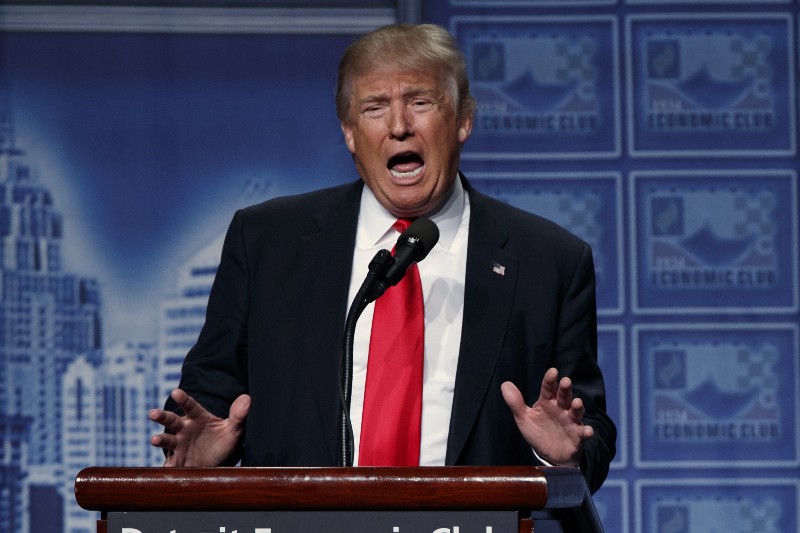
Republican presidential nominee Donald Trump will meet with a group of around 700 evangelical pastors this week, hoping to win over hardline, anti-gay Religious Right leaders who have thus far been hesitant to embrace his struggling candidacy.
Trump is scheduled to speak on Thursday at a closed-door meeting in Orlando, Florida hosted by the American Renewal Project (ARP), a group of evangelical Christian pastors. The event has been widely criticized as anti-LGBT, with another selected speaker — former Florida senator and former GOP presidential candidate Mark Rubio — fending off accusations of insensitivity for appearing at the event so soon after the tragic murder of nearly 50 people in Orlando at a gay nightclub in June.
“Lane’s group is largely sponsored by the American Family Association, which is listed as an anti-gay hate group by the Southern Poverty Law Center.”
Accusations of anti-gay sentiment are rooted in inflammatory statements made by the ARP’s founder, David Lane. Lane’s group is sponsored by the American Family Association, which is listed as an anti-gay hate group by the Southern Poverty Law Center. In addition, he has personally called for “war” against the “pagan onslaught imposing homosexual marriage” in the past, and repeated similarly bombastic sentiments to Bloomberg this week.
“Homosexual totalitarianism is out of the closet, the militants are trying herd Christians there,” Lane said.
Indeed, Lane appeared hopeful that Trump would be swayed to his right-wing ideology. He said he appreciated the businessman’s support for repealing the Johnson Amendment — the law that makes it illegal for churches to retain tax-exempt status if they explicitly endorse candidates — but remained focused on pushing him to embrace policies many believe discriminate against LGBT people in the name of religion.
“[Repealing the Johnson Amendment is] a good first step,” Lane told Bloomberg. “But what about the religious liberty of Christian photographers, Christian bakers, Christian retreat centers, and pastors who believe same-sex intercourse and marriage is sin? These Christians were simply living out their deeply held convictions of their Christian faith when they politely refused to provide services for a same-sex wedding. Doesn’t the First Amendment give us all a right to our beliefs?”
For his part, Trump has insisted he supports “traditional marriage,” and he reportedly agreed to speak to the group at the urging of Liberty University president Jerry Falwell Jr., an influential evangelical and supporter of the businessman. Moreover, despite repeatedly bumbling attempts to discuss religion and faith, Trump now enjoys more support among white evangelicals than Republican Mitt Romney, a devout Mormon, did at the same time period in the 2012 election.
But The Donald has thus far failed to attract the support of other right-wing Christian leaders, despite the fact he already met with a similar group of more than 900 pastors in June in New York City. It was there he unveiled his Evangelical Advisory Committee, a slate of 25 faith leaders that promised to consul Trump — but many of which have yet to formally endorse him.
Trump could, hypothetically, push on without such endorsements, but there is a tactical value at stake: Evangelical turnout operations are often heavily reliant on leadership — especially faith leaders who attend Pastors and Pews meetings, many of whom played a key role in evangelical get-out-the-vote efforts during the 2012 election cycle.
This means Lane’s wish for a more vocally-anti-LGBT Trump could very come true, if only out political necessity. Nearly three-quarters of white evangelical Christians remain opposed to marriage equality — even though most other major religious groups in America support it. Since the group still makes up a sizable part of the Republican electorate, Trump may be hoping to revive his rapidly decreasing poll numbers by winning back the core of his Republican base.
That said, Trump has had trouble defending his opposition to marriage equality in the past. When CNN asked him last year how the twice-divorced man would respond if a same-sex couple accused him of being hypocritical, the famously indignant Trump was uncharacteristically sheepish.
“Well, they have a very good point,” he said.