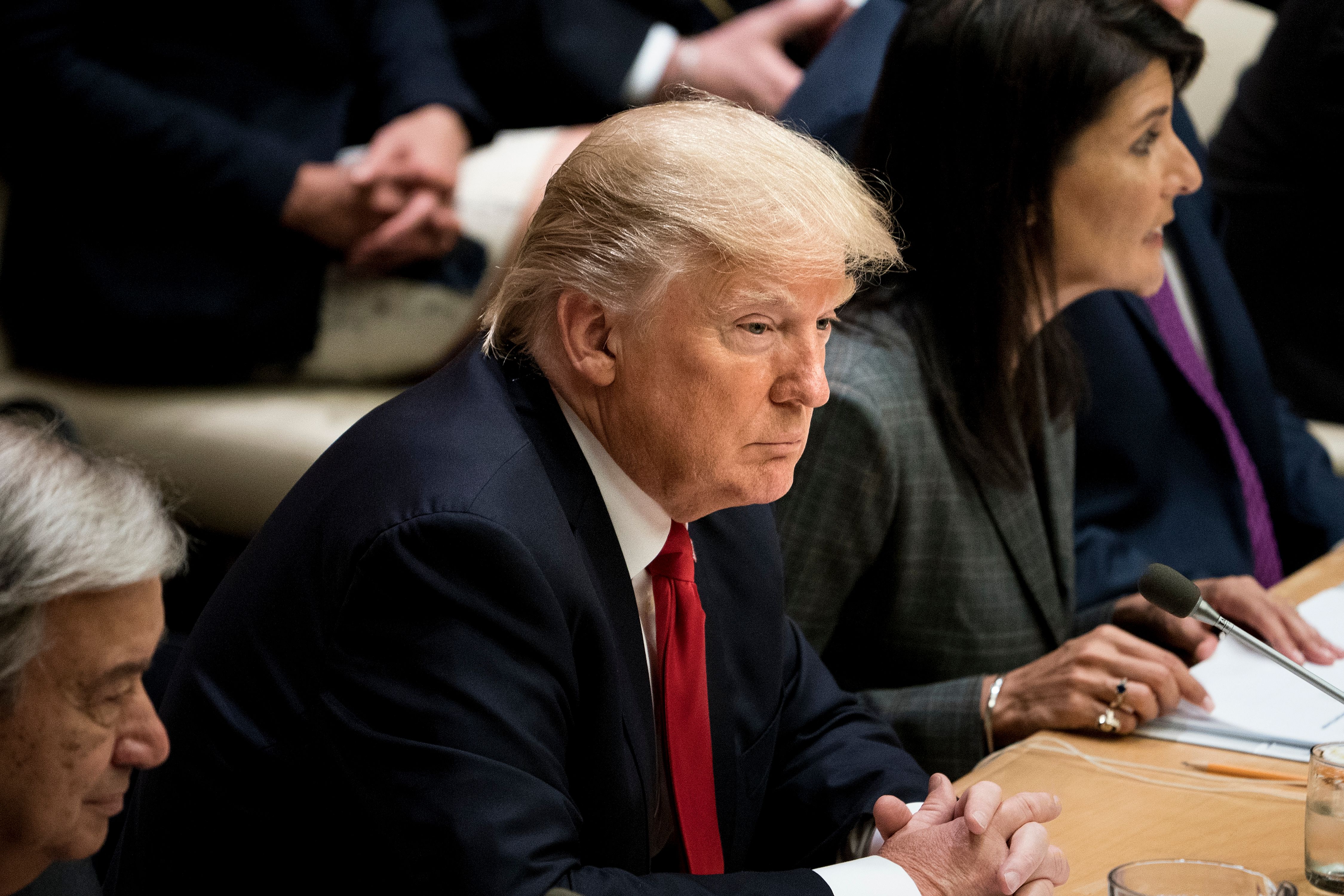
Like many countries, the U.S. track record at the United Nations is spotty — votes on resolutions there are a game of backroom politics, at times counter-intuitive and morally questionable.
Still, even by those metrics, the United States had an eventful year at the United Nations under President Donald Trump, who will complete his first year in office on Saturday. It’s been a busy year, with the United States trying every which way to gain traction for its anti-Iran sentiment within the United Nations and getting new sanctions pushed through against North Korea. For the most part, the Trump administration seems to be fixated only on undoing marquee initiatives of his predecessor, President Barack Obama.
Akshaya Kumar, Human Rights Watch’s deputy director for the United Nations, told ThinkProgress that while the United States has been very vocal on Iran, Venezuela (also the target of U.S. sanctions), and North Korea, it has been “absent in a number of spaces.”
“They are very reluctant to publicly call out allies like the Saudis, for their abuses in Yemen, or even to take on and impose consequences on [Myanmar’s leader] Aung San Suu Kyi and the Myanmar military for its persecution of the Rohingya people,” said Kumar, pointing out that the latest crackdown on the Rohingya was not the start of the trouble for the Muslim minority.

“There were people who were actually pushed out [of Myanmar] last year, and well into January, when the Trump administration took office…and for months, they did nothing, and in some ways, created an enabling environment…that left a vacuum which allowed the military to commit this second, even more expansive round of ethnic cleansing from August to the end of last year,” she said, adding that other players in the U.N. Security Council, such as China, are also reluctant to move on these issues and that all the blame ought not be laid at the feet of the Trump administration.
Still, there has been no action, said Kumar. “A large part of the action is where they’re willing to exercise their muscle — on an issue like trying to defend themselves on Jerusalem, it’s clear that [U.S. ambassador to the U.N.] Nikki Haley was calling in favors, wielding threats, hosting parties, and really making it a signature question. We haven’t seen that kind of diplomatic muscle go towards responding to a situation of mass atrocity, whether it’s Yemen, or Burma [another name for Myanmar] or South Sudan.”
Instead, she said, the Trump administration tends to wield its leverage over those populations with the aid it provides. “We saw the Trump administration put its stamp on the way it was willing to blatantly politicize funding issues — funding for U.N. refugee efforts in Palestine, or for peacekeeping missions in Congo — the Trump administration took an approach that it was willing to use its leverage as a donor to try to achieve political outcomes, sometimes very nakedly,” Kumar said, adding that it was “worrying” that the United States was “willing to use refugees as a bargaining chip,” which she fears might be “feature of how they do business.”
ThinkProgress has reviewed U.S. actions at the U.N. the past year. Here are some of the most remarkable moments:
The Jerusalem votes — a defeat in two parts
Following President Trump’s decision last month to recognize Jerusalem, a city that is the subject of a heated, existential dispute between Israelis and Palestinians, as the capital of Israel, the rest of the world responded not only with protests across Asia, Europe, and the Middle East, but with U.N. votes.
First, on December 18, the U.N. Security Council, a 15-member council including the United States, voted 14-1 in favor of nullifying Trump’s decision. The United States used its veto power to shut down the vote, the second time it had done so in a decade (the last time was in 2011, on a resolution against Israeli settlements on Palestinian territory, including East Jerusalem). But there is no veto power at the U.N. General Assembly, which voted on the same draft resolution three days later. Despite threats by Haley (who started her stint at the U.N. on January 27, 2017), and President Trump himself (who vowed to cut humanitarian aid to countries who voted in support of the non-binding resolution), member states voted 128 to 9 in favor of striking down Trump’s Jerusalem decision, which includes eventually moving the U.S. embassy there from Tel Aviv.
Choosing to save the death penalty over protecting LGBTQ lives
In September, the U.S. was one of 13 nations (including Saudi Arabia and Egypt) to vote against a resolution condemning the use of the death penalty in a number of cases, including ones that target LGBTQ people at the U.N. Human Rights Council. State Department Spokeswoman Heather Nauert said that the United States voted against the resolution “because of broader concerns with the resolution’s approach in condemning the death penalty in all circumstances, and it called for the abolition of the death penalty altogether.” She added, “We had hoped for a balanced and inclusive resolution that would better reflect the positions of states that continue to apply the death penalty lawfully as the United States does.”
The United States has not supported measures on the death penalty in the past, but in 2014, the Obama administration chose to abstain from a death penalty resolution.
So long, Global Compact on Migration
Just over a year after President Obama led the creation of the New York Declaration for Refugees and Migrants, the State Department announced that it was pulling out of the pact because it “could undermine the sovereign right of the United States to enforce our immigration laws and secure our borders.” When he led a special summit on migrants and refugees at the U.N. General Assembly in September 2016, Obama called the refugee crisis a “a test of our common humanity” and encouraged U.N. member states to accept more people from war-torn countries and to step up their financial contribution to the U.N. programs that keep them alive. UN General Assembly president Miroslav Lajčák was dismayed at Trump’s December decision, saying in a statement, “The role of the United States in this process is critical as it has historically and generously welcomed people from all across the globe and remains home to the largest number of international migrants in the world.
Au revoir, Paris Climate Accord
President Trump in June announced that the United States would pull out of the 2015 Paris Climate Agreement, a pact intended to create a global, cooperative response to climate change at a crucial time when the planet is experiencing temperature increases that has triggered not only humanitarian crises in the form of floods and famine, but also poses a major security threat.
Although the Obama administration’s strategy identified climate change as “an urgent and growing threat to our national security,” President Trump’s national security strategy makes no mention of it, vowing instead to reduce “traditional pollution, as well as greenhouse gases” while growing the economy. The U.S. departure from the Paris Agreement is major, given that it is the only country in the world opposed to the pact after Syria signed on to it in November. Rather than pausing to consider why it is the only nation in the world to oppose the agreement, the United States struck a defiant tone upon hearing the news that Syria had signed on to the the agreement. Nauert told reporters that, “If the Government of Syria cared so much about what was put in the air, then it wouldn’t be gassing its own people.”
Let them eat (roughly half a) cake
Figuring that coercion is the way to get Palestinians back to the negotiating table, Ambassador Haley has been pushing for the United States to cut all of its funding the U.N. Relief and Works Agency, which aids Palestinians. On Tuesday, it was reported that $60 million of the $125 million in aid will still be delivered, at the behest of Secretary of State Rex Tillerson and Secratary of Defense James Mattis, but this is still a very significant cut. UNRWA Commissioner-General Pierre Krähenbühl issued a statement he will launch a fundraising campaign to keep schools and clinics open after the cuts, which could affect 525,000 children in 700 schools. “At stake is the dignity and human security of millions of Palestine refugees, in need of emergency food assistance and other support in Jordan, Lebanon, Syria, and the West Bank and Gaza Strip,” he said. President Trump earlier this month tweeted: “We have taken Jerusalem, the toughest part of the negotiation, off the table, but Israel, for that, would have had to pay more. But with the Palestinians no longer willing to talk peace, why should we make any of these massive future payments to them?” But in admitting that he had unilaterally taken Jerusalem “off the table” when it comes to negotiations, he Trump effectively made the case for why Palestinians would not be inclined to negotiate. Palestinian President Mahmoud Abbas on Sunday called Trump’s Middle East peace plan, “a slap in the face,” with the Palestinian Liberation Organization voting the following day to leave the 1993 Oslo Agreement it signed with Israel, with one official telling The Washington Post that Trump had taken any kind of potential for peace “hundreds of miles back.”
Pounding North Korea with sanctions
The United States has led the way in several, ever-harsher rounds of sanctions being leveled at North Korea over its nuclear and ballistic missile programs. It should be noted that this is no small feat within the U.N. Security Council, where Russia and China, two key North Korean trading partners, hold sway and could kill such resolutions. While a sanctions regime is seen as far more preferable to any military action — as threatened by both Trump and North Korean leader Kim Jong Un — what seems to be missing is direct diplomatic talks with North Korea. So although the United States succeeded in championing the passage of the sanctions (which the Russians regard as pointless), what has not yet materialized is the desired outcome, at least, from the U.S. perspective: that North Korea will place its weapons programs on the negotiation table. Kumar told ThinkProgress that while it’s great that the United States along with the rest of the U.N. Security Council, passed sanctions on North Korea, it also managed to push for a meeting on Human Rights in North Korea (the fourth annual one) despite China’s objections.”That is important — that they didn’t break precedent…however, we’re still in a position where the broader issue with North Korea [its weapons program] is even more tense than its ever been,” she said.