MEXICALI, MEXICO — After her father poured her green-colored medicine into a glass, eight-year-old Valentina Pérez went to sit in the dining room to drink. Every day she takes five different medications to keep her allergies from triggering painful rashes that in the past have made her shed mountains of skin overnight. Taking five medications is a great improvement.
Not long ago, Valentina had as many as 15 prescriptions for a single day. “We tried everything,” Valentina’s mother, Angelica López, told ThinkProgress. Valentina quickly spoke up.
“Lots of things and almost nothing worked,” Valentina said, before jumping onto a nearby couch. She was dressed in pastel colors, her long black hair fell past her shoulders, and her eyes had a conspicuous pink aura around them, the most visible — though not the only — trace of the outbreaks that have tortured her since she was a baby.

Though Valentina has had more tests than her parents can remember, it is still unclear exactly what triggers the hyperallergy that makes her skin become rough and inflamed with blisters that itch and bleed. What seems clear to her father, Jesús Pérez, is that Mexicali, for years one of the most air-polluted cities in Mexico, plays a role in his daughter’s illness.
“Of course the environment affects her,” Pérez, 28, told ThinkProgress in Spanish. “When the sky is clear my child is perfect, but when do we have that kind of weather here in Mexicali?”
Epidemiological studies suggest a strong relationship between air pollutants generated by traffic or industry, and the development or exacerbation of allergic reactions. Hector Velázquez, Valentina’s doctor, said her atopic disease comes from genetic and indeed environmental factors. “She is an unbelievable case,” Velázquez told ThinkProgress. “She breaks almost all paradigms of what we know.”
Valentina is just one example of how a disproportionate number of children, women, and men in Mexicali suffer allergies, asthma, cancer, heart conditions, and premature deaths that local experts and studies link to the stifling air pollution. Mexicali, the state capital of Baja California and an important corridor on the U.S.-Mexico border, has like other border cities been struggling with poisonous air for decades; all while consistently violating the nation’s air quality standards.
But the harms of air pollution extend beyond the borders of Mexicali. Dirty air hovering over this desert strip of the border reaches the lungs of thousands of men, women, and children in Imperial County, California, located right across the fence separating the developed north from the emerging south. Imperial, which grows two-thirds of the vegetables consumed during the winter in the United States, is also constantly in violation of federal standards. And while much of the air pollution contaminating the area is believed to originate in Mexicali, the United States is a culprit, too, according to experts, activists, and Mexican officials.
The overall dynamic of how this happens is a function of the daily exchange of two sister communities that, like many others along the border, share all aspects of life including family, education, economy, leisure, and, of course, pollution.
So while emissions from sources in Mexicali freely cross the iron fence that some U.S. leaders habitually promise to expand, agricultural fumes and desert dust from Imperial travel south and into Mexicali, as well. Efforts to ameliorate air pollution — such as paving programs that cover the dust from dirt roads — do exist. The Environmental Protection Agency and the California Air Resources Control Board have also funded monitoring systems in Mexico, and public outreach campaigns to reduce winter holiday fireworks south of the border. However, in background conversations environmental officials say that no substantial improvement has been achieved. That’s because the border presents a unique challenge for two nations that need to solve a growing environmental problem in unison, but differ in the political disposition and resources to do so.

“Federal, state and local agencies, academia, affected industry and other stakeholders have worked collaboratively for years to address a wide range of water, waste and air pollution problems along the U.S. — Mexico border,” said the EPA in a statement to ThinkProgress, but noted, “despite our efforts, more work is needed to protect public health on both sides of the border.”
In interviews with ThinkProgress, experts, activists, and officials on both sides of the border said unhealthy air quality stems from multiple sources, including old vehicles, increasing auto usage, idling cars at the border crossing, a particular aging geothermal plant, legal and illegal burning of fields or garbage, and dust from the surrounding deserts. To top that off, geographic factors like low altitude and nonstop sunshine collude with temperature, particularly during the winter, to keep pollution close to the ground. The amount of responsibility that can be attributed to each source is somewhat unclear in Mexico, experts and officials said, in part because Mexico’s monitoring network is in disrepair and unreliable.
Yet all interviewed agreed that the larger problem is that rules go mostly unenforced in Mexico. “Here in Mexico, we started to have environmental regulations, but to this day impunity and corruption is favored over the rule of law,” said Jesús Jiménez Payán, Baja California’s subdelegate at the Federal Attorney General’s Office for Environmental Protection, or PROFEPA, an agency best described as the enforcement arm of Mexico’s EPA.
Located some 120 miles east of the Pacific Ocean, this desert region is known for its punishing hot weather and its arid land turned fertile a century ago thanks to the diverted waters of the Colorado River. Imperial County and Mexicali built themselves around agriculture, and since their founding have remained major producers of alfalfa, cotton, wheat, and vegetables like onions and lettuce.
But while Imperial has stayed overwhelmingly rural, Mexicali has slowly yet surely pushed farming to its periphery, as it diversified into other industries like food processing or the manufacturing of textiles, electronics, and heavy machinery.
“Most of the city’s monitors have been down since 2008.”
As a result, Mexicali has grown to about a million people while Imperial has fewer than 180,000 residents. That growth has come with a spike in air-conditioning usage, burning trash or biofuels for cooking, vehicular traffic, and overall energy consumption that emits the harmful greenhouse gases and particulate matter that cause climate change and disease. In fact, Mexicali now has one of the highest vehicle density rates in Mexico, according to a report by the Molina Center for Energy and the Environment, a nonprofit.
Mexicali may be only a million people strong, but it has more premature deaths linked to air pollution than much larger cities like Guadalajara (1.4 million people) or Tijuana (1.6 million people), according to the Mexican Institute for Competitiveness, or IMCO in its Spanish acronym. In fact, at least 283 Mexicali residents prematurely die every year due to pollution, according to IMCO.
No other Mexican city with a million people or less is close to having as many deaths linked to noxious air, and only a handful of larger cities in this nation of 121 million beat Mexicali in a problem that transcends health and burdens the local economy with as much as $11 million in costs a year. “Air quality is an environmental problem that creates a major economic effect in the country, and clearly, Mexico City’s metropolitan area is not the most affected,” Fátima Masse, a consultant at IMCO, told ThinkProgress in Spanish.
For perspective, Mexico City has about 20 times more people than Mexicali, but health costs associated with its air pollution are only three times higher, according to IMCO data.
“We know that we have a serious pollution problem based on the last data we have available,” said Marco Antonio Reyna, a researcher at the Autonomous University of Baja California, who’s studied air pollution for decades. Yet the exact state of the city’s air is unclear, he said, because most of the city’s monitors have been down since 2008.

Reyna told ThinkProgress past research notes that particulate matter smaller than the diameter of a human hair, known as PM 10, and the even tinier PM 2.5, are the biggest problems, followed by ozone and carbon dioxide. “If we don’t tackle this, the problem will go from bad to worse,” he said.
The EPA says PM can be carried long distances by wind and can damage soil, crops, and wildlife when it settles on ground or water. And when humans inhale PM, these particles can reach deep into the lungs and bloodstream, causing a long list of ailments such as decreased lung function, heart attack, aggravated asthma, and premature death. Studies have also found that combustion pollution affects humans’ resistance to airborne diseases — and may increase the risk of developing tuberculosis.
The chemical properties of PM 10 and PM 2.5 vary depending on the source, but may include a mixture of acids such as nitrates and sulfates, as well as organic chemicals, metals, and dust. PM 10 is mostly associated with dusty roadways or industries, while PM 2.5 may stem from common smoke or gases from factories or vehicles reacting in the air.
A Mexican government-sponsored study from as far back as 2004 concluded that Baja California tops Mexico’s respiratory system mortality in every age group and explicitly associated human-caused particulate matter with bronchitis, heart attacks, and cancer. “Air pollution causes deaths, that’s been proven,” said Reyna. “And we have the highest rates of lung cancer in the country. And we have the highest rates of tuberculosis in the country.”

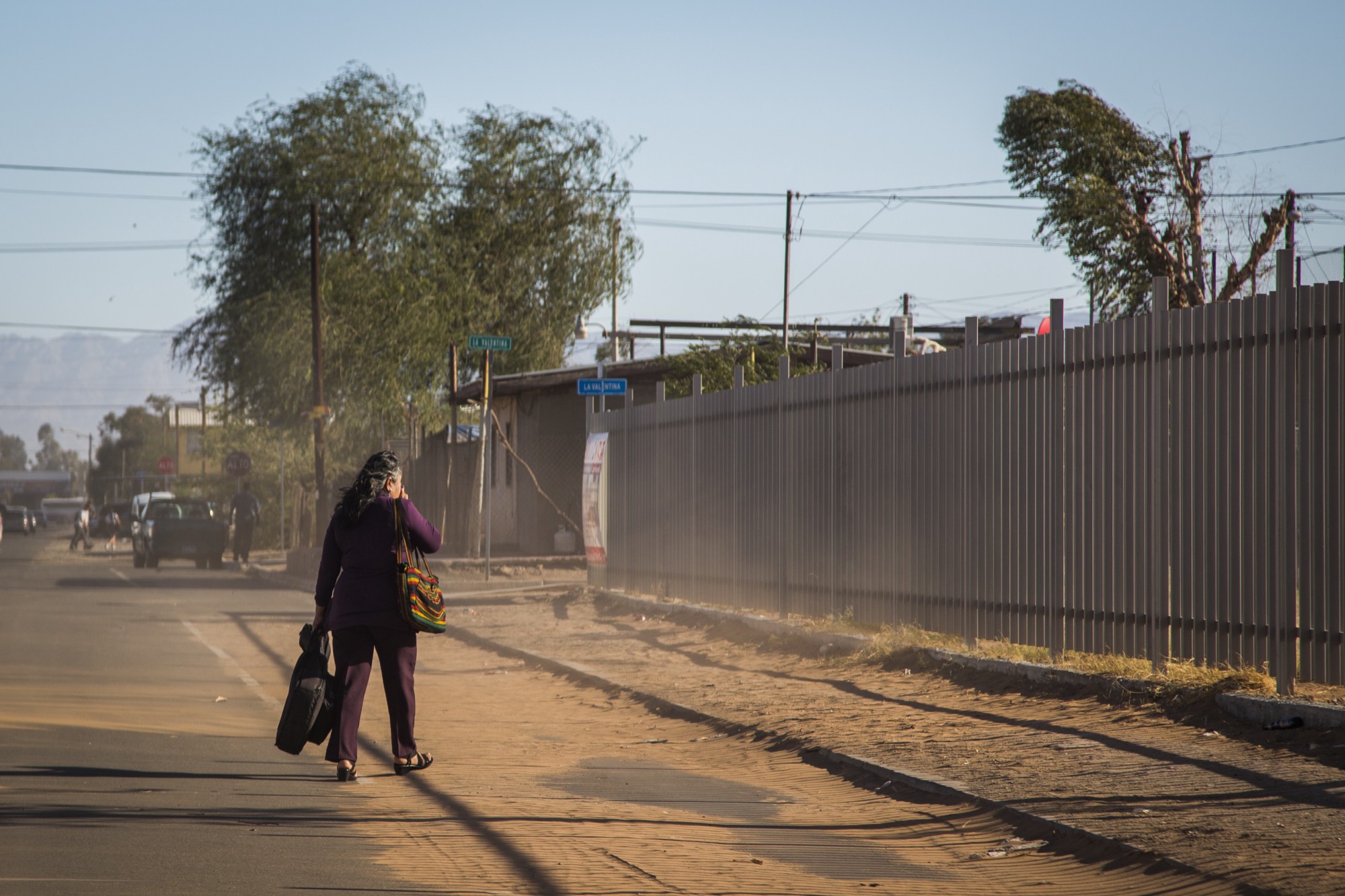
PM 2.5 is impossible to see with the naked eye, but smog clouds rich in these and many other toxins can often be seen with ease from Mexicali’s tallest bridge as the sun begins to set. A dense brown haze hovers over neighborhoods, streets, and traffic. It’s an imposing view. Particularly when wind gusts pick up dust from the 22 percent of roads that are still unpaved in the city; all while the sun disappears behind the western mountains, and bathes this desert city with a powerful golden light that makes the smog on the horizon look as overwhelming as it is.
When Deloris M. Jacoe moved from Oklahoma to Imperial in 1953, she was struck with how stunning the county was. “The whole valley was clear air,” Jacoe, 79, told ThinkProgress.
What Jacoe saw was not much different from what the renowned photographer Dorothea Lange saw when she toured Imperial County in the late 1930s. There were citrus orchards, pig farms, dairies, and fields of vegetables, stretching wide across the horizon. “You could see everything, and it was a beautiful valley. I fell in love with it,” said Jacoe.

Citrus and dairy farms have mostly gone elsewhere, but agriculture in Imperial County has evolved in sophistication and size. It is now robust in alfalfa, as well as other grass and vegetable crops. Despite some recent market contractions, agricultural gross production for 2014 was nearly $2 billion, according to the latest Imperial County Agricultural Crop and Livestock Report.
But being the food basket of a nation of 324 million people comes with a cost to the environment and the air.
Industrial-scale agricultural production requires heavy machinery and fertilizers that produce greenhouse gases such as carbon dioxide and nitrous oxides. (The latter comes when the soil doesn’t absorb excess fertilizers.) Furthermore, every year hundreds of farmers intentionally burn thousands of acres of fields to prepare the land for the growing season.
Burning is a cost-effective method of cleaning fields of straw and stubble. But while fire rids the land of impurities for planting, the smoke puts harmful PM 2.5 in the air that some who live near the fields resent. “The stuff that is in the air is so thick that it makes my scalp itch,” said Jacoe, a former schoolteacher who lives near the western fields of the county. “It makes it difficult to breath.”
Among the harmful particulate matter found in air pollution, the smaller PM 2.5 is paradoxically the bigger concern because tinier particles can travel deeper into the lungs. The majority of PM 2.5 emissions produced in Imperial comes from farming, burning, windblown dust, and aircraft, according to Imperial County Air Pollution Control District reports.

Emissions readings depend on the time of year and wind conditions. That makes it difficult to pinpoint exactly which source is the largest polluter in the Imperial Valley at any given time. What is known is that 75 percent of the county is desert land, and the area experiences seasonal gusts over 40 miles per hour that stir dust, particularly in the spring. “One of the largest contributors to the PM 10 and PM 2.5 for Imperial County is the desert,” Reyes Romero, the county’s assistant air pollution control officer, told ThinkProgress. “That’s not exclusive of Imperial County.”
In addition, Imperial has a rural airport of sparse commercial activity and a small naval air facility that can have more than 450 flight operations a day. Still, particulate matter from agriculture is the main air quality concern in Imperial, and county documents show that’s been the case for decades.
Romero said the county follows strict guidelines for burning, though there is no burning limit. “If it’s windy we definitely won’t allow [burning],” said Romero. The thermal inversion that usually happens in the winter, when the sun warms a layer of warm air that holds down cool air and pollution from dissipating, can’t be occurring either, he added.
The county also coordinates burns so that smoke doesn’t overtake cities or neighborhoods, and sends inspectors to make sure farmers minimize smoke. When conditions are good, said Romero, some 1,000 acres may be scorched a day.
Last year, farmers burned 16,000 acres of land in Imperial, which is equivalent to roughly 20,000 football fields, according to Imperial County data. That’s down from the recent high of 40,000 acres burned in 2011.

Limitless burning may be a necessity in Imperial County, where farming is the one job-creating industry not related to the government or to retail services. (The renewable energy industry invested in solar plants and wind turbines, but created mostly temporary jobs. Projects have dried up over the years as transmission lines reach capacity.)
The recent drop in burning follows a fall in prices for agricultural commodities, Romero said, which has slowed agriculture production. The county also implemented a form of voluntary carbon trading that gives farmers emission certificates that they can sell for profit. Certificates “are kind of valuable,” he said, and may be having an effect, too.
Meanwhile, nearly 30 deaths in Imperial County can be attributed to particulate matter pollution and toxic ozone every year, according to the American Thoracic Society.
Imperial is also ground zero for asthma hospitalizations and emergency room visits among minors and the elderly, the two most vulnerable groups. For asthma, the county has far exceeded state averages for almost a decade, according to state data submitted to ThinkProgress.
In 2014, Imperial County’s rate of asthma-related emergency room visits for minors was 149 per 10,000 residents, while the state average was 80. For the elderly, 72 people per 10,000 went to the emergency room for asthma, fully double the state average.
Though still worrisome, recent data shows improvement and now asthma hospitalization rates are on par with the state, said Aidee Fulton, Imperial Valley Child Asthma Program director. Her financially-strapped 16-year-old agency is widely credited with asthma education and prevention campaigns now driving local progress.

“Fortunately we did reduce hospitalization,” said Fulton in an interview with ThinkProgress. “There is obviously a big problem here, and unfortunately many factors and not as [many] resources to alleviate the current need.”
Funding shortfalls for services are common in Imperial County, which is mostly Hispanic and poor, and habitually tops the rest of the nation with unemployment rates over 20 percent. The county has two hospitals and more than a dozen clinics, but lacks a dedicated pediatric specialist for asthma and suffers from a severe shortage of doctors as a whole. Reasons for this shortage vary depending on who you ask, but in general the county’s remote location, rural nature, harsh weather, depressed wages, and even notoriety as an air-polluted region may be exacerbating recruitment struggles.
Keeping up with the needs of so many with just a couple of staffers is a daunting task, Fulton said. “We are already stretched to the max.”
Seeing no end in sight to the difficulties, Fulton concentrates her efforts in educating parents and schools to keep indoor air clean. “People [are] indoors 90 percent of their time,” she said.
Officials are aware of the persistent problems affecting the county. They note, however, that while Imperial County emissions have been improving, U.S. federal rules have become more stringent. “The thing is that air quality is like a moving target,” said Romero, adding the newest PM 2.5 standard is just about a decade old.
And as federal rules in the United States grow more stringent, they force Imperial County to reduce emissions as quickly as it can without risking its already-fragile economy.
But some say the county has been too lax and too slow in how it regulates, while also too eager to side with industry, especially agriculture. For one thing, advocates note the price of burning permits. Burning 40 acres costs $80, while every extra acre on top of that costs $1.50.
“In federal standards Imperial County just fails tremendously, and yeah [officials] will put the blame on everybody else, but how can you blame your neighbor if you are not doing the best you can for your own community,” said Luis Olmedo, executive director of Comité Cívico del Valle, an advocacy organization.
“First of all they don’t hire enough people. They might claim that they don’t have enough money, enough resources. Well, maybe they should increase the cost of permits,” he said in an interview with ThinkProgress. “But they don’t do it, because they then will burden the industry.”

The county’s permit costs have been on the rise since 2005, though increases don’t happen every year as they are tied to consumer price index formulas. Aside from more stringent requirements to control air pollution from agricultural activity, the EPA noted rules for off-highway vehicles used in dirt roads and dunes have also become more rigorous. The county has also updated its rules for dust emissions happening in industries like construction.
Revised county rules have taken shape as the EPA sanctioned Imperial under the Clean Air Act in 2010 and the two agencies ended up in court. Still, activists like Olmedo say more is needed given the ongoing public health threat.
“We can go much further,” he said. “I think the federal government needs to play a more active role.”
But as Olmedo and others continue pushing for more at home, in the end, growing Mexicali always lags behind, dragging Imperial’s air quality down.
“To lower the standard in the U.S. does nothing for Mexico,” said Brad Poiriez, former Imperial County Air Pollution Control officer, in a recent interview with ThinkProgress. “It’s the same story that we have to deal with.”
Poiriez, who left the office over the summer, said the county’s air is nonetheless better than ever. He explained for county officials the larger concern right now is the nearby Salton Sea, California’s largest lake now fast evaporating while exposing toxic dust and sediments to the elements. PM 2.5 violations are most frequent, he said, and they are mostly happening in Calexico, the town closest to Mexicali.
This is part one of a two-part story on air pollution on the U.S.-Mexico border. To read part two click here.