Thanks to a clause buried deep into many contracts between corporations and their consumers or employees, companies are pushing claims of wrongdoing out of the court system and into an arbitration process that is often rigged in their favor.
In a three–part series, the New York Times reviewed thousands of court records, plus hundreds of interviews with lawyers, judges, arbitrators, executives, and plaintiffs. The investigation turned up forced arbitration clauses in contracts related to credit cards, cable service, online shopping, rental cars, employment, nursing homes, medical care, and many other areas of American life.
“Forced arbitration clauses are infiltrating every aspect of American life,” Julia Duncan, director of federal programs at the American Association for Justice, said on a call with the media. “They are forcing Americans to give up their constitutional right to access the courts, and most don’t know it.”
Rep. Hank Johnson (D-GA) has firsthand experience with these clauses. On the same call, he recounted having to sign onto them twice: once when trying to downsize his house and again when seeking a nursing home for his elderly father. The building contract for the new home contained a clause that he found to be “disturbing,” but when he asked about taking it out he was told every contract had them. “If I wanted to build in that area, I was going to be subject to that arbitration clause,” he said.
Later, he had to find a nursing home for his father as he left the hospital. He had just 24 hours of notice to find a place that would suit his father’s physical, mental, and financial situation. “There wasn’t a lot of leverage that we as consumers had” to find a place that didn’t insist on a forced arbitration clause, he pointed out. “It’s done under duress or a coercive circumstance.”
The shift has had a huge dampening effect on people’s ability to bring class action lawsuits. The Times found that companies got a favorable ruling for four out of every five class action lawsuits they sought to instead push into arbitration. In 134 out of 162 cases in just last year alone, judges upheld contractual bans on class action lawsuits.
It’s done under duress or a coercive circumstance
The arbitration process can be pricey for consumers, who have to shoulder the costs alone rather than share them with a wider class of plaintiffs or recoup them in court. One proof of that may be that between 2010 and 2014, according to the Times’s investigation, just 505 consumers decided to go to arbitration of a dispute concerning $2,500 or less, possibly because such small amounts just weren’t worth it. And once they do take action, they face daunting odds of seeing any relief. About two-thirds of consumers who contested credit card feeds or fraud or costly loans got no monetary awards at all.
Unlike in a court of law, arbitration takes place behind closed doors and the decisions aren’t made by an impartial judge. In fact, companies can and often do steer cases to arbitrators who are friendly to their claims, and arbitrators often face an incentive to rule in the company’s favor to get business in future cases. The Times found that among 41 arbitrators, they each handled 10 or more cases for a single company between 2010 and 2014. And in interviews, more than 30 arbitrators said that they felt pressure to rule for the companies that bring them such business.
Yet the arbitrators have immense power in the proceedings. They decide how much evidence each side can present or withhold. The Times found that they have also “twisted or outright disregarded the law” in making decisions. Yet unlike court cases, arbitrations are difficult to appeal: plaintiffs have almost always lost their requests to get courts to intervene.
Calling forced arbitration “the greatest violation of consumer rights,” Linda Lipsen, CEO of American Association for Justice, said on the call with media, “Forced arbitration is nothing more than a corporate bullying tactic designed to kick people out of court,” disrupting their “right to seek justice.”
There’s no data on how many people have been dissuaded out of taking any action altogether, of course. But it does seem that by forcing customers into arbitration where they have to pay any costs and out of the courts where they can either share or recoup lawyer’s fees, fewer cases are being brought. Verizon has 125 million subscribers but faced just 65 consumer arbitrations between 2010 and 2014, the Times found. Sprint has 57 million subscribers but faced just six arbitrations. Time Warner Cable has 15 million customers but dealt with seven cases.
Consumers could also seek relief in small claims court, which is not blocked by arbitration clauses, but few people take advantage of that route. They also often have an opt out provision within a certain number of days of signing, but most people don’t even know they’ve signed onto a forced arbitration clause or know what it entails.
Forced arbitration is nothing more than a corporate bullying tactic designed to kick people out of court
One consequence of the sea change toward contracts that include arbitration clauses is that consumers of financial products have little recourse. For example, customers with debit cards accused banks in a series of lawsuits that began in 2009 of deducting large charges before small ones in order to increase overdraft fees. With the ability to bring court cases, customers won a settlement of more than $1 billion over fees that amounted to just $35 per incidence. Yet now at least seven of the banks involved in those cases have since added arbitration clauses, protecting themselves from a repeat legal fight over the billions they are still collecting in overdraft fees.
Another shows up between employers and employees. Fast food and retail companies — such as Applebee’s, Taco Bell, PF Changs, Kmart, Macy’s, and Sears — have added clauses to their employment contracts. That meant that when suits were brought against Applebee’s from low-wage workers saying they weren’t paid for extra tasks like cleaning and stocking, dropping their pay below the minimum wage, the charges were thrown out and employees were told they had to bring them to arbitration. Few actually did: just four brought the company into that process between 2010 and 2014. The practice has spread to higher-paid sectors as well, such as Wall Street and Silicon Valley employers.
The uptake of arbitration clauses was spearheaded by a coalition of credit card companies and retailers looking to protect themselves from costly lawsuits. That effort got results with two Supreme Court rulings, one in 2011 and one in 2013, that upheld companies’ right to use these clauses and force people out of class action lawsuits.
Now the practice has spread much further than Wall Street and retail. Medical practices, schools, nursing homes, and funeral homes use them. So do a wide variety of consumer products, from Amazon to Budget rental cars to Netflix to Travelocity.
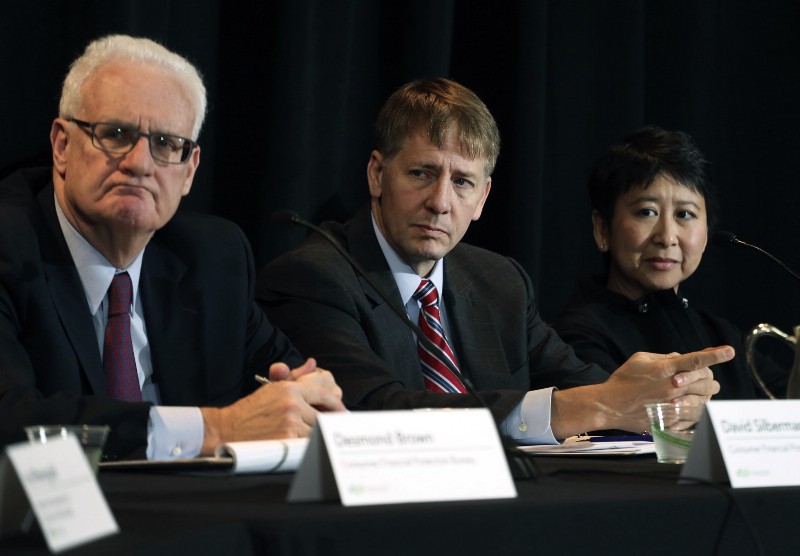
There have been some rumblings from federal regulators about tamping down on arbitration. In October, the Consumer Financial Protection Bureau (CFPB) said it is considering proposed rules that would ban consumer financial product companies from using arbitration clauses to block class action lawsuits. “Consumers should not be asked to sign away their legal rights when they open a bank account or credit card,” CFPB Director Richard Cordray said in a statement. “Companies are using the arbitration clause as a free pass to sidestep the courts and avoid accountability for wrongdoing.”
The Centers for Medicare and Medicaid Services (CMS) issued its own proposal to require nursing homes to explain arbitration clauses and not require people to sign them in order to be admitted but not to outright ban them, although it invited comments on whether it should ban them in the final rule. Members of Congress have sent the agency letters urging it to do just that.
Lipsen is calling on the CFPB and CMS to go further. “The CFPB should strengthen the plan to ensure all consumers..have the right to hold corporations accountable when they break the law,” she said. “The CMS should not simply acknowledge the problem… It should ban the practice altogether.”
Some in Congress are also trying to take stronger action. Rep. Johnson and Sen. Al Franken (D-MN) re-introduced the Arbitration Fairness Act earlier this year, which would nullify the use of arbitration clauses in the cases of antitrust, consumer, employment, or civil rights disputes. “It’s about giving the right to people to go to court,” Franken told the media. “It’s in the Constitution.”
“Forced arbitration is not voluntary, it’s not just, and it’s simply not fair,” Johnson said. “In essence, it’s simply un-American.”
Update:
This post has been updated to more accurately reflect the CMS’s proposed rule.