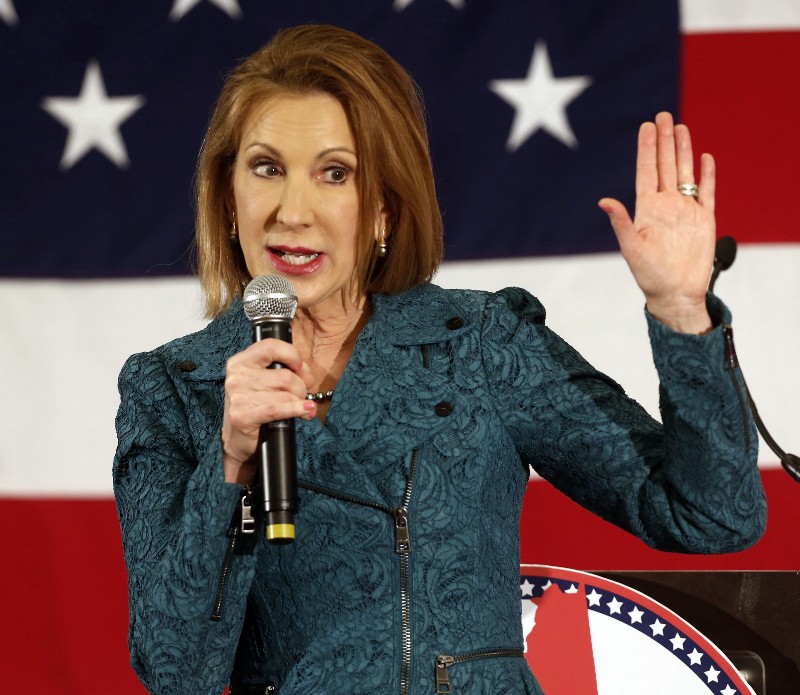
Presidential hopeful Carly Fiorina has quickly become a polarizing figure since announcing her candidacy earlier this week, with her embattled track record as Hewlett-Packard’s CEO taking center stage.
Fiorina has been ridiculed for building her campaign around her business acumen and ability to take charge. Before she was HP’s CEO and oversaw massive layoffs of 30,000 HP employees, she held executive positions at AT&T; and Lucent Technology. She successfully helped split AT&T; from Ma Bell, and spun off the company’s equipment division into a separate entity, Lucent. That move created 22,000 jobs over the course of her stay.
Her legacy as a high-profile tech executive has been marred by her controversial stint as HP’s CEO, which ended abruptly when she was fired in 2005. Her firing was highly politicized with the company facing record losses, extensive layoffs and rampant dysfunction among its ranks. Fiorina attributed her ousting to sexism in tech and the glass cliff — a phenomenon where women and people of color are often promoted to high-level positions during a company’s period of great change or tumult.
The situation rings similar to that of Ellen Pao, who recently lost a gender discrimination lawsuit claiming that she was fired from her position because she was an Asian-American woman. But while the jury definitely believed she experienced discrimination, they concluded that she would have been fired anyway because of her declining performance and the company’s climate at the time.
The same can be said for Fiorina’s leadership history — she almost certainly experienced the same microaggressions many women in executive positions at top companies do — but the so called real reason she was ousted was tied to the company’s morale and performance while she was at the helm, and therefore, she would be a terrible Commander in Chief. But sexism or not, Fiorina’s business record has become the number one reason to discount her as a legitimate candidate.
As with other candidates, her run for president has drudged up her failures. It’s a logical step to publicly scrutinize a candidate’s past behavior as an indication of how valuable they are as a candidate, and more importantly, how efficient they will be if elected to public office. The result, however, is the common trope that business acumen cures the ills of a sluggish and inefficient government.
Bloomberg View bluntly stated she was veritable train wreck of a leader, one whom not only led the company into financial disaster because of poor market judgments, but contributed to dissent and chaos among board members. Fiorina hasn’t had a similar role since and has instead turned to politics, losing her run for Senate in 2010.
Business minds have long sought public office, claiming their successes and experiences in the private sector would make government more productive. But even with questionable business ethics or performance, have made it in politics. For example, Florida Governor Jeb Bush (R) has suspicious private company holdings and his brother former President George W. Bush was forced to sell his once-floundering oil business. Mitt Romney, former presidential candidate and Massachusetts governor, was responsible for thousands of layoffs and multiple now bankrupted companies during his run at Bain Capital investment firm.
Despite rally cries from tech moguls such as Bill Gates and recruitment efforts from Republicans and Democrats, a candidate’s performance in the private sector — whether good or bad — are not an accurate indicators of a successful candidacy or policy leadership. In 2013, Gates’ called out the government’s dysfunction in a Politico interview saying, “You don’t run a business like this,” meaning that for the government to be business efficient there would be a calculated “measuring what you are doing, picking the measurements that count like customer satisfaction and performance” to thrive on.
History shows that business knowledge runs contrary to effective presidents. As Peter Allan wrote in U.S. News & World report found during the 2012 presidential election:
None of the great or near-great presidents — Teddy Roosevelt, Franklin Roosevelt, Harry Truman, or Woodrow Wilson — was a businessman. Truman was a failed businessman (a haberdasher) before entering politics, but that hardly constitutes a ringing endorsement of Romney’s claim for private sector ascendency.
For that matter, none of the better-than-average presidents was a businessman either. In this category think of Presidents John F. Kennedy, Dwight Eisenhower, Ronald Reagan, Lyndon Johnson, and Bill Clinton.
Probably the most successful president with real business experience (and success) was George H.W. Bush. Before going into politics he founded Zapata Petroleum, which ultimately became Pennzoil. Bush 41 ended up a one-term president unable to kick-start an economy in a recession and seemingly out of touch with the problems of the common man.
Overall, most successful presidents either had no business background or were unsuccessful — something that possibly could work in Fiorina’s favor, anti-net neutrality politics and technology blunders notwithstanding. Things the internet and comedian Seth Meyers, who nabbed CarlyFiorina.org before her campaign, will make sure she never lives down.