In the aftermath of six separate attacks around the city of Paris that killed more than 100, there are a lot of questions about how the attack unfolded and who exactly is behind it. Though French officials haven’t yet released the identities of the attackers, there are some things we already know.
One of the attackers reportedly had a Syrian passport, another appears to be native to France
https://twitter.com/ap/status/665500256621223936
Reuters reported on Saturday that the passport-holder had passed through Greece in October.
BREAKING: Holder of Syrian passport found at scene of Paris attack passed through Greece in October: Greek officials https://t.co/cKskpR2lP8
— Reuters Live (@ReutersLive) November 14, 2015
Prosecutors confirmed as much on Saturday.
Prosecutor: 1 #Paris attacker was French born known to authorities & was arrested 8 times for criminal violations before he was radicalized
— Ayman Mohyeldin (@AymanM) November 14, 2015
Prosecutor: another #paris attacker born in #syria
— Ayman Mohyeldin (@AymanM) November 14, 2015
What this actually means, however, is less clear. The attackers could be Syrian, or, as Mike Giglio, a correspondent for BuzzFeed based in Turkey pointed out, it could be a clever move on the part of the attackers.
one reason to bring a Syrian passport with you to commit a terror attack—to demonize refugees locally, which is exactly what ISIS wants.
— Mike Giglio (@mike_giglio) November 14, 2015
Europe has been struggling for months with a refugee crisis from the Syrian civil war, with German Chancellor Angela Merkel declaring in August that Europe had failed those who were trying to escape the violence.
There have been mixed reports about the nationality of the attackers, however, with one Agence France-Presse tweet reporting that one of the potential attackers was actually French.
#BREAKING Frenchman identified as possible concert hall attacker: police sources
— AFP news agency (@AFP) November 14, 2015
Police are reportedly raiding a Brussels neighborhood in connection with the Paris attacks.
#BREAKING Police raid Brussels neighbourhood in connection with Paris attacks: Belgian TV
— AFP news agency (@AFP) November 14, 2015
BRUSSELS (AP) – Belgium justice minister: "number of" arrests made in Brussels relating to Paris attacks
— Maggie Haberman (@maggieNYT) November 14, 2015
ISIS appears to be behind the attacks
The Islamic State, also known as ISIS or ISIL, has claimed responsibility for the attacks. In a statement released in Arabic, English, and French, they promised that these attacks were “the first of the storm.” They also called France a “capital of prostitution and obscenity.”
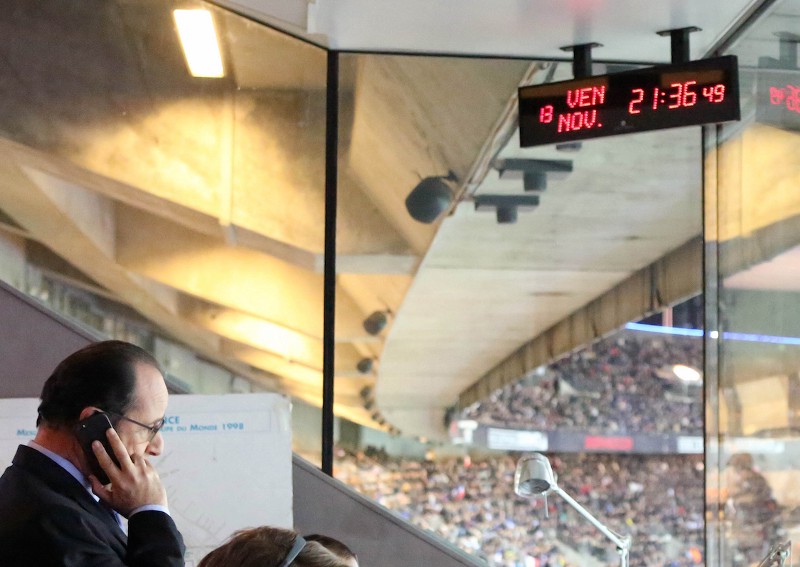
“Eight brothers, wrapped in explosive belts and armed with machine rifles, targeted sites that were accurately chosen in the heart of the capital of France,” the group said in the statement, according to the New York Times, “including the Stade de France during the match between the Crusader German and French teams, where the fool of France, François Hollande, was present.”
French President François Hollande also said in a statement Saturday that ISIS was responsible for the attack, and experts say that these types of attacks were more consistent with ISIS than with other terrorist groups like Al Quaeda.
Syrian President Bashar al-Assad, after a meeting with a French delegation in Damascus, blamed France itself for the attacks.
France’s “mistaken policies… had contributed to the spread of terrorism.”
“The terrorist attacks that targeted the French capital Paris cannot be separated from what happened in the Lebanese capital Beirut lately and from what has been happening in Syria for the past five years and in other areas,” he said.
Paris wasn’t the only place where terrorist attacks have been happening
On Thursday evening, blasts stuck Burj al-Barajneh, a suburb of Beruit, Lebanon, which has been deemed the deadliest attack in the country since the end of its civil war in 1990, killing included 41 and wounding more than 400. ISIS took credit for that attack.
The White House said in a statement condemned terrorist incident saying it “would only serve to reinforce our commitment to support the institutions of the Lebanese state, including the security services, to ensure a stable, sovereign and secure Lebanon.”
Another suicide bomb attack in Baghdad killed 26 and wounded dozens more. ISIS also claimed responsibility for that attack as well.
Over 200,000 people have died in Syria in the past 4.5 years.
That's a Paris attack EVERY SINGLE DAY.
That's what refugees are fleeing.
— Adam Khan (@Khanoisseur) November 14, 2015
So what happens now?
France has already closed its borders, and other countries are starting to do the same.
And so it begins. #Poland says it won't accept its quota of refugees after #ParisAttacks https://t.co/bMkYT90S1O pic.twitter.com/HoHrNnOl8q
— Joseph Willits (@josephwillits) November 14, 2015
Meanwhile, the French government is restricting the movement and assembly in the country, invoking the first mandatory curfew since World War II.
France is under its first mandatory curfew since 1944 https://t.co/9UIinmIPxm #Paris
— PBS NewsHour (@NewsHour) November 14, 2015
Charlie Hebdo attacks ended Jan. 9. Two days later, there were massive crowds and people marching in solidarity in central Paris 1/2
— Kim Hjelmgaard (@khjelmgaard) November 14, 2015
2/2 This time, the government has banned any kind of public gathering until Nov. 19
— Kim Hjelmgaard (@khjelmgaard) November 14, 2015
Update:
This post has been updated.