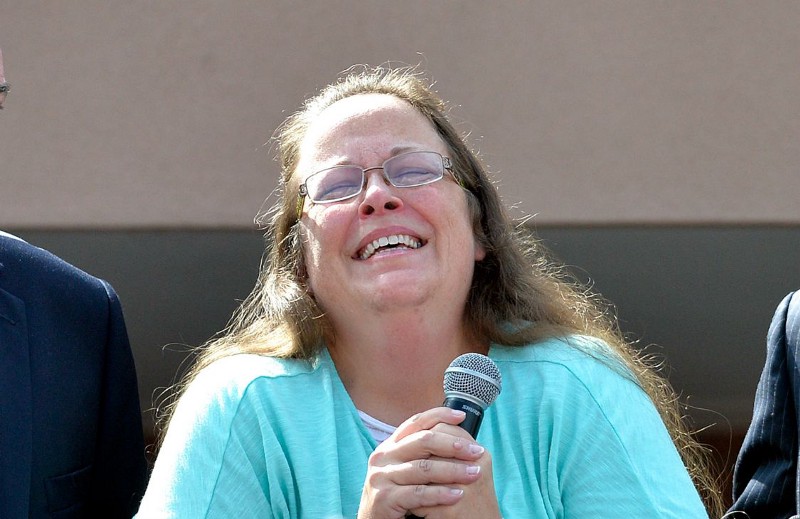
This week, Rowan County Clerk Kim Davis triumphantly waled out of jail. Her refusal to issue a marriage license to a same-sex couple in Kentucky has made her a conservative folk hero.
Several Republican presidential candidates rushed to her side. Former Sen. Rick Santorum has compared her to Martin Luther King Jr. Former Arkansas Gov. Mike Huckabee actually said God was working through her. Sen. Ted Cruz (R-TX) traveled to Kentucky to support her, only to be blocked from a crucial photo op by his rival’s staff.
It’s not hard to imagine she’ll take the same path that others who refused to serve same-sex couples have found, appearing at conservative conferences and finding a place on the right-wing media circuit. But if history is any guide, her moment in the sun could be a relatively temporary setback in the long view of history.
Perhaps the best guide we have for what will happen to the county clerks, probate judges, and justices of the peace who object to same-sex marriage can be found in the immediate aftermath of Loving v. Virginia, the Supreme Court case that legalized interracial marriage across the United States.
Local officials in many places initially fought the Loving ruling, Julie Novkov, professor of political science at the University of Albany and the author of Racial Union: Law, Intimacy, and the White State in Alabama, 1865–1954 explained to ThinkProgress. “Not all of them resulted in litigation, but there were instances in various places in the south where state officials tried to resist or throw sand in the gears,” Novkov said.
“I guess if we were to take lessons from the struggle for interracial marriage, what I would predict is that these episodes of resistance are going to be a fairly short-term phenomenon,” Novkov said.
One of the closest analogies to Davis’ legal challenge is United States v. Brittain. U.S. Army Sergeant Louis Voyer, a white man, and Phyllis Bett, a 17-year-old black woman, went to the Calhoun County courthouse in Alabama on November 10, 1970 to get a marriage license, but they were refused by local probate judge G. Clyde Brittain. Eventually Brittain received support from the state’s attorney general to challenge that Alabama’s law took precedence over the Supreme Court ruling in Loving v. Virginia. Because Voyer was a member of the military, it was the Nixon administration itself that had to argue Alabama’s anti-miscegenation law, originally passed in 1854, was unconstitutional. The federal government won, and the state’s law was struck down.
Brittain wasn’t alone. At the time of the Loving ruling, 15 states still had anti-miscegenation laws on the books, but then state law after state law was overturned in court. Some of the last holdouts were in the deepest of the deep South: Mississippi and Georgia. District Judge Harold Cox — the same notoriously racist justice who presided over the Mississippi burning trial — reluctantly ruled Mississippi’s anti-miscegenation law unconstitutional in 1970 under strong urging from the Fifth Circuit. Georgia, the final state, complied with the federal ruling on interracial marriage by Valentine’s Day 1972.
“They’re all deep south states. This is Georgia, this is Alabama, Mississippi, Louisiana,” said Peter Wallenstein, a history professor at Virginia Polytechnic Institute and State University and the author of Tell The Court I Love My Wife, which outlines the post-Loving struggle. “These are the states you would expect to see the least inclination to comply. Yet, within a fairly short period, you get compliance. Now in Georgia’s case we’re talking about all the way up to 1972, but we’re talking about five years.”
In some ways, Wallenstein argues, the arguments these clerks were making were somewhat different from the one Kim Davis outlines, which is clearly rooted in the Supreme Court’s newfound power of religious liberty. Instead, these county clerks argued that they were bound by state law rather than a federal Supreme Court ruling.
“One reason I suspect that was these officials seemed to take seriously what they understood their obligation under the law to be,” Wallenstein said. “I think it was a difficult place to be in multiple respects, to be the local county clerk or whatever the position was. Think about it … ‘I’ve got to go home to my family and my neighbors and I can’t be perceived as a weakling on race.’” Once a higher authority stepped in, though, they conceded to the law, Wallenstein said.
Ultimately, as compliance increased, it was easier and easier for interracial couples to obtain a marriage license. Even the couple in the analogous case to Kim Davis went from Alabama to Tennessee to get married (and the state had tried unsucessfully to argue the case was a moot point because they’d gotten married elsewhere).
But what happened to Brittain and others who objected to issuing the licenses is less clear. We know Brittain continued to serve as probate judge until 1975, five more years after the case was decided. He died in 1986, and is buried in Calhoun County. A call to Calhoun County’s probate office revealed that they don’t keep records on the race of couples, so it would be hard to tell if Brittain signed off on marriages of interracial couples after the ruling.
But these clerks’ legacies, especially when compared to couples like the Lovings, have faded far into the public memory. If anything, they’re held up as out-of-date justification, like a Louisiana justice of the peace who refused an interracial couple in 2009. Trying to trace these names leads you to little notice gravestones and obituaries. Their legacies are only notable for the brief period that they delayed progress.